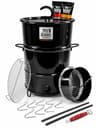
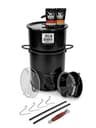
The best Weber Smokey Mountain alternative is the Pit Barrel Cooker 18.5-inch — because it replaces the WSM’s idea rather than copying it. A WSM holds a low temperature with a pan of water; a Pit Barrel holds one by having a single intake you set once for your altitude and then never touch. You hang the meat from eight steel hooks in the smoke column above the coals instead of laying it on a grate, which the maker rates at eight racks of ribs or two to three pork butts alongside 220 square inches of grate area. The budget pick is the VEVOR vertical offset — six height-adjustable grates in a cabinet 21.3 inches deep, fed by a side firebox, and the cheapest route on this page into stacked-rack charcoal capacity. Every price here is read live from the current listing — 6 of 6 picks had a buyable offer as of November 24, 2026, and each button carries that date.
Start with what the Smokey Mountain is actually known for, because the case is a strong one. Charcoal burns in the bottom bowl, a water pan sits between the fire and the food, and water cannot go past boiling at atmospheric pressure — so the cooker parks itself in the 225–250°F band and stays there with very little input from you. Weber publishes 481 square inches across two plated-steel grates in a porcelain-enameled lid and bowl, with adjustable dampers, a built-in lid gauge and a 41 x 21 x 21-inch footprint at 51 pounds. It is the cheapest cooker in barbecue that holds a brisket temperature by physics instead of electronics, Weber wear parts are stocked everywhere, and our best charcoal smokers roundup ranks it first in the category for exactly those reasons. Nothing below is here because the WSM is bad.
The three reasons people shop away from it are all real, and they are all specific. First, it has one job: a water smoker cannot grill, sear or crisp chicken skin, so if it is going to be your only charcoal cooker you are buying a second one later. Second, there is no hopper and no thermostat — charcoal and water both need topping up on an overnight cook, and the lid gauge reads dome temperature rather than what your food sees. Third, 481 square inches spread over two round grates is less usable rib capacity than the number suggests, which is precisely the problem hanging solves. Each pick below answers one of those three. None answers all three.
If capacity for ribs is the complaint, hang the meat instead of laying it down. That is the Pit Barrel’s argument, and it is a method difference rather than a feature difference. Fat drips onto the coals and returns as vapor, the meat cooks from every side at once, and a rack of ribs comes off in roughly half the time an offset takes. The honest costs: the barrel runs in a narrow band around 275–300°F, so you do not pick the temperature the way you do on a WSM, there is no lid thermometer, and it costs more than a 22-inch kettle that can also grill. If this is the direction you are heading, best drum smokers compares four barrels on the one spec that separates them.
If you want to choose the temperature and grill as well, buy a drum with real vents. The Oklahoma Joe’s Bronco publishes 284 square inches on split porcelain grates, nine hooks and three hangers, an adjustable airflow system, a diffuser plate and a removable basket rated to around 8 pounds of charcoal and wood — so it will sit low for a brisket or open up and grill directly over the coals. It is the closest thing here to a one-cooker answer. It also weighs 136.5 pounds, hands vent management back to you, and 8 pounds of fuel is a modest load for a long overnight cook.
If fuel burn is the complaint buy insulation; if refueling is the complaint buy a hopper and a fan. A WSM is a single steel wall, so wind and winter cost you charcoal. The Char-Griller AKORN is triple-wall 22-gauge steel with a dead-air gap, 447 square inches total (314 primary), a published 200–700°F range and 100 pounds of body — it burns noticeably less fuel to hold a line, and it will also sear, which the WSM never will. The powder coat and gaskets wear faster than ceramic, and ceramic vs steel is honest about what the cheaper material costs. The Masterbuilt Gravity Series 800 goes the other way entirely: lump or briquettes drop down a vertical hopper, a fan decides how much air reaches the bottom of that column, and a control panel holds the set point — Masterbuilt publishes 225°F in 8 minutes and 700°F in 14 across 800 square inches, with a griddle insert in the box. It needs mains power for the whole cook, carries a one-year warranty, and adds a fan, a controller and two gasketed doors that a WSM does not have. Best gravity feed smokers explains how that mechanism works before you spend the money.
If the WSM is simply more smoker than you need, or more money than you want to spend, the last two picks are the cheaper answers. The Pit Barrel Junior is the same hang-and-forget method at 38 pounds and 33 inches tall — 150 square inches and four hooks, rated at six racks of ribs or one full brisket, and light enough to lift into a car. The VEVOR vertical offset is the cheapest cooker here and the one with the most rack space: six adjustable grates of roughly 14 x 13.4 inches each in a 72-pound body. VEVOR publishes no steel gauge and no total cooking area, specifies charcoal rather than firewood, and the area figure on this page is our arithmetic on its own published grate size — that is a thinner spec sheet than Weber’s, and thin steel in a tall cabinet means wind and cold hit it hard. It is a learning cooker, honestly priced as one.
Two things no alternative on this page takes away from the WSM. The first is the water pan: nothing here holds 225°F as passively, because everything here manages temperature with air, a fan or your attention instead of with a physical buffer. The second is Weber’s parts and resale position — grates, dampers and door seals for current Weber cookers are stocked for years, and a used WSM sells in a weekend. Char-Griller, Oklahoma Joe’s, Pit Barrel, Masterbuilt and VEVOR all have thinner parts networks than that, and VEVOR is the thinnest of them. We have not tested any of these cookers; every figure here is the maker’s own published spec, read from the source named on each card, and our methodology page sets out exactly how we work.