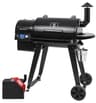
The best portable smoker is the Traeger Tailgater — 300 square inches on folding legs, an 8 lb pellet hopper, a 450°F ceiling and a retailer-listed 62 pounds, backed by the deepest parts, pellet and dealer network in pellet cooking. It wins not on its spec sheet, which is the thinnest here, but on the thing that matters when a cooker lives in a truck and gets used at campsites: when something wears out, you can replace it anywhere. The budget pick is the Char-Griller AKORN Jr. — 153 square inches of cast-iron grate in a triple-wall, 22-gauge insulated tabletop body that needs no power at all. Every price here is read live from the current listing — 4 of 4 picks had a buyable offer as of November 22, 2026, and each button carries that date.
Answer the power question before you look at anything else. A pellet grill is a machine: an auger, an induction fan and a controller, all of which need mains electricity. At a tailgate with a generator or an RV site with a hookup, that is fine, and you get set-and-forget temperature control in a body you can carry. At a dispersed campsite, on a beach or anywhere off-grid, a pellet grill is a boat anchor. Charcoal needs nothing but charcoal. Two of the picks below are pellet and two are charcoal, and that is the real fork in this page.
The second question is whether you want to smoke at the destination or just cook there. There is a real difference. A 300-square-inch pellet grill will hold 225°F for as long as the hopper lasts, which makes a genuine low-and-slow cook possible away from home. A 153-square-inch tabletop kamado is superb at hot-and-fast and perfectly capable of a small smoke, but you are cooking two racks of ribs, not a brisket. Be honest about the food before you buy for the format.
If you want the longest unattended run, the Z Grills 450B is the better pellet choice. It publishes 459 square inches — half again the Tailgater’s grate — a 15 lb hopper that is nearly double, a 180–450°F range and a PID controller, which measures the chamber and modulates the auger to hold a set point rather than feeding on a fixed timer. On paper it beats the Traeger comfortably. What it does not have is the Traeger network, and it is a small cart rather than a folding unit, so it travels in a vehicle rather than being carried to a site. Our best pellet grills under $500 page ranks both against the Z Grills 550B2.
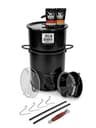
If flavor is the point, take the charcoal and accept the smaller numbers. The Pit Barrel Junior is a 14-inch drum: 150 square inches of grate plus four hooks, 38 pounds, 33 inches tall, rated by Pit Barrel for six rib racks or one pork butt or brisket. Hanging meat in a vertical smoke column over coals is the method that produces the deepest smoke of anything on this page, and the cooker has almost nothing to manage — one intake, set once for your altitude. At 38 pounds it is also the lightest pick here by a wide margin. The AKORN Jr. is the other charcoal option and a different trade: insulated steel sips fuel and runs from low smoking heat up to searing heat, in the smallest footprint on the page.
Two honest gaps in the table below. Neither Z Grills nor Char-Griller publishes an assembled weight for these two models in the spec sheets we read, so those cells show a dash rather than a figure we cannot cite — which is awkward on a page about portability, and we would rather say so than estimate. And “cooking area” is not comparable across these shapes: Pit Barrel quotes a grate figure plus hooks because hanging capacity is not a square-inch number, while the pellet grills quote a flat grate. Count the longest thing you cook instead.
What is not here. There is no portable electric smoker in this list, because an electric cabinet needs power and gives you the lightest smoke of any fuel — the worst of both constraints for travel. There is no portable offset either; a stick burner small enough to carry has too little thermal mass to hold a line. If you want a portable cooker for burgers and steaks rather than smoke, read best gas grills for small spaces and best portable griddles instead — both are better answers to that question than anything on this page. We have not tested these cookers; our methodology page explains how we work.