Meat Smoking Temperature Chart
Every cut you smoke has two numbers, and almost all the confusion in barbecue comes from treating them as one. This is the chart for both — the USDA safe minimum, and the much higher temperature at which a tough cut finally becomes tender.
Quick answer
Every smoked cut has two temperatures. The USDA safe minimumis the food-safety number: 145°F for whole beef, pork and lamb cuts (plus a three-minute rest), 160°F for ground meat, 165°F for all poultry. The finish temperature is the barbecue number — around 203°Ffor brisket and pork shoulder — and it has nothing to do with safety. It is the temperature at which connective tissue has broken down into gelatin. A brisket is safe at 145°F and inedible until roughly 200°F. Run the smoker at 225–275°F for almost everything.
The two-temperature idea, in one paragraph
A steak and a brisket come off the same animal and are cooked to temperatures sixty degrees apart. The reason is collagen. Tender cuts — steaks, chops, loins, chicken breast — have very little of it, so you cook them only as far as safety and personal preference require and then stop, because every degree past that squeezes out moisture. Tough cuts — brisket, chuck, shoulder, ribs, shank — are full of it, and collagen does not break down until the meat is well past 160°F and held there for hours. You are deliberately overcooking them, by the standards of a steak, because that is the only way the connective tissue turns to gelatin.
So the question “what temperature should I smoke this to?” always has two answers, and which one you want depends entirely on which kind of cut is in front of you. Everything below is organized that way.
USDA safe minimum internal temperatures
These are the published USDA FSIS figures, not our opinion, and they are the floor for every cut. The source is linked at the bottom of this page.
| Food | USDA safe minimum | Rest required |
|---|---|---|
| Beef, pork, veal, lamb — steaks, chops, roasts | 145°F | 3 minutes |
| Ground beef, pork, veal, lamb | 160°F | None |
| All poultry — whole, parts, ground, stuffing | 165°F | None |
| Ham, fresh or smoked, uncooked | 145°F | 3 minutes |
| Fish and shellfish | 145°F | None |
| Leftovers and casseroles | 165°F | None |
Note what is noton that list: brisket, pork shoulder, ribs and beef short ribs do not have their own entry, because as whole cuts of beef and pork they are covered by the 145°F line. That is the single most useful thing on this page. A brisket crosses the safety threshold in the first couple of hours of a twelve-hour cook. Everything after that is about texture.
Barbecue finish temperatures
These are ours — the temperatures at which each cut is actually good, written from how collagen behaves and from the broad consensus of cooks who make these cuts regularly. They are not safety figures and they are not precise to the degree: the honest version of this table has ranges in it, because the right moment is a texture and the number is a proxy for it.
| Cut | Smoker temp | Finish temp | Why that number |
|---|---|---|---|
| Beef brisket (whole packer) | 250°F | 200–205°F | Probe slides in with no resistance; collagen fully rendered |
| Pork shoulder / butt (for pulling) | 250°F | 200–205°F | Below ~195°F it slices; above ~200°F it pulls |
| Pork ribs (spare or St. Louis) | 250°F | 195–203°F | Bend test matters more than the number |
| Beef short ribs | 275°F | ~203°F | Heavily collagenous; same endpoint as brisket |
| Pork loin | 250°F | 145°F | Lean and tender — no collagen to render, so stop at safe |
| Whole chicken / turkey (breast) | 300–325°F | 165°F | Safety number is also the quality ceiling for breast meat |
| Chicken thighs and legs | 300–325°F | 175–185°F | Dark meat has collagen; it improves above the safe minimum |
| Beef chuck roast | 250°F | ~205°F | Cooks like a small brisket |
| Smoked sausage (fresh) | 225°F | 160°F | Ground meat figure; above it the fat renders out |
| Salmon | 225°F | 145°F | Delicate protein; the safe number is the finish number |
Three patterns are worth pulling out of that table. Everything that pulls apart finishes near 203°F. Everything lean and tender finishes at its safe minimum and not a degree higher. And poultry splits: breast at 165°F, dark meat happier at 175–185°F, which is why cooking a whole bird is always a compromise and why pulling on the breast is the right call.
“Probe tender” beats any number
Experienced cooks talk about probe tenderness rather than temperature on the big cuts, and they are not being mystical. Two briskets of the same weight from the same supplier can be done nine degrees apart, because the amount and distribution of connective tissue varies between animals. The test is physical: slide a thermometer probe or a skewer into the thickest part, and if it goes in and comes out with no more resistance than warm butter, it is done. If it grips, it needs longer, whatever the display says.
Use the finish temperatures above as the window in which to start testing. At 195°F, begin probing every 30 to 45 minutes. Somewhere between there and about 207°F it will let go. That is the cook.
Why 225°F is not automatically the right smoker temperature
“Low and slow at 225°F” is barbecue’s default advice and it is a reasonable default. It is not a rule. Running at 250–275°F finishes a brisket or a shoulder several hours sooner and, on a well-sealed cooker, makes no meaningful difference to the result — plenty of competition cooks run hotter than 225°F deliberately. The thing a higher chamber temperature genuinely costs you is margin for error: at 275°F everything happens faster, including the mistakes.
Poultry is the exception where the default is actively wrong. Chicken and turkey want 300–325°F, because skin only renders at real heat and because there is no collagen in a breast to reward patience. A 225°F chicken has rubbery skin that nobody eats.
The stall, and why your thermometer looks broken
Somewhere around 150–170°F internal, a brisket or pork shoulder will stop climbing — sometimes for hours. This is the stall, and it is evaporative cooling: moisture is coming to the surface and evaporating as fast as the fire is adding heat, so the meat sits at wet-bulb equilibrium. Nothing is wrong.
You have two options and both are legitimate. Wait it out, and accept a longer cook and a better bark. Or wrap in foil or butcher paper, which stops the evaporation and pushes straight through — faster, softer bark. What you should not do is raise the fire to force it, because that overshoots the moment the stall breaks.
Where to measure, and what gets this wrong
- Thickest part, away from bone and fat. Bone conducts heat and reads high; a fat seam reads low. On a brisket that means the thickest point of the flat, not the point end.
- Never trust a lid thermometer.It measures the air several inches above the grate, on the wrong side of the chamber, and on most cookers it is off by 25°F or more. Measure grate-level air temperature where the food actually is.
- Color is not doneness. The USDA says so directly: poultry can be safe and still pink near the bone. On smoked meat it is worse, because smoke produces a pink ring in the outer layer that has nothing to do with how cooked it is. The smoke ring is a chemical reaction, not an indicator.
- Carryover is small on barbecue.A steak off a hot grill climbs several degrees while resting. A brisket that has been at 250°F for twelve hours has very little gradient left, so expect a degree or two, not ten. Do not pull a brisket at 195°F expecting it to coast to 203°F.
How this is funded: we earn a commission if you buy through our links, at no extra cost to you. It never changes which product we recommend, and we’ll tell you when we’d skip one, or point you to a cheaper option when it’s the better buy. Full disclosure.
A chart is useless without something to measure with
Live prices, fetched and date-stamped. The distinction that matters: an instant-read spot-checks a cut in seconds, a leave-in probe watches a twelve-hour cook without you opening the lid. Most people who smoke seriously end up with one of each.
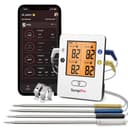
ThermoPro TP25 4-Probe Bluetooth Thermometer
Four color-coded leave-in probes with 650 ft of range — enough to monitor two large cuts plus grate-level air temperature, which is the reading your lid thermometer is lying about.
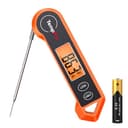
ThermoPro Digital Instant-Read Meat Thermometer
Three to four seconds to a reading, foldaway and waterproof. This is the one you use to probe a brisket in five places looking for the soft spot — the test that actually ends the cook.
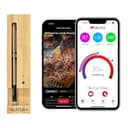
MEATER Plus Wireless Smart Meat Thermometer
A single wireless probe reading internal and ambient temperature at once, with app-guided cooks. Best for someone cooking one cut at a time who wants no trailing wires.
Rough timings, with the usual warning
Time per pound is for planning the day, never for deciding doneness. At 250°F, plan on roughly 1½ hours per pound for brisket and pork shoulder — a 12 lb brisket is a 15 to 18 hour day including rest, and it may be two hours either side of that. Ribs run three to five hours. Chicken at 325°F is 2 to 2½ hours for a whole bird.
Build the buffer in at the end, not the beginning. A brisket that is done early can be wrapped and held in a cooler or a low oven for hours and will arguably improve; one that is running late cannot be rushed without wrecking it.
Where to go next
The three cooks this chart exists for, in order of difficulty: ribs, pork shoulder and brisket. For holding a chamber temperature steady enough for any of them, how to use an offset smoker is the fire management, and best offset smokers for competition covers what heavier steel actually buys you in temperature stability. If you are smoking poultry rather than beef or pork, the method differs enough to need its own page: how to smoke a turkey.
Frequently asked questions
What is the safe internal temperature for smoked meat?
The USDA safe minimums are 145°F for whole cuts of beef, pork, veal and lamb with a three-minute rest, 160°F for ground meat, and 165°F for all poultry including stuffing. Those are safety floors and they apply regardless of cooking method. Brisket, pork shoulder and ribs have no separate entry because as whole cuts they are covered by the 145°F line — which means they become safe to eat in the first couple of hours of a twelve-hour cook.
What temperature is brisket done at?
200-205°F internal, with the real test being probe tenderness rather than the number. A brisket was safe to eat at 145°F; the reason it goes another sixty degrees is collagen, which only breaks down into gelatin well above 160°F and needs hours there. Start probing the thickest part of the flat at 195°F and look for a probe that slides in with no resistance. Two briskets of the same weight can finish nine degrees apart.
What temperature should I set my smoker to?
225-275°F for almost everything, with 250°F as the sensible default for brisket, pork shoulder and ribs. Running at 250-275°F finishes a big cut several hours sooner than 225°F with no meaningful difference in the result on a well-sealed cooker; what you lose is margin for error, because everything happens faster including the mistakes. The exception is poultry, which wants 300-325°F so the skin actually renders.
Why does brisket go to 203°F when beef is safe at 145°F?
Because safety and tenderness are two different problems. 145°F is where bacteria are dealt with. 203°F is roughly where the collagen that makes a brisket tough has broken down into gelatin, which takes both high temperature and hours of time. By steak standards you are overcooking it enormously, and that is correct: a brisket pulled at 145°F is safe and essentially inedible. Lean cuts with no collagen, like pork loin, stop at 145°F for exactly the same reason in reverse.
What temperature do chicken thighs need?
They are safe at 165°F like all poultry, but they are better at 175-185°F. Dark meat contains connective tissue that benefits from going past the safe minimum, in the same way a pork shoulder does on a larger scale. Breast meat is the opposite and dries out above 165°F, which is why cooking a whole bird is always a compromise — pull on the breast at 165°F and tent it if the legs need longer.
What is the stall and should I wrap?
Around 150-170°F internal, a large cut stops climbing, sometimes for hours. That is evaporative cooling: moisture reaching the surface evaporates as fast as the fire adds heat, so the meat sits at equilibrium. Nothing is wrong. You can wait it out for a better bark, or wrap in foil or butcher paper to stop the evaporation and push through faster with a softer bark. What you should not do is raise the fire to force it, because that overshoots once the stall breaks.
Can I trust the thermometer in my smoker lid?
No. A lid thermometer measures air several inches above the grate, often at the wrong end of the chamber, and on most cookers it reads 25°F or more away from the temperature where the food actually is. Use a probe at grate level next to the meat for chamber temperature, and a separate probe in the meat itself. This single swap fixes more barbecue problems than any technique change.
Does the pink smoke ring mean the meat is undercooked?
No — it is a chemical reaction, not a doneness indicator. Nitric oxide from the smoke reacts with myoglobin in the outer layer of the meat and fixes it pink, and it forms early in the cook regardless of final temperature. The USDA says plainly that color is not a reliable doneness test in either direction, including that poultry can be fully cooked and still pink near the bone. Only a thermometer reading tells you anything.
Sources
- USDA FSIS — Safe Minimum Internal Temperature Chart — The USDA's official safe minimum internal cooking temperatures for beef, poultry, pork and more (accessed July 22, 2026)
- USDA FSIS — Doneness Versus Safety — USDA on why color is not a reliable doneness test and a thermometer is (accessed July 22, 2026)
Keep reading
How to Smoke a Brisket on an Offset
Trim, season, hold 250°F, ride the stall and wrap — the first-brisket walkthrough using the finish temperatures above.
Read the guide →Best Instant-Read Thermometers
Three to six seconds to a reading — the tool that turns a temperature chart into a usable cook.
See the picks →How to Use an Offset Smoker
Light it, run it, and hold 250°F for hours — the fire management behind every number on this page.
Read the guide →Grilling vs Smoking
What separates the two methods on heat, time and fuel — and which cooker you actually need.
Read the guide →