A charcoal grill is the most flavor for the least money in outdoor cooking. There are no electronics, no gas line, and almost nothing to break — a steel bowl, a grate, a lid and two dampers, over a bed of burning charcoal that hits a searing heat a gas grill can only dream about and lays down the smoky char that most people mean when they say “grilled.” The trade is that you manage a fire instead of turning a knob, and that the cheap ones swing temperature and rust out fast. This roundup is about spending your money where it actually changes the cooking.
We’re ranking kettle and barrel charcoal grillshere — the round Weber-style bowl and the horizontal barrel. If you want a ceramic charcoal cooker that sears and smokes and sips fuel, that’s a kamado, and it has its own roundup. If you want a dedicated low-and-slow smoker with a side firebox, that’s an offset. This page is the everyday charcoal grill: the one you light on a Tuesday for burgers and can still bank into a two-zone fire for a slow rack of ribs on Sunday.
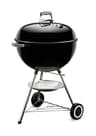
One brand dominates this category, and pretending otherwise would be dishonest: Webermakes the 22-inch kettle that defined the shape, and its parts, gaskets and accessory ecosystem are so deep that a Weber kettle bought today is still fully serviceable in twenty years. Five of our six picks are Weber for that reason, spanning a $90 portable to a $450 cart, and we include a budget Royal Gourmet barrel to show what the money buys you at the very bottom — and what it doesn’t. If a grill in the table below shows “—” for a spec, the manufacturer doesn’t publish that number and we won’t invent one.
The spec that decides most of the cooking is cooking area, and it’s more subtle than a single number. A 22-inch kettle gives you 363 square inches of grate — enough to bank all the coals to one side and still have a cool zone to cook indirectly, which is the whole trick to grilling anything thicker than a burger without burning it. Drop to the 18-inch Jumbo Joe’s 240 square inches and you can still do it, just for fewer people. The Royal Gourmet barrel claims the most grate here at 490 square inches across a main grate and a warming rack, but a barrel spreads that area over a long, shallow firebed that’s harder to set up for true two-zone cooking than a deep round bowl. Bigger isn’t automatically better; the shape of the cooking area matters as much as the size.
After area, the honest differences between these grills are conveniences, not cooking. A hinged grate lets you add coals mid-cook without lifting the food; a sealed One-Touch ash sweeper empties the bowl with a lever instead of a shovel; a built-in lid thermometer saves you clipping on your own; a work table gives you somewhere to set the platter. None of those change the flavor of the food — the base Weber Original Kettle grills identically to the Performer that costs three times as much. They change how pleasant the grill is to live with, which, if you cook often, is worth paying for, and if you grill twice a summer, is not. We’ll tell you which is which on every pick.
Build quality is the last lever, and it’s where the budget barrel gives ground. Weber’s porcelain-enameled bowls carry a 10-year no-rust-through warranty and genuinely earn it; the thin painted steel on a sub-$150 barrel will surface-rust and lose heat faster in wind and cold. That doesn’t make the cheap grill a bad buy — it makes it a different buy, for someone who wants the most grate for the least money and isn’t planning to hand it down. We rank six grills that are genuinely on sale right now, on the specs that predict how they cook and how long they last. We didn’t test them in a lab — nobody handing you a listicle tested a shed full of grills either. What we did is compile every published spec, do the arithmetic, and read the consensus of real owners; exactly how is on our methodology page.
One thing to buy alongside whichever grill you pick: a meat thermometer and a chimney starter. The thermometer fixes more bad barbecue than any grill upgrade because doneness is a temperature, not a time, and the chimney lights charcoal cleanly in fifteen minutes with no lighter fluid taste. Neither costs much, and both matter more than the difference between two of the kettles below.
Never cooked on charcoal before? Read charcoal grilling for beginners before you buy anything — it covers the three-tool starter kit, lighting without fluid, and the two-zone fire that makes all of this easy. Then your first charcoal grill cook walks through an actual evening start to finish, how much charcoal to use gives you the amounts by grill size, and common beginner mistakes is the list of things that go wrong the first time.