Traeger vs Camp Chef
Nearly the same cooking area, nearly the same hopper, the same 500°F convection ceiling. So this comparison is not about size — it is about three mechanisms Camp Chef has and Traeger doesn't, and one network Traeger has and Camp Chef doesn't.
Quick answer
Buy the Traeger Woodridgeif you want the safest possible pellet grill: 860 sq in, a reliable RTD sensor, WiFIRE app control, and the largest parts, accessory and support network in the category. Buy the Camp Chef Woodwind Pro 24if you want the grill to do more: 811 sq in, a Smoke Box that burns real wood chunks alongside the pellets, Slide and Grill direct-flame searing to 650°F, and an ash-cleanout cup that empties in seconds. Camp Chef wins on capability; Traeger wins on certainty.
How this is funded: we earn a commission if you buy through our links, at no extra cost to you. It never changes which product we recommend, and we’ll tell you when we’d skip one, or point you to a cheaper option when it’s the better buy. Full disclosure.
| Spec | 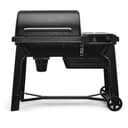 | 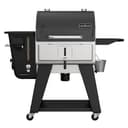 |
|---|---|---|
| Cooking area | 860 sq in | 811 sq in |
| Hopper capacity | 20 lb | 22 lb |
| Temp range | 180-500°F | 160-500°F |
| Control | WiFIRE app + RTD probe | Gen 2 PID + WiFi |
| Price | $899.99 · View on Amazon Price as of October 13, 2026. #ad How we’re funded |
Why these two get cross-shopped
Because on paper they look like the same grill. 860 square inches against 811 is a 6% difference — roughly one rack of ribs’ worth, and not a reason to choose either. 20 lb of hopper against 22 lb is noise. Both top out at 500°F in convection mode, both run PID-style control with app connectivity, both hold a low-and-slow line properly. A buyer comparing the spec sheets reasonably concludes it is a coin toss and picks on price.
That conclusion is wrong, and the reason is that the specs these two grills differ on are not the ones usually printed at the top of a listing. Camp Chef has three mechanisms that change what the grill can physically do. Traeger has one asset that changes what owning it is like. Everything below is about those four things.
A note on scope, so you are not reading the wrong page: this compares the two brands’ mainstream 24-inch-class grills on their published figures. If you want Camp Chef against the value field instead, that is Camp Chef vs Z Grills; if you want Camp Chef against the other searing-capable grill at a very different price, that is Pit Boss vs Camp Chef; and Traeger against the value brands is Traeger vs Pit Boss.
Mechanism 1 — the Smoke Box: real wood, not just pellets
The most common criticism of pellet grills is fair: they produce thin smoke. The reason is physics rather than cost-cutting. A small, fan-fed pellet fire burns very efficiently, and efficient fires produce less of the partially combusted compounds that people actually taste as smoke. A pellet grill run at 225°F is closer to a wood-fired convection oven than to a stick burner, and cooks coming from charcoal notice immediately.
Camp Chef’s answer on the Pro models is a separate Smoke Box that burns wood chunks, chips or lump charcoal alongsidethe pellet fire — on top of PID-controlled temperature, not instead of it. You keep the set-and-forget behavior and add a second, deliberately less efficient wood fire for flavor. Traeger has no equivalent; its answer is to sell pellets in more species. If smoke flavor is the specific thing you are unhappy about, this is the single most important paragraph on this page — and the software-and-fuel approaches that work on any pellet grill are in how to get more smoke flavor from a pellet grill.
Mechanism 2 — searing: 650°F against 500°F
Both grills publish a 500°F convection ceiling, which roasts well and sears badly. Camp Chef adds Slide and Grill: a lever that pulls the internal heat diffuser back so food sits directly over the firepot, for direct-flame grilling up to 650°F. That is real crust-making heat on one zone of the grate while the rest of the chamber stays in convection.
The Traeger has no such mechanism. Searing a steak on a Woodridge means accepting 500°F convection, or buying aftermarket rail panels, or finishing in a skillet. None of those is a disaster — plenty of good cooks reverse-sear in a cast-iron pan on purpose — but it is one cooker versus two steps. The wider field, including the roughly 1,000°F a Pit Boss Flame Broiler reaches and the whole-chamber 700°F approach recteq takes, is ranked in best pellet grills for searing.
Mechanism 3 — ash cleanout, the one nobody shops for
Every pellet grill accumulates fine ash in and around the firepot, and on most of them removing it is a shop-vac job you postpone until the grill starts holding temperature badly. Camp Chef’s patented ash-cleanout cup turns that into pulling a knob: the ash drops into a removable cup and you empty it. It takes seconds.
This is the least glamorous item on the page and probably the one that most changes how much you enjoy the grill in year three. Ash is the main cause of temperature drift and poor startup on a neglected pellet grill, so a cleanout system that gets used because it is easy is a reliability feature wearing a convenience badge. Traeger’s firepot is serviceable but conventional.
Traeger’s asset — the network, and why it is a real spec
Traeger defined this category and still dominates it, and that produces four concrete advantages that never appear on a spec sheet. Parts are stocked and ship fast. Every accessory maker sizes to Traeger first. Every failure mode has already been diagnosed publicly by somebody with the same grill. And resale value holds, which quietly lowers the real cost of being wrong.
Traeger’s own hardware contribution is the RTD temperature sensorrather than a thermocouple — a more stable sensing element, which is part of why Traegers have a reputation for boring, dependable temperature holding — plus the WiFIRE app, which is the most mature app in pellet grilling. Camp Chef Connect is good; WiFIRE has had more years and more users finding its bugs.
For a first pellet grill, that network is worth more than any single mechanism above. For a second one, bought by somebody who already knows what annoys them about pellet grills, it usually isn’t.
What the numbers actually say
| What you are comparing | Traeger Woodridge | Camp Chef Woodwind Pro 24 |
|---|---|---|
| Cooking area | 860 sq in | 811 sq in |
| Hopper | 20 lb | 22 lb |
| Convection range | 180–500°F | 160–500°F |
| Direct-flame sear | None | Slide and Grill, to 650°F |
| Burns wood chunks | No | Yes — Smoke Box |
| Ash cleanout | Conventional firepot | Patented ash cup |
| Sensor / app | RTD probe + WiFIRE | Gen 2 PID + Camp Chef Connect |
| Published warranty | 10 years, limited | Per Camp Chef listing |
Read that table honestly and Camp Chef wins six rows on capability, Traeger wins on grate area, sensor maturity and everything the table cannot show. Camp Chef also sits at the top of our pellet shortlist on price, above the mainstream Traegers — the live figures for both are in the table above, updated daily. Neither of these grills is a bad buy; they are optimized for different owners.
How this is funded: we earn a commission if you buy through our links, at no extra cost to you. It never changes which product we recommend, and we’ll tell you when we’d skip one, or point you to a cheaper option when it’s the better buy. Full disclosure.
The two grills in this comparison — and the one that undercuts them
Live prices from our daily refresh. Camp Chef sits at the top of our pellet shortlist; the Pit Boss undercuts both while still searing, at the cost of controller polish.
Traeger Woodridge Wood Pellet Grill
860 sq in, an RTD sensor, WiFIRE, and the biggest parts and accessory network in pellet. No direct-flame sear.
Price as of October 13, 2026. #ad How we’re funded
Camp Chef Woodwind Pro WiFi 24 Pellet Grill
811 sq in plus a Smoke Box for real wood, Slide and Grill searing to 650°F and the best ash cleanout in the category.
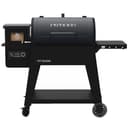
Pit Boss Navigator 850 Wood Pellet Grill
932 sq in and a 30 lb hopper with a Flame Broiler lever for direct flame — less polished app and controller than either grill above.
Price as of October 13, 2026. #ad How we’re funded
Who should buy which
Buy the Traeger if this is your first pellet grill, if you want the one that is easiest to get help with and easiest to sell, if 860 square inches of plain reliable convection is exactly the job, and if you are content to finish steaks in a pan. It is the lower-risk purchase and there is nothing wrong with buying the lower-risk purchase.
Buy the Camp Chefif you already own a pellet grill and know what frustrates you about it — thin smoke, no sear, ash you keep putting off — because the Woodwind Pro is built to answer all three, and no amount of Traeger ecosystem answers any of them. It is also the pick if you cook often enough that a five-second cleanout materially changes your weekend.
And if the honest answer is that you want maximum grate per dollar rather than either of these arguments, neither is your grill: start with best pellet grills under $1,000, where the ranking is explicitly on value.
Frequently asked questions
Is Camp Chef better than Traeger?
Camp Chef's Woodwind Pro is the more capable grill and Traeger is the safer purchase. Camp Chef adds three mechanisms Traeger has no equivalent for: a Smoke Box that burns real wood chunks alongside the pellets, Slide and Grill direct-flame searing to 650°F, and a patented ash-cleanout cup. Traeger counters with 860 sq in against 811, a mature RTD sensor and WiFIRE app, and by far the largest parts, accessory and support network in pellet grilling. For a first pellet grill that network is usually worth more than the mechanisms; for a second one it usually isn't.
Does a Camp Chef hold temperature better than a Traeger?
Both hold a low-and-slow line properly — this is not where they differ. Traeger uses an RTD temperature sensor rather than a thermocouple, which is a more stable sensing element and part of why Traegers have a reputation for dependable temperature holding. Camp Chef's Gen 2 PID controller is also well regarded. The practical difference is longer-term: Camp Chef's knob-pull ash cleanout keeps the firepot clear, and firepot ash is the main cause of temperature drift on a neglected pellet grill.
Which is bigger, the Traeger Woodridge or the Camp Chef Woodwind Pro 24?
The Traeger Woodridge, by 49 square inches — 860 sq in against 811. That is about a 6% difference, which is roughly one rack of ribs and not a sensible reason to choose either grill. Hopper capacity goes the other way: 22 lb on the Camp Chef against 20 lb on the Traeger. Both numbers are close enough that the mechanisms, not the dimensions, should decide this.
Can a Traeger sear a steak?
Not the way a direct-flame grill can. The Woodridge publishes a 500°F ceiling, which is a roasting temperature — enough for crisp chicken skin, not enough for a hard steak crust. There is no diffuser lever or sear hatch. Your options are aftermarket sear panels, accepting 500°F convection, or reverse-searing and finishing in a cast-iron pan, which many cooks prefer anyway. The Camp Chef's Slide and Grill reaches 650°F over naked flame instead.
What does the Camp Chef Smoke Box actually do?
It is a separate compartment that burns wood chunks, chips or lump charcoal alongside the pellet fire, so you get real wood smoke on top of PID-controlled temperature rather than instead of it. It exists because an efficient, fan-fed pellet fire burns very clean, and clean fires produce less of what people taste as smoke. It is the main thing the 'Pro' badge buys, and Traeger has no equivalent hardware.
Keep reading
Camp Chef Woodwind Pro 24 Review
Camp Chef's current 24-inch flagship — the Gen 2 PID, the Smoke Box and the best ash cleanout in the category.
Read the review →Traeger Woodridge Review
The mainstream Traeger, examined on the numbers — WiFIRE control, cooking area and what the premium buys.
Read the review →How to Get More Smoke Flavor From a Pellet Grill
Six things that actually change how much smoke a pellet grill lays down — and the two that don't.
Read the guide →