What You Need for an Offset Smoker
A new offset is not a finished smoker. Six things turn it into one — and most of them cost less than the delivery charge. Here's the list, in the order it matters, and the accessories you can happily ignore.
Quick answer
Six things, in order of how much difference they make: a probe thermometer (grate and meat), a high-temp gasket kit to seal the lid and firebox door, a chimney starter, heat-resistant gloves, a supply of seasoned hardwood splits plus lump charcoal, and a long slicing knife. Everything else — baffles, water pans, covers, rib racks — is genuinely optional.
How this is funded: we earn a commission if you buy through our links, at no extra cost to you. It never changes which product we recommend, and we’ll tell you when we’d skip one, or point you to a cheaper option when it’s the better buy. Full disclosure.
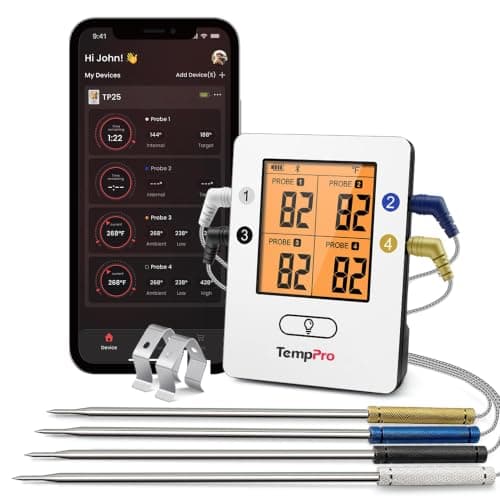
ThermoPro TP25 4-Probe Bluetooth Thermometer
1. A probe thermometer (buy this before anything else)
The lid gauge that came with your smoker measures the air temperature at the top of the dome. It does not measure the grate, where the food is, and on a thin-steel offset the difference between the two can be 30°F or more. It also tells you nothing about the meat, which is the only number that decides when a cook is finished. A two-probe unit — one clipped at grate level, one in the thickest part of the meat — converts guessing into information, and it does it on the first cook.
If you cook overnight, or if the smoker lives far enough from the house that you can’t hear an alarm, step up to a WiFi or Bluetooth monitor that pushes to your phone. The full field, from a $10 instant-read to a four-probe monitor, is in best meat thermometers for smoking.
2. A high-temp gasket kit (about $20, biggest gain per dollar)
Every retail offset leaks. The lid seats on bare metal, the firebox door seats on bare metal, and air arrives where you didn’t plan for it — which is precisely why a cheap pit swings temperature and burns through fuel. A roll of self-adhesive high-temperature gasket on the lid lip and firebox door turns airflow into something you control with the intake vent and the stack, which is the entire theory of running an offset. Do it before your first cook, not after your first frustrating one.
3. A chimney starter
You need a bed of properly lit coals to start an offset, and a chimney is how you get one in fifteen minutes without lighter fluid, which taints food and is unnecessary. Newspaper or a wax cube underneath, charcoal on top, wait for the top layer to ash over, pour into the firebox, then start feeding wood. Our picks are in best charcoal chimney starters. A useful detail for offset owners specifically: the compact size is often the better buy, because a firebox rarely wants a full standard chimney of coals to start.
4. Gloves — two pairs, honestly
One coated pair for food and hot metal, one long leather pair for the firebox. Running an offset means opening a fire door, moving burning splits and repositioning a coal bed with your forearm inside the heat, and a food glove is the wrong tool for that: embers burn holes in coated fabric, and leather that has soaked up rendered fat should never touch meat. Both jobs, and the materials that suit them, are covered in best BBQ gloves.
5. Fuel: splits and lump, not chips
An offset burns wood, not wood chips. You want seasoned hardwood splits— oak, hickory, pecan, cherry, apple — dried to roughly 20% moisture, in pieces around 12 to 16 inches long, sized to your firebox. Green or wet wood smolders instead of burning, and smoldering is what produces the acrid, sooty smoke that makes food taste like an ashtray. You also want a bag of lump charcoal to build the initial coal bed: charcoal gets you a hot, stable base fast, and the splits you add to it ignite cleanly instead of sulking. Species, lump size and burn time are compared in best lump charcoal, and which wood species suits which meat — plus the kiln-dried mini splits worth buying if you have no local supplier at all — is in best wood for smoking.
One thing that is not on this list: a bag of wood chips. Chips are for gas grills and short cooks. In an offset firebox they burn out in minutes and achieve nothing.
6. A long slicing knife
The last two minutes of a twelve-hour cook. A dedicated slicer of at least 11 inches crosses a brisket flat in one pull, which is what gives you clean slices instead of torn, ridged ones. It is the cheapest way to make your barbecue look like it cost more than it did. Picks are in best brisket knives.
What you can skip
- A water pan — probably.The theory is that it adds humidity and thermal mass. In practice, in a leaky retail offset with a fire you’re already managing, it mostly gives you another thing to refill. Get the pit sealed and stable first; add a water pan later if you want to experiment.
- Tuning plates — at first. On a traditional offset they genuinely even out the gradient, but you should learn where your hot spot is before you spend money flattening it. On a reverse-flow pit, the baffle already does this job.
- Wood chips and chunks. An offset is a stick burner. If you are buying bagged chunks for it, something has gone wrong with your fuel supply.
- Injectors, spritzers and mops — for now. All have their advocates and none of them will fix an unstable fire. Get the fire right; then start changing one variable at a time.
- A cover — unless you have to.Worth it if the smoker lives uncovered outdoors. If it’s under an eave or in a shed, a cover mostly traps moisture against the steel, which is the thing that actually rusts a pit out.
- The twenty-piece tool set.You need tongs, a turner and a brush, and you will never touch the corn holders or the basting brush that came with them. Buy the three individually — our picks are in best grilling tools, which also covers why the wire-bristle brush in that case should go in the trash.
The order to buy in
If the budget is tight, buy in this order: thermometer, gaskets, chimney, gloves, fuel, knife. The first two together cost less than most people spend on meat for a single brisket cook, and they change more about how the smoker behaves than any upgrade to the smoker itself would. The thermometer and the gaskets are also the first two entries in the offset mods that actually work, which picks up where this list ends — the stack, the basket and the tuning plates. Once the kit is sorted, read how to season an offset smoker for the burn-in, then how to use an offset smokerfor the fire-management method — and cook chicken before you cook brisket.
Frequently asked questions
What do I need to start using an offset smoker?
Six things, in order of impact: a probe thermometer for the grate and the meat, a high-temp gasket kit to seal the lid and firebox door, a chimney starter, heat-resistant gloves, a supply of seasoned hardwood splits plus lump charcoal for the starting coal bed, and a long slicing knife. Season the smoker with a burn-in before the first cook. Almost everything else sold as an offset accessory is optional.
Do I need a water pan in an offset smoker?
Not to begin with. The argument for one is added humidity and thermal mass, and on a well-sealed pit it can help. On a leaky retail offset with a fire you're still learning to manage, it mostly adds a chore — one more thing to refill mid-cook. Seal the lid and firebox first, get the fire stable, and treat a water pan as a later experiment rather than a requirement.
What wood should I use in an offset smoker?
Seasoned hardwood splits — oak, hickory, pecan, cherry or apple — dried to roughly 20% moisture and cut to 12 to 16 inches to suit your firebox. Oak is the reliable base wood; hickory and pecan are stronger; cherry and apple are mild and add color. Avoid green or wet wood, which smolders instead of burning and produces acrid, sooty smoke. Wood chips are for gas grills and are useless in an offset firebox.
Do I need to season a new offset smoker?
Yes. A burn-in cures the high-temperature finish and burns off the manufacturing oils and dust left from the factory, so your first cook doesn't taste of them. It also gives you a low-stakes run to find where the pit leaks and how it responds to the vents before there's food at stake. The full method is in our guide to seasoning an offset smoker.
How much should I budget for offset smoker accessories?
Roughly $100 to $150 covers the essentials well: about $40 for a two-probe thermometer, $20 for a high-temp gasket kit, $20 for a chimney starter, $25 for gloves, and $20 to $70 for a slicing knife depending on how nice you want it. Fuel is ongoing on top of that. The thermometer and the gaskets are the two that change how the smoker behaves — buy those first even if nothing else fits.
Keep reading
Best Offset Smokers for Beginners
The offsets that punish a new cook least, ranked on forgiveness rather than price.
See the picks →How to Use an Offset Smoker
Light it, run it and hold 250°F for hours — the fire-management basics.
Read the guide →How to Smoke a Pork Shoulder on an Offset
The most forgiving large cut in barbecue and the right second cook after ribs — trim, 250°F, the stall, and why the finish temperature has nothing to do with food safety.
Read the guide →