Inkbird IBBQ-4T vs ThermoPro TP25
WiFi that reaches the whole house or Bluetooth for the backyard — the two best-value four-probe monitors, compared on range, probes and app. Which one fits how far you roam during a long cook.
Quick answer
Buy the Inkbird IBBQ-4T if you want WiFi— it reports over your home network with no distance limit, so you can monitor an overnight cook from bed or from the store; the catch is it needs home WiFi to reach the grill. Buy the ThermoPro TP25 if you want simpler Bluetooth— it’s great across the whole yard and has a smoother rechargeable base, but its range is limited to about 650 ft. Both give you four probes. Inkbird for overnight and away; ThermoPro for backyard cooks.
How this is funded: we earn a commission if you buy through our links, at no extra cost to you. It never changes which product we recommend, and we’ll tell you when we’d skip one, or point you to a cheaper option when it’s the better buy. Full disclosure.
| Spec | 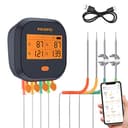 | 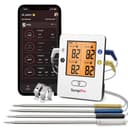 |
|---|---|---|
| Type | Leave-in, WiFi | Leave-in, Bluetooth |
| Probes | 4 | 4, color-coded |
| Range | WiFi (no Bluetooth limit) | 650 ft (line of sight) |
| Power | Rechargeable 2000 mAh | Rechargeable |
| Price |
The short version
The Inkbird IBBQ-4T and the ThermoPro TP25 are the two best-value four-probe leave-in monitorsyou can buy, and they’re close enough that the decision comes down to a single question: how far do you roam during a cook? Both give you four probes, per-probe alerts, a rechargeable base and an app. The difference is the radio. The Inkbird is WiFi, so it reports over your home network and has no practical distance limit — you can be at the store. The ThermoPro is Bluetooth, capped at about 650 ft line-of-sight, but simpler to set up and, by most accounts, a slightly smoother base to live with. That’s the whole decision; everything below is the detail behind it.
WiFi vs Bluetooth — the core difference
This is the axis the whole comparison turns on. Bluetoothis a direct radio link between the base and your phone: no network, no login, nothing to configure — pair once and it works, even if your WiFi is down or you’re cooking at a campsite with no network at all. Its limit is distance and walls; Bluetooth is a line-of-sight, short-to-medium-range technology that degrades fast through obstructions. WiFiflips both the strength and the weakness. The Inkbird joins your home network and pushes readings to the cloud, so your phone can be anywhere with a signal — the same house, or three towns over. The price of that reach is dependence: the base has to sit within range of your homeWiFi, and if your router doesn’t reach the grill at the far end of the yard, the Inkbird can’t phone home. Bluetooth needs nothing but your phone nearby; WiFi needs your network to reach the grill but then frees your phone entirely. We cover the connected category in full in best WiFi & Bluetooth thermometers.
Range & where you can roam
The practical question isn’t “which has more range” but “where are you allowed to be?” The ThermoPro TP25reaches up to about 650 ft line-of-sight — enough to cover a house and a yard, so you can be in the kitchen, on the couch, or out front and still get your alerts. What it can’t do is follow you off the property. The Inkbird IBBQ-4Thas no distance limit at all: because it’s riding your home WiFi and the internet, you can check the pit from bed on the far side of a two-story house, from the grocery store, or from a kid’s game across town. For a genuinely long, unattended cook — an overnight brisket you want to glance at at 3 a.m. without walking outside, or a smoke you start before running errands — that away-from-home reach is the Inkbird’s entire reason to exist. If you never leave the yard during a cook, though, the TP25’s 650 ft is all the range you’ll ever use, and you skip the WiFi setup entirely.
Probes & alerts
Here the two are near-identical, which is why the range question dominates. Both carry four probes, and four is the number that changes how you cook: run four racks of ribs and know which finished first, or put three probes in three cuts and clip the fourth to the grate to read the pit where the food actually sits — not the often-inaccurate dome gauge. Both let you set a high and low alert per probe, so your phone tells you when a cut crosses temperature or when the pit drifts out of band, which is the core job of a leave-in. The small edge goes to the ThermoPro’s probes being color-coded, so at a glance you know the red channel is the brisket and the blue one is the pit without reading labels. The Inkbird’s alert on the pit drifting lowis arguably more valuable on a long cook, because catching a dying fire early — from wherever you are — is exactly what WiFi buys you. Functionally, though, four probes plus per-probe alerts is the shared foundation; neither out-monitors the other on a spec sheet.
App & setup
This is where Bluetooth’s simplicity earns its keep. The TP25is close to plug-and-play: install the app, pair over Bluetooth, done — there’s nothing to log into and nothing that can go wrong with your network. The Inkbirdasks for a little more up front: you create an account and join the base to your 2.4 GHz WiFi, the standard one-time faff of any smart-home device, and if your router is flaky or far from the grill you’ll feel it. Once it’s connected the Inkbird app is functional and does the job, but neither of these apps is a thing of beauty — they’re about clear numbers and reliable alerts, not polish. If you want a genuinely slick app and a smart single probe over raw capability, that’s the MEATER’s territory, which we weigh against the same TP25 in MEATER vs ThermoPro TP25. Between these two, the TP25 is the faster thing to get running; the Inkbird trades a few minutes of WiFi setup for a lifetime of away-from-home range.
Power & battery
Both bases are rechargeablerather than battery-swappers, which is the right call for a device you leave running through a twelve-hour cook. The Inkbird specifies a 2000 mAh cell in its base; ThermoPro rates the TP25 as rechargeable without publishing the capacity, and where the manufacturer doesn’t publish a number we won’t invent one. In practice both comfortably outlast a normal cook on a charge, and both can run on the cable if you’re nervous about an overnighter — worth doing on the Inkbird especially, since the whole point of it is unattended cooks where you don’t want the base dying at hour ten. Treat battery life as a wash and decide on range and setup instead; that’s where the real difference lives.
Inkbird vs TP25 at a glance
| Dimension | Inkbird IBBQ-4T | ThermoPro TP25 |
|---|---|---|
| Connection | WiFi (home network) | Bluetooth |
| Range | No distance limit | Up to 650 ft line-of-sight |
| Probes | 4 | 4, color-coded |
| Setup | Account + join home WiFi | Pair over Bluetooth, done |
| Power | Rechargeable (2000 mAh) | Rechargeable |
| Best for | Overnight & away-from-home | Backyard cooks, simpler base |
Which should you buy?
Buy the Inkbird IBBQ-4Tif your cooks are long and unattended and you leave the property during them — overnight briskets, smokes you start before errands, anything you want to watch from bed or the store. Its WiFi reach is the whole point, and the only price is a one-time network setup and needing your router to reach the grill. Buy the ThermoPro TP25if you stay within a house-and-yard’s distance during the cook and want the simpler tool: pair-and-go Bluetooth, color-coded probes and a smooth rechargeable base, with no network to depend on. Both are four-probe monitors, not spot-check tools — pair either with a fast budget instant-readfor the final doneness check — and you can see how each ranks against the wireless MEATER and the instant-reads in the full meat thermometers roundup. Short version: WiFi for range, Bluetooth for simplicity; match the radio to how far you actually roam.
Frequently asked questions
Inkbird IBBQ-4T or ThermoPro TP25 — which is better?
It comes down to how far you roam during a cook. The Inkbird is WiFi, so it reports over your home network with no distance limit — buy it if you monitor overnight or away-from-home cooks. The ThermoPro is Bluetooth, capped at about 650 ft but simpler to set up and a smooth base to live with — buy it for backyard cooks where you stay near the grill. Both give you four probes and per-probe alerts; the radio is the real difference.
Do I need WiFi or Bluetooth for a meat thermometer?
Bluetooth is enough if you stay within a house-and-yard's distance of the grill — it needs nothing but your phone nearby, works with no network, and is simpler to set up. WiFi is worth it only if you leave the property during a cook: it reports over your home network and the internet, so you can check the pit from bed across a big house or from the store. Choose Bluetooth for backyard cooks, WiFi for overnight and away.
Does the Inkbird IBBQ-4T need home WiFi?
Yes — that's the trade for its unlimited range. The base joins your 2.4 GHz home network and pushes readings to the cloud, so your phone can be anywhere, but the base itself has to sit within reach of your router. If your WiFi doesn't reach the grill at the far end of the yard, the Inkbird can't phone home, and a Bluetooth unit like the TP25 (which needs only your phone nearby) would serve you better.
How many probes do the Inkbird and ThermoPro have?
Both carry four probes, which is the count that changes how you cook: run four racks and know which finished first, or put three probes in three cuts and clip the fourth to the grate to read the pit where the food actually sits. Both let you set a high and low alert per probe. The ThermoPro's probes are color-coded, so at a glance you know which reading is which — a small but genuine convenience over an identical set of channels.
Can I use these to monitor an overnight brisket?
Both can watch the cook, but only the WiFi Inkbird lets you watch it from bed. The TP25's Bluetooth covers a house and yard, so you'd get alerts anywhere on the property but not if you're a long way from the base in a large home. The Inkbird has no distance limit, so you can glance at the pit at 3 a.m. without walking outside — which is exactly what makes WiFi the better tool for genuinely long, unattended cooks.
Keep reading
Best WiFi & Bluetooth Thermometers
The connected leave-in picks in full, including the WiFi model for overnight and away-from-home cooks.
Read the guide →Best Meat Thermometers
The full roundup — instant-read, leave-in and connected, compared on type and use.
See the roundup →MEATER Plus Review
The fully wireless smart probe — no cable through the lid, dual sensors and a finish-time estimate. What it does well, and its one real limit.
Read the review →