Napoleon vs Weber
Two four-burner premium grills, the same 48,000 BTU across the main burners, and about $130 between them. Weber gives you more primary grate. Napoleon gives you thicker steel, infrared searing, a rotisserie burner and a lifetime warranty. Here is which trade is the right one.
Quick answer
Buy the Napoleon Prestige 500 RSIBif searing and rotisserie cooking are why you are spending premium money: 8.5 mm stainless grates, a rear infrared burner for spit-roasting, an infrared side burner, 82,000 BTU total and a lifetime bumper-to-bumper warranty. Buy the Weber Genesis S-435if you want the most usable primary cooking surface and the most dependable dealer and parts network — 646 sq inof primary grate against Napoleon’s 500, a dedicated Sear Zone burner, and a 12-year cookbox term.
How this is funded: we earn a commission if you buy through our links, at no extra cost to you. It never changes which product we recommend, and we’ll tell you when we’d skip one, or point you to a cheaper option when it’s the better buy. Full disclosure.
| Spec | 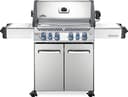 | 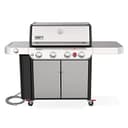 |
|---|---|---|
| Main burners | 4 | 4 |
| Main burner BTU | 48,000 | 48,000 |
| Primary cooking area | 500 sq in | 646 sq in |
| Grates | 8.5 mm stainless steel | 7 mm stainless steel |
| Warranty | Lifetime, bumper to bumper | 12-yr cookbox, 10-yr burners |
| Price | $1,879.00 · View on Amazon Price as of October 14, 2026. #ad How we’re funded |
Check the fuel type before you click either link
This is first because it is the mistake that costs the most. The Weber in this comparison is the Genesis S-435, and its published specification says natural gas— it needs a gas line run to the patio and it will not run off a propane tank as shipped. The Napoleon Prestige 500 RSIB spec sheet we read does not publish a fuel row at all, so confirm it on the listing before you buy.
Both manufacturers sell these models in more than one SKU, and fuel type is usually the difference between two near-identical listings. If you do not have a gas line and are not willing to pay for one, verify the listing says liquid propane before adding anything to a cart. Never buy a grill intending to convert it yourself; conversion kits are model-specific, warranty-relevant and in many jurisdictions a licensed job.
The numbers these two actually share
Start with what is identical, because it removes the spec most buyers lead with. Both grills publish four main burners and 48,000 BTUacross them. That is not a coincidence — it is where the premium four-burner class lands. So raw heat output is off the table as a tiebreaker, and anyone selling you one of these on BTU alone is selling you a number that does not distinguish them. If you want the arithmetic on why BTU is a weaker spec than it looks, that is how many BTUs a gas grill actually needs.
What is left is how each brand spent the rest of the budget, and they spent it in genuinely opposite directions.
Weber’s case: primary cooking area
646 square inches of primary grate against 500.That is a 29% advantage and it is the single most practically useful difference on this page. Primary area is the surface directly over the burners — the part you can actually cook on at temperature, as opposed to warming racks and side shelves. Napoleon publishes 914 square inches of total cooking area, which is the larger headline figure, but a good deal of that total is secondary surface.
Comparing a total figure against a primary figure is the most common way gas grill specs mislead, so read both rows on any listing. On primary area, which is the row that decides how many steaks fit at once, Weber wins clearly. Weber also fits a dedicated 12,000 BTU Sear Zone burner and a 12,000 BTU side burner, so it is not conceding the searing argument entirely — it concedes the infrared argument.
Napoleon’s case: steel, infrared and a lifetime warranty
Three things, each of which a Weber at this price does not offer.
8.5 mm stainless grates against 7 mm.Grate mass is thermal mass. A heavier bar holds more heat, loses less of it when cold meat lands on it, and therefore puts down a better mark and recovers faster. Both of these are stainless rather than coated cast iron, which is the right material at this money; Napoleon’s are simply thicker. It is a small number doing real work.
The RSIB burners.RSIB stands for rear and side infrared burner, and this is the specification that most separates the two grills. A rear infrared burner is what makes a rotisserie worth owning: it radiates heat onto the spit from behind rather than heating the air, so a chicken or a porchetta browns evenly instead of drying on one side. The infrared side burner is a searing station that runs far hotter than a conventional side ring. Weber’s Sear Zone is a concentrated gas burner; Napoleon’s is a different mechanism, and it is why total output reaches 82,000 BTUagainst Weber’s 48,000 main plus two 12,000 auxiliaries.
Lifetime, bumper to bumper.Napoleon publishes a lifetime warranty on this grill. Weber publishes 12 years on the cookbox and 10 on the burners, which is itself excellent and far better than the industry norm. Warranty length is one of the few honest proxies for what a manufacturer expects its own product to survive, and “bumper to bumper” is a broader claim than a component-by-component schedule. Read the exclusions on both — every warranty at this level has them — but the headline difference is real.
Side by side, on the rows that matter
| What you are comparing | Napoleon Prestige 500 RSIB | Weber Genesis S-435 |
|---|---|---|
| Main burners | 4 | 4 |
| Main burner BTU | 48,000 | 48,000 |
| Primary cooking area | 500 sq in | 646 sq in |
| Total cooking area | 914 sq in | Not published as a total |
| Total BTU | 82,000 | 48,000 main + 12,000 sear + 12,000 side |
| Grate thickness | 8.5 mm stainless | 7 mm stainless |
| Searing mechanism | Infrared side burner | Sear Zone gas burner |
| Rotisserie burner | Yes — rear infrared | Not published |
| Published fuel | Not published on the spec sheet | Natural gas |
| Warranty | Lifetime, bumper to bumper | 12-yr cookbox, 10-yr burners |
Every figure above is read from each manufacturer’s own published specification or an authorised retailer listing, and where a maker does not publish a row we say so rather than printing a reseller’s guess. We have not cooked on either grill — our methodology sets out exactly what we do instead.
How this is funded: we earn a commission if you buy through our links, at no extra cost to you. It never changes which product we recommend, and we’ll tell you when we’d skip one, or point you to a cheaper option when it’s the better buy. Full disclosure.
The two in this comparison — and where most people should stop
Live prices from our daily refresh. The Genesis E-325 is the honest answer for most buyers: the same Weber build quality and dealer network, three burners instead of four, for a lot less money.
Napoleon Prestige 500 RSIB Gas Grill
8.5 mm grates, rear and side infrared burners, 82,000 BTU total and a lifetime bumper-to-bumper warranty.
Price as of October 14, 2026. #ad How we’re funded
Weber Genesis S-435 Gas Grill (Natural Gas)
646 sq in of primary surface, a dedicated Sear Zone burner and Weber's parts network. Published as natural gas — you need a line.
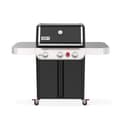
Weber Genesis E-325 3-Burner Gas Grill
513 sq in of primary grate, 39,000 BTU and the same 12-year cookbox term, for far less than either grill above.
Who should buy which
Buy the Napoleon if you will actually use the rotisserie and the infrared sear station. Those are the two features you cannot add to a Weber afterwards, and they are what the extra money buys. The thicker grates and the lifetime warranty are the supporting argument rather than the reason. If you spit-roast, or if a hard steak crust is the thing you have never been able to get off a gas grill, this is the grill that fixes it.
Buy the Weberif you cook flat food on a grate — steaks, chops, burgers, chicken pieces, vegetables — because 29% more primary surface is worth more than an infrared burner you will use four times a year. Weber’s other advantage is boring and important: parts availability. A Genesis bought today will have burners, flavorizer bars and igniters on the shelf in a decade, which is not equally true of every brand at this price.
Buy neither if you are not certain you need a four-burner premium grill. The honest truth about this price band is that most people are better served by stopping at the Genesis E-325, or by reading best high-end gas grills to see what the whole premium field offers before committing. If a grand is the ceiling, best gas grills under $1,000 is the right page.
If the Napoleon is the one you are leaning towards, the long-form version of its side of this comparison — the two infrared burners, the 8.5 mm stainless wave grates and what the lifetime warranty is actually worth — is our Napoleon Prestige 500 RSIB review.
Frequently asked questions
Is Napoleon better than Weber?
They are optimized differently at the same price. Napoleon's Prestige 500 RSIB wins on grate thickness (8.5 mm against 7 mm stainless), on searing and rotisserie capability thanks to its rear and side infrared burners, on total output (82,000 BTU) and on warranty — Napoleon publishes a lifetime bumper-to-bumper term against Weber's 12-year cookbox. Weber's Genesis S-435 wins on usable primary cooking area, 646 sq in against 500, and on parts availability. Both publish the same 48,000 BTU across four main burners.
Does Napoleon or Weber have more cooking area?
It depends which row you read, and this is the most common way gas grill specs mislead. Weber publishes 646 square inches of primary cooking area against Napoleon's 500 — a 29% Weber advantage on the surface directly over the burners, which is the part you can actually cook on at temperature. Napoleon publishes 914 square inches of total cooking area, which is the bigger headline figure but includes secondary surface such as warming racks. Compare primary against primary.
What does RSIB mean on a Napoleon grill?
Rear and Side Infrared Burner. The rear infrared burner is what makes the rotisserie genuinely useful: it radiates heat onto the spit from behind rather than heating the surrounding air, so a chicken or a roast browns evenly instead of drying out on one side. The side infrared burner is a searing station that runs much hotter than a conventional side ring. Together they are the main reason the Prestige 500's total output reaches 82,000 BTU.
Is a thicker grill grate actually better?
Yes, and it is one of the few specs that is not marketing. Grate thickness is thermal mass: a heavier bar stores more heat, so it loses less temperature when cold meat lands on it and recovers faster between batches. That is what produces a defined sear mark rather than a gray stripe. Napoleon's 8.5 mm stainless bars hold more heat than Weber's 7 mm. Both are stainless rather than coated cast iron, which is the right material at this price.
Do I need natural gas for the Weber Genesis S-435?
The S-435's published specification says natural gas, which means it needs a gas line run to the patio and will not run from a propane tank as shipped. Fuel type is usually the difference between two otherwise identical listings, so confirm it before buying. Do not plan to convert a grill yourself — conversion kits are model-specific, affect the warranty, and in many places the work must be done by a licensed fitter.
Keep reading
Best High-End Gas Grills
The premium field ranked on burner count, primary cooking area and warranty — and where spending more stops buying more.
See the picks →How Many BTUs Does a Gas Grill Need?
The arithmetic behind the number every listing leads with — and why BTU per square inch is the spec that matters.
Read the guide →Gas Grill Buying Guide
Burners, BTU, grate material and build — the checklist for what actually matters before you buy.
Read the guide →