Blackstone 28-inch Omnivore Griddle Review
The middle of the Blackstone ladder, and the size most people should buy — big enough to feed six, small enough to live on a normal patio. Here is what the published specs actually buy you, where it loses to the 36, and the maintenance commitment nobody puts on the box.
Quick answer
Buy the 28 if you cook for four to six people and the griddle has a permanent spot outdoors. It gives you 524 square inches across two independently controlled burnersand 24,000 BTU, with built-in wind guards on the Omnivore plate — which matter more than they sound, because wind is what usually stops a flat-top holding heat. It costs well under the 36 and fits a patio the 36 crowds. The honest catch is heat density: 24,000 BTU over 524 sq in works out to roughly 46 BTU per square inch, against about 78 on the 36, so the 28 recovers more slowly when a cold batch of food lands on it. If you routinely feed a crowd or smash burgers in big batches, that difference is the reason to size up.
How this is funded: we earn a commission if you buy through our links, at no extra cost to you. It never changes which product we recommend, and we’ll tell you when we’d skip one, or point you to a cheaper option when it’s the better buy. Full disclosure.
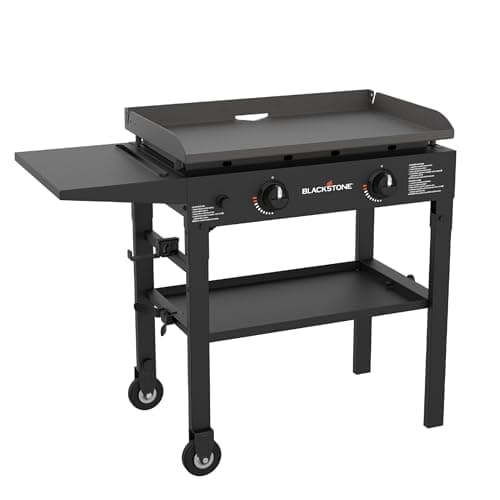
Blackstone Original 28-inch Omnivore Griddle (2-Burner)
Price as of October 20, 2026. #ad How we’re funded
What you are actually buying
A Blackstone is a slab of rolled steel over propane burners on a wheeled cart. There is no grate, no lid in the box on this model, and nothing electronic — which is the appeal. The decisions that matter are all about size and burner count, and the 28 sits deliberately in the middle of a four-model ladder that runs from a 17-inch tabletop to a 36-inch four-burner station.
The published figures for this one, read from Blackstone’s own product page and the Amazon listing:
- 524 square inchesof cooking surface — 45% more than the 22-inch tabletop, and about a third less than the 36.
- Two H-style burners, independently controlled, so you can run a hot half and a moderate half at the same time.
- 24,000 BTU total output.
- Rolled steel plate with built-in wind guards on the Omnivore version.
- Rear-mounted grease management, which is Blackstone’s patented system on this model.
We have not cooked on this unit. Everything on this page is read from the published spec sheet, the current listing, and arithmetic we do ourselves and label as ours — our methodology explains exactly what that means and what it does not.
The two burners are the point
It would be easy to read this as a size decision, and the more useful way to read it is as a zone decision. A single-burner flat-top like the 17-inch tabletop puts the whole plate at one temperature, which means cooking in sequence: burgers, then buns, then eggs, with everything cooling while it waits. Two independently controlled burners let you run the plate as two surfaces.
In practice that is what unlocks the three cooks people buy a griddle for. Breakfast needs bacon and hash browns hot while eggs and pancakes sit moderate. Smash burgers need the plate as hot as it goes on one side and buns toasting gently on the other. Fajitas need a searing zone and a holding zone so the first batch is still warm when the last one is done. The 28 does all three; the tabletops do them in relays.
What two zones will notdo is give you a third one. The 36 has four burners, which in practice means a sear zone, two working zones and a genuine holding area at the far end. If your normal cook is a weekend for a large family, that is a real difference — the 28 vs 36 comparison is entirely about that.
The wind guards are the underrated feature
This is the spec most reviews skip, and on an outdoor flat-top it does real work. A griddle heats only from below and has a large flat surface exposed to the air, so moving air strips heat off the plate continuously. Everyone who cooks on a flat-top in a breeze notices the same thing: the plate reads hot in the middle and will not brown anything near the edges.
Built-in wind guards on the Omnivore plate are a structural answer to that rather than an accessory. It is worth knowing that Blackstone sells bolt-on wind guards as a separate part for the 36, which tells you the company treats this as a real problem — on the 28 Omnivore you are not buying it twice. If you cook on an exposed deck or near the coast, this is the single line on the spec sheet most likely to change your experience.
Where the 28 loses: heat per square inch
Here is the arithmetic, which is ours and is the kind of thing we think a review should actually do rather than assert. Divide total output by cooking area across the Blackstone ladder, using each model’s own published figures:
| Model | Cooking area | Total BTU | BTU per sq in | Burners |
|---|---|---|---|---|
| 17-inch tabletop | 267 sq in | 12,500 | ~47 | 1 |
| 22-inch tabletop | 361 sq in | 24,000 | ~66 | 2 |
| 28-inch Omnivore | 524 sq in | 24,000 | ~46 | 2 |
| 36-inch 4-burner | 769 sq in | 60,000 | ~78 | 4 |
The 28 is the least heat-dense model in the lineup— it carries the same 24,000 BTU as the 22-inch tabletop across 45% more steel. That is the one genuinely unflattering fact about this griddle and we are not going to bury it.
What it means in practice is narrower than it looks. Steady-state cooking is unaffected: a preheated plate at a given temperature is at that temperature regardless of how it got there. What suffers is recovery— the moment a batch of cold food lands and pulls heat out of the steel. On the 36 the burners put it back faster. On the 28, cook in slightly smaller batches and give the plate a moment between them, and the gap mostly disappears. If smash burgers for ten people is your weekly event, buy the 36; if it is breakfast for five, this is a non-issue.
The maintenance nobody mentions before you buy
Every Blackstone cooking surface is bare carbon steel with no coating. That is not a flaw — it is what makes the thing cook the way it does — but it comes with a standing commitment that catches people out, and it is the most common reason a griddle ends up unused in a garage.
Two jobs, neither optional. Season it on day one, which means building a polymerized oil film by heating thin coats of oil past their smoke point three to five times — how to season a griddle has the method. Then after every single cook, scrape it hot, steam it with a little water, wipe it dry and put a thin coat of oil on the warm plate — about two minutes, covered in how to clean a Blackstone griddle.
Skip the oil step a few times in a wet climate and the plate goes orange. That is recoverable with a restoration kit and a reseason, and it is far easier to simply not let it happen. If a two-minute ritual after every cook sounds like too much, a gas grill with porcelain-coated grates is the honest alternative — see griddle vs grill.
What it does not come with
Three things worth budgeting for, because the box does not solve them.
A hood. This model is an open plate. A hood lets you trap heat to melt cheese and keeps weather off the surface between cooks, and Blackstone sells them as sized hardware per griddle size and generation. Without one, a melting dome does the first job for far less money.
Usable turners. A flat-top is cooked with long, stiff steel turners, not tongs, and the thin flexible spatula that ships with most griddles is the single most-replaced accessory in the category.
A cover.Water is the only thing that genuinely ruins a griddle. Covers are sized per model, and Blackstone alone sells several different 36-inch covers depending on whether the griddle has a hood — so measure before ordering, and see best grill covers for the three measurements to take.
How this is funded: we earn a commission if you buy through our links, at no extra cost to you. It never changes which product we recommend, and we’ll tell you when we’d skip one, or point you to a cheaper option when it’s the better buy. Full disclosure.
The model above, the model below, and the turner either one needs
Live prices, fetched and date-stamped. Both alternatives are the same plate and the same seasoning routine in a different footprint — the decision is burner count and how many people you feed.
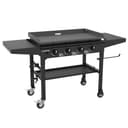
Blackstone 36-inch 4-Burner Griddle Cooking Station
769 sq in, four independently controlled burners and 60,000 BTU — the most heat-dense model in the ladder at about 78 BTU per square inch. Buy it if you host, smash burgers in big batches, or want a true holding zone.
Price as of October 20, 2026. #ad How we’re funded
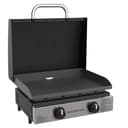
Blackstone 22-inch Tabletop Griddle with Hood
361 sq in across two burners with a hood, in a body that sits on a table and stores in a cupboard. Keeps the two-zone cooking that matters and gives up the cart and a third of the plate.
Price as of October 20, 2026. #ad How we’re funded
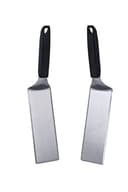
Blackstone Extra Long Griddle Spatula Set (5550, 2-piece)
Two long stainless turners — one for flipping, one for chopping and scraping the plate between batches. The turners that ship in the box are too short and too flexible, and this is the tool you will pick up every cook.
Who should buy it
Buy the 28 if you cook for four to six people, you have a patio or deck where it can live under a cover, and you want the full two-zone flat-top experience without a 36-inch footprint. It is the size most households actually need, and it is the one we would recommend by default.
Buy the 36 instead if you host regularly, cook in big batches, or want four zones. The extra heat density is the real upgrade, not the extra steel.
Buy a tabletop instead if the griddle has to travel or be stored indoors between cooks. The portable griddle roundup covers the 17, 22 and 28 for travel specifically.
Do not buy any griddle ifwhat you actually want is grill marks, open-flame char, or smoke. A flat-top is a large outdoor skillet and it does none of those — which is exactly why the people who own one tend to also own a grill.
Where to go next
The size decision in full is Blackstone 28 vs 36, and the tabletop pair is 17 vs 22. Before the first cook, read how to season a griddle; after it, what to cook on a griddle and best griddle for smash burgers are the two pages that pay the purchase off. The accessories worth owning, in buying order, are in best griddle accessories.
Frequently asked questions
Is the Blackstone 28 big enough for a family?
Yes, comfortably, for four to six people. 524 square inches is enough for about a dozen smash burgers in two batches, or a full breakfast of bacon, eggs, hash browns and pancakes running at the same time across two heat zones. Where it runs out is hosting: if you regularly cook for eight or more, or want a genuine holding zone as well as a sear zone, the four-burner 36 is the right size and the extra burners matter more than the extra steel.
What is the difference between the Blackstone 28 and 36?
Three things: 524 against 769 square inches, two burners against four, and 24,000 against 60,000 BTU. The burner count is the practical difference, because four lets you run a sear zone, two working zones and a holding area at once. The BTU gap also means heat density — about 46 BTU per square inch on the 28 against roughly 78 on the 36 — so the 36 recovers faster when cold food lands on the plate. The 28 fits a normal patio and costs considerably less.
How many BTU does the Blackstone 28 have?
24,000 BTU total across two independently controlled H-style burners, per Blackstone's published spec sheet. That is the same total output as the 22-inch tabletop spread over 45% more cooking surface, which works out to roughly 46 BTU per square inch — the lowest figure in the Blackstone ladder. It does not affect steady-state cooking temperature, but it does mean slower heat recovery after a cold batch of food hits the plate, so cook in slightly smaller batches.
Does the Blackstone 28 come with a hood?
The Omnivore model we track is an open plate with no hood included. Blackstone sells hoods as sized hardware per griddle size and generation, so one has to match your exact model rather than just the width. A cheaper way to get most of the benefit is a melting dome, which traps heat over part of the plate to melt cheese or steam vegetables for a fraction of the cost. For weather protection between cooks, a fitted fabric cover is the item to buy.
Do you have to season a Blackstone 28?
Yes, on day one and then continuously. The cooking surface is bare carbon steel with no coating, so what makes it non-stick is a polymerized oil film you build by heating thin coats of oil past their smoke point three to five times. After that, the routine after every cook is scrape it hot, steam it with a little water, wipe it dry and rub on a thin coat of oil. Skipping the oil step repeatedly in a wet climate is how griddle tops go orange.
What are the wind guards on the Blackstone Omnivore for?
They stop moving air stripping heat off the plate. A griddle heats only from below and presents a large flat surface to the air, so a breeze cools the perimeter faster than the burners can replace it — which shows up as a plate that reads hot in the middle and will not brown anything near the edges. On the Omnivore plate the guards are built in rather than a bolt-on accessory, which is a meaningful advantage if you cook on an exposed deck.
Can you smoke or grill on a Blackstone 28?
No to both, and that is worth being clear about before buying. A flat-top is solid steel with no grates, so there is no open flame reaching the food, no fat dripping to vaporize, no grill marks and no smoke. It is a large outdoor skillet, and it is better than a grill at eggs, pancakes, smash burgers, fried rice and fajitas. If you want char and smoke flavor as well, most griddle owners end up keeping a grill alongside it.
Is the Blackstone 28 worth it over a gas grill?
They do different jobs rather than competing. A griddle wins on anything small, loose or liquid — eggs, chopped vegetables, fried rice, smash burgers — because nothing falls through and the whole surface is cooking. A gas grill wins on thick steaks, bone-in chicken, anything you want grill marks on, and anything that benefits from fat dripping and flaring. If you already own a working gas grill, a griddle is an addition rather than a replacement.
Keep reading
Blackstone 28 vs 36 Griddle
The size decision in full — two burners or four, and how much flat-top you actually need.
Compare them →Blackstone 17 vs 22 Griddle
One rung down the ladder: the tabletop pair, where the second burner is the whole story.
Compare them →How to Clean a Blackstone Griddle
The two-minute routine this griddle commits you to after every cook, and the rust fix if you skip it.
Read the guide →What to Cook on a Griddle
Breakfast, smash burgers, fried rice, fajitas — what 524 square inches of steel is actually for.
Read the guide →