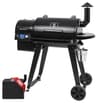
The good news about a sub-$1,000 pellet budget is that it buys nearly the whole category. A grand no longer gets you an entry-level box with a swingy dial controller and a hopper you refill every two hours — it gets you a wood-fired grillwith a real PID brain, a hopper big enough to run a brisket overnight, WiFi on most models, and on one pick here, a direct-flame hatch that sears a steak the way pellet grills are usually accused of not being able to. The question at this price isn’t whether you can afford a good pellet grill. It’s where you want the money to go, because every one of these five picks spends it differently.
Start with the controller, because it’s the part that does the actual cooking. A pellet grill is a wood-fired oven with a thermostat, and the thermostat is the whole game. Every grill on this list runs a PID controller — the algorithm that reads the chamber temperature many times a minute and trickles pellets to the fire in tiny corrections, holding a set 225°F within a tight band instead of overshooting to 260°F and sagging back to 200°F the way an older-style on/off controller does. PID is the single feature that separates a grill that smokes well from one that merely holds an average. The Z Grills, the recteq and the Pit Boss all run it; Traeger’s WiFIRE controller pairs it with an RTD temperature sensor, which is a more accurate probe than the cheap thermocouples some budget grills use. At this budget, PID is table stakes — and all five clear it.
Two of these five get a full single-grill write-up worth reading before you commit: the recteq Patio Legend 600 review explains why 304 stainless and a 700°F ceiling come at the cost of the smallest grate here, and Traeger vs Camp Chefcovers the step just above this budget, where the Woodwind Pro’s Smoke Box and ash cup start to justify the jump.
Next is hopper capacity, which is really a question of how long the grill runs before you have to think about it. The pellets live in a side bin and an auger feeds them in; a bigger bin means longer unattended cooks. The spread here is wide. The Pit Boss Navigator 850 carries a 30 lb hopper — enough for a long low-and-slow session start to finish without a top-up. The Traeger and the big Z Grills hold 20 lb, still comfortably an all-day cook. The recteq’s 18 lb and the portable Z Grills 450B’s 15 lb are the ones you’ll keep an eye on during a genuinely long overnight brisket. None of these is too small to smoke on; the bigger hoppers just let you walk away for longer.
Then there’s connectivity, and this is where the brand premium starts to show. Traeger’s WiFIRE app is the most polished in the business — you set temperatures, get probe alerts and run guided cooks from your phone across the house or the neighborhood. recteq’s dual-band WiFi and the Pit Boss’s WiFi plus Bluetooth do the same core job with less spit and polish; on the Pit Boss it’s included rather than sold as a step-up trim. The Z Grills 700D and 450B skip the app entirely at this trim — you get the same steady PID fire, controlled from the dial on the front. Whether that matters depends entirely on whether you actually want to watch a cook from your phone, or whether you set a temperature and let a probe thermometer do the watching.
Searingis the one thing most pellet grills genuinely can’t do, and it’s worth being honest about. Most of these top out around 500°F, which roasts a steak nicely but won’t lay down the hard, dark crust a screaming-hot grate gives you — the Traeger and the Z Grills sit in that camp. Two picks break out of it, in different ways. The Pit Boss Navigator 850’s Flame Broiler lever slides a plate aside to expose open flame under the grate for a real sear, up toward 1,000°F. The recteq Patio Legend 600 has no hatch at all — it simply runs to 700°F on convection heat, hot enough to build a crust without opening the firepot. If “I want to smoke ribs on Sunday and sear a steak on Tuesday without a second grill” describes you, those are the two to look at — and it’s why the Pit Boss, which goes hottest, takes best overall here.
Finally, the brand premium versus valueaxis, which is really what separates these five. A Traeger costs more than an equal-spec rival, and you’re paying for the largest accessory and support ecosystem in pellet, the best app, and the resale value that comes with the most recognized name in the category — a fair trade for a lot of upgraders, and the case we lay out in Traeger vs Pit Boss. Z Grills sits at the other pole: the most cooking area per dollar of anything here, honest PID cooking, and a smaller dealer network as the trade. Pit Boss and recteq split the difference — more grill than the Z Grills, less brand tax than the Traeger. There’s no wrong answer on this list, only the one that matches what you value.
Here’s who each pick is for, in one breath. The Pit Boss Navigator 850 is the do-everything pick — the most grill for the money, plus the sear hatch, plus a big hopper and WiFi. The Traeger Woodridge is for the cook who wants the app, the ecosystem and the resale value and will pay for them. The recteq Patio Legend 600is for the buyer who wants sear heat and materials — 700°F, 304 stainless grates and a four-year warranty. The Z Grills 700D is the value champion, maximum grate for minimum money. And the Z Grills 450Bis the one for a balcony, a campsite or a tailgate, where a 900-square-inch cabinet simply won’t fit. If you’re still deciding whether the format is right for you at all, read is a pellet grill worth it before you spend.
Two things matter more than the gap between any two of these grills, and both are cheap. First, pellets: budget for good food-grade hardwood pellets, not the filler bags, because a PID controller can only cook as cleanly as the fuel it burns. Second, a meat thermometer: the grill holds the chamber temperature, but doneness is the meat’s internal temperature, and no controller reads that for you. A cheap instant-read or a leave-in probe fixes more bad barbecue than any upgrade on this page. We didn’t test these five in a lab — we compiled every published spec, did the arithmetic, and read the consensus of real owners; exactly how is on our methodology page. If a grill shows “—” for a spec, the manufacturer doesn’t publish that number and we won’t invent one.