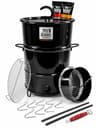
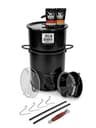
If you want one answer: buy the Pit Barrel Cooker Premier Series 18.5-inch. You set its single air intake once for your altitude, light a basket of charcoal, hang the meat from steel hooks and shut the lid. There is nothing else to adjust for the rest of the cook. 220 square inches on the hinged grate plus eight hanging hooks, which the maker rates at eight racks of ribs or two to three pork butts, at 62 lb and 36 inches tall.
Before the picks, the mechanism — because it explains every number on this page. A drum smoker is a vertical barrel with a charcoal basket at the bottom and the food hanging from rods at the top, with nothing in between. Fat and juice drip straight onto the coals and vaporize, which is where the flavor comes from. The food cooks from every side at once instead of from one side, which is why hang times are short. And because the fire is directly under the meat with no baffle, a drum runs hot by design — typically somewhere between 275°F and 300°F rather than the 225°F the internet treats as gospel. Ribs come off in about four hours instead of six. That is not a shortcut; it is a different cooker.
The four criteria we ranked on
This is the argument behind the order, and the part worth disagreeing with.
1. Whether you control the air, or the cooker does.This is the real fork in the category and it is not a quality difference. A Pit Barrel has one intake you set once and then leave; the cooker finds its own temperature and holds it, and you cannot meaningfully change it. A Bronco has an adjustable airflow system and a diffuser plate, so it will run low for a brisket or open right up to grill over the coals. The first design removes a skill you then never need; the second gives you a range you then have to learn. Which one is “better” depends entirely on whether fire management is the part of barbecue you enjoy.
2. Hanging capacity, not grate area.Grate square inches badly understate a drum, because hanging uses the barrel’s height rather than its floor. The Pit Barrel 18.5 lists 220 square inches of grate and is rated for eight racks of ribs — a figure no 220-square-inch kettle could approach. So the spec table on this page carries both numbers, and the capacity each maker publishes is the one to read if you are deciding whether a barrel will feed your family.
3. Fuel capacity, because it sets the ceiling on unattended time. A drum that holds 8 lb of charcoal is a six-to-eight-hour cooker; one that holds 17 lb can genuinely be left overnight. That single number is the difference between a ribs-and-chicken machine and something you can put a packer brisket on at ten at night. It is the reason the ranking below is not simply ordered by size.
4. Weight, which decides where the cooker lives. The spread here is enormous for one category: 38 lb to 162 lb. A 38 lb barrel goes in a car; a 62 lb barrel moves across a patio; a 162 lb barrel needs a permanent spot and two people to position it. Nothing else on the spec sheet changes the ownership experience as much, and nobody ranks on it.
What this page is not
It is not a test.We own none of these barrels and have cooked on none of them. Every figure quoted on this page and in every product card comes from the manufacturer page named inside that card — and where a maker contradicts itself, we print the figure from its own comparison table and say so. Pit Barrel’s FAQ gives the 18.5-inch capacity as “8 to 10 racks” while its product description says eight; we print eight. The ranking is editorial reasoning from published specs, which is what our methodology commits to and all it commits to.
It is not the whole category.The names a competition cook would recognize — Gateway, Hunsaker, Big Poppa’s — are direct-order businesses with no retail listing we can verify a live price against, so they are not on this page and are not in our registry. We would rather tell you they exist than pretend the four cookers below are the entire market. They are the four you can buy today through the channel this site earns from, and they genuinely cover the useful range.
And it is not an offset-smoker page.A drum and an offset are both charcoal-and-wood cookers and they do different jobs. An offset puts the fire in a separate box and pulls heat across the food, which is what produces a sharp smoke ring, heavy bark and the ability to hold 250°F for fourteen hours. A drum puts the fire underneath. If the long-cook ritual is what you want, best offset smokers for beginners is the right page instead, and grilling vs smoking is the step before that.
The one accessory this category genuinely requires
A leave-in probe thermometer, and not for the reason you think.On a drum you are not using it to manage the pit — on two of these four picks there is nothing to manage. You need it because hanging meat cannot be judged by eye or by a lid gauge, and because a drum runs hotter than you expect, so the cook finishes earlier than any recipe written for a 225°F offset. Two of these barrels ship without a thermometer of any kind. Our best meat thermometerspage covers the options, and the USDA’s own guidance — cited at the foot of this page — is blunt that color is not a doneness test and a thermometer is.
The four, at a glance
Read the second column first. It is the decision; everything else is sizing.
| Smoker | Air control | Fuel load | Buy it if |
|---|
| Pit Barrel 18.5" | Fixed — set once, never touched | Basket (one-cook) | You want barbecue, not a hobby |
| Oklahoma Joe’s Bronco 18" | Adjustable + diffuser plate | Up to 8 lb | You want to pick the temperature |
| Oklahoma Joe’s Bronco Pro 21.5" | Adjustable + diffuser plate | 17 lb | You cook overnight or for a crowd |
| Pit Barrel Junior 14" | Fixed — set once, never touched | Basket (small) | The cooker has to travel |
Where the money goes in this category
Prices move, so the live number in each row above is the one to trust. The shape of the spend is stable:
- The bottom of the range buys the method, not the hardware. A small barrel, four hooks, a basket and one fixed vent. It cooks exactly like the bigger one; it just cooks less food and runs out of fuel sooner.
- The middle buys either capacity or control, and you choose one.Around the same money you can have a simple 18.5-inch barrel with eight hooks, or a heavier 18-inch barrel with adjustable vents, a diffuser plate and split grates. More hooks or more range — not both.
- The top buys fuel capacity, which is the only thing here you cannot work around. You can stand next to a cheap barrel. You cannot refuel one at three in the morning without opening it and losing the cook, which is exactly what a 17 lb load exists to prevent.
- Then there is the running cost, which is low. A drum is the most fuel-efficient charcoal cooker on this site after a kamado, because the fire is small, enclosed and burning upward into the food rather than across a long chamber. How long a bag of charcoal lasts does that arithmetic, and lump vs briquettesmatters here — a basket wants uniform fuel, which is the one place briquettes genuinely win.
If you are cross-shopping outside the category at similar money, best budget offset smokers and best pellet grills under $1,000 are the two nearest alternatives, and Black Friday BBQ deals records which classes of cooker have actually discounted in past Novembers.
How to get the most out of any of them
Four things make a bigger difference on a drum than the choice between these four models.
- Hang, do not grate, whenever the food will hang. Ribs, chicken halves, pork butt and whole birds all hang, and hanging is the point of the cooker: all-round heat, fat dripping on the coals, and far more capacity than the grate number suggests. Use the grate for brisket flats, fish, vegetables and anything that would fall off a hook.
- Stop fighting the temperature.A drum wants to run around 275°F to 300°F. That is a feature: collagen renders faster, skin actually crisps, and ribs are done in roughly four hours. Recipes written for a 225°F offset will finish early on a drum, so cook to internal temperature and feel, not to the clock — the meat smoking temperature chart is the reference to keep open.
- Use chunks, not chips, and only two or three. A drum is a small sealed column and smoke concentrates in it. Two fist-sized chunks buried in the basket is plenty for a whole cook; a handful of chips burns off in minutes and a full load of wood makes the food bitter. Our best wood for smoking page covers species and format.
- Set the intake for your altitude and then leave it alone. On the fixed-vent barrels this is the only setup step there is, and higher elevation needs the vent further open because there is less oxygen per lungful of air. Getting it right once is the whole learning curve. On the Bronco, make small adjustments and wait ten minutes before judging whether one worked — the same discipline as running an offset, with far less to do.
Who should not buy a drum smoker
Three groups, and we would rather say it here than sell you the wrong cooker.
If you want heavy bark and a sharp smoke ring, buy an offset. A drum produces excellent smoked meat and a good ring, but the bark it builds is softer, because hanging in a humid column of vaporized fat is a moister environment than the dry convective flow of an offset. That moisture is why the food is so forgiving and why the cooker is so easy; it is also why competition cooks who want a crust use something else. The Oklahoma Joe’s Highland is the offset most upgraders start with, and reverse-flow vs traditional is the decision after that.
If you want one cooker that also grills and sears properly, look at a kamado or a gravity-fed charcoal grill.The Bronco will grill over its coals, and that is genuinely useful, but a barrel is a tall narrow box with a deep fire — it is not a steak machine. A ceramic or steel kamado does both jobs well (see offset vs kamado), and a Masterbuilt Gravity Series 800 holds a smoking temperature by thermostat and then reaches 700°F in minutes.
If you want to set a number and walk away for twelve hours, buy a pellet grill or an electric cabinet. A fixed-vent drum is wonderfully simple but it is not programmable: you get the temperature the cooker gives you, and when the basket is spent the cook is over. Best pellet grills for beginners is the page for set-and-forget with real wood, and best electric smokers is the cheapest route to walking away entirely.
Where to go next
The best first cook on any barrel here is ribs, because hanging is what a drum is uniquely good at and four hours is a forgiving afternoon — how to smoke ribs gives the method, and the timings run short on a drum for the reasons above. After that, how to smoke a whole chicken is the cook a drum does better than almost anything else, because 300°F in a humid column is exactly what poultry skin needs. For gear, what you need for a smoker is the short list, and it starts with the thermometer for the reason given above.