Oklahoma Joe's Highland Reverse Flow Review
The offset most upgraders should start with — reverse-flow baffles that even out the heat, convertible airflow, and heavy-enough steel at a hobbyist price. Here's an honest, spec-driven look at what it is, what it isn't, and who should buy it.
Quick answer
The Oklahoma Joe’s Highland Reverse Flow is the offset we recommend to most upgraders. Its reverse-flow baffles even out the hot spot that ruins cheap offsets, it converts to a traditional smokestack when you want it, and it’s heavy-enough steel at a price a hobbyist can justify. It still needs a fire managed — and a gasket kit — but it’s the most forgiving real offset at this money.
How this is funded: we earn a commission if you buy through our links, at no extra cost to you. It never changes which product we recommend, and we’ll tell you when we’d skip one, or point you to a cheaper option when it’s the better buy. Full disclosure.
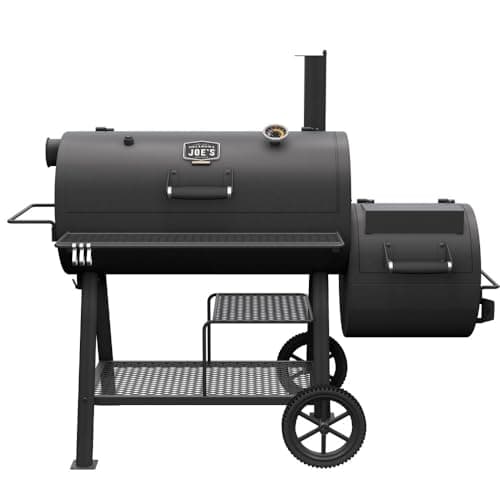
Oklahoma Joe's Highland Reverse Flow Offset Smoker
Price as of September 21, 2026. #ad How we’re funded
What it is
The Highland Reverse Flow is Oklahoma Joe’s mid-size horizontal offset smoker, set up from the factory to run reverse-flow. Instead of letting heat draft straight from the firebox across the food and out a far-side chimney — the traditional layout that always runs hot near the firebox — the Highland uses a set of baffle plates under the cooking grate to push heat and smoke down the length of the chamber and back before it exits near the firebox end. The result is a chamber that cooks far more evenly than a cheap traditional offset, which is exactly what a newer offset cook needs. It gives 619 sq in of primary cooking area (1,093 sq in total with the warming rack), enough for two full briskets or a big load of ribs.
Build and steel
The Highland is built from a heavy-gauge steel with a high-temp finish — genuinely heavier than the thin barrel offsets in the sub-$300 tier, though not as thick as the 2.5 mm cold-rolled chamber on the bigger Longhorn. In practice that means the Highland holds temperature well for its price, but it will respond to weather — a cold, windy day pulls heat out of it faster than out of a heavier pit, so you feed the fire a little more often. This is the honest reality of an offset at this money: you’re buying enough steel to cook well and learn on, not a custom pit that holds 250°F through a blizzard. For most backyard cooks in most weather, it’s plenty.
Reverse-flow, and the convertible trick
The reverse-flow baffles are the reason this is our top pick for upgraders. They trade a little peak efficiency and add a bit of cleanup (grease pools on the plates and has to be wiped down after greasy cooks) in exchange for a much more even chamber — and evenness is forgiveness. You spend less of your first several cooks chasing a hot end and more of them actually learning to hold a clean fire. Better still, the Highland Reverse Flow is convertible: pull the baffle plates and move the smokestack to the far end and it runs as a traditional offset. That means you can learn on the forgiving reverse-flow setup and later experiment with a traditional hot-end layout for grilling or multi-zone cooking, without buying a second smoker. Few offsets at this price give you both. We go deeper on the trade in reverse-flow vs traditional.
Living with it
Assembly takes an afternoon, and — like nearly every offset in this class — the Highland ships with lid and firebox-door seals that leak a little out of the box. The single best thing you can do is add a gasket kit(about $20) to seal those gaps; it stops the small air leaks that cause temperature swings and it’s the near-universal first mod owners make. Beyond that, it’s a straightforward smoker to run: light a clean fire in a chimney, build a small hot fire in the firebox, and manage the intake damper to hold roughly 225–275°F. It’s lighter and easier to move around a patio than the Longhorn, which makes it the more livable of the two if your smoker has to share space or get wheeled into a garage. Our how to use an offset smoker guide covers the fire-management basics, and how to season an offset walks through the burn-in before your first cook.
Where it falls short
No offset at this price is set-and-forget, and the Highland is no exception: it wants a fire managed every 30 to 60 minutes for the length of a cook, and its heavy-gauge (rather than heavy-plate) steel means it’s more weather-sensitive than a custom pit. The reverse-flow plates add cleanup after greasy cooks. And if you routinely cook for a crowd or want the absolute steadiest temperature, the heavier Longhorn or the Longhorn Reverse Flow is the better — if pricier and much heavier — buy. If you don’t want to manage a fire at all, an offset is the wrong tool entirely; read offset vs pellet before you spend, because a pellet grill may be what you actually want.
Who should buy it
Buy the Highland Reverse Flow if you’re an upgrader moving up from a kettle or a cheap barrel, you want to learn real fire management, and you want the most forgiving offset at a price a hobbyist can justify. It’s the pick for someone who values even heat and flexibility over maximum steel mass, who has a bit of space but not a dedicated concrete pad for a 226 lb pit, and who’s willing to add a $20 gasket kit and buy a probe thermometer. It is, for exactly these reasons, our overall top pick in the best offset smokers roundup. If you want heavier steel and more room and don’t mind the weight and price, compare it against the Longhorn before you decide.
Frequently asked questions
Is the Oklahoma Joe's Highland Reverse Flow a good smoker?
Yes — it's our top pick for most upgraders. The reverse-flow baffles even out the hot spot that plagues cheap offsets, it converts to a traditional smokestack setup when you want it, and it's heavy-enough steel at a hobbyist price with 619 sq in of primary cooking area. It still needs a fire managed and benefits from a $20 gasket kit, but among real offsets at this money it's the most forgiving to learn on and live with.
Does the Oklahoma Joe's Highland need modifications?
One mod is close to essential and cheap: a gasket kit (about $20) to seal the lid and firebox door, which leak a little out of the box and cause temperature swings. Beyond that, most owners are happy stock — the reverse-flow baffles already even out the heat, so you don't need the tuning plates a traditional offset often wants. A good probe thermometer isn't a mod but is the other must-buy alongside the smoker.
How big is the Oklahoma Joe's Highland Reverse Flow?
It offers 619 square inches of primary cooking area and 1,093 square inches total including the warming rack — enough for two full briskets or a big load of ribs. That makes it a mid-size offset: substantial cooking capacity for a family or a small gathering, without the weight and footprint of the larger Longhorn. If you routinely cook for a crowd, the Longhorn's bigger main chamber may suit you better.
Can you convert the Highland Reverse Flow to a traditional offset?
Yes. The Highland Reverse Flow is convertible: remove the reverse-flow baffle plates and reposition the smokestack to the far end, and it runs as a traditional offset with a hotter firebox end. That flexibility is a real advantage — you can learn on the forgiving reverse-flow setup and later run a traditional layout for grilling or multi-zone cooking, all with one smoker.
Highland Reverse Flow or Longhorn — which should I buy?
Choose the Highland Reverse Flow for a lighter, cheaper, more forgiving offset with even heat and convertible airflow — the better first serious offset. Choose the Longhorn for heavier 2.5 mm cold-rolled steel that holds temperature harder and a larger main chamber, at the cost of weight (around 226 lb) and price. Our Highland vs Longhorn comparison breaks the decision down spec by spec.
Keep reading
Highland vs Longhorn
The two Oklahoma Joe offsets compared on steel, area and airflow — which one fits you.
Read the comparison →Best Offset Smokers
All seven offsets we rank, on steel gauge, cooking area and price.
See the roundup →How to Smoke a Brisket on an Offset
Trim, season, hold 250°F, ride the stall and wrap — the first-brisket walkthrough for a new offset owner.
Read the guide →