Weber Kettle vs Kamado
The question every kettle owner eventually asks. A 22-inch Master-Touch gives you 443 square inches; a Kamado Joe Classic II gives you 256 for roughly five times the money. So what exactly does the ceramic buy — and is it the upgrade you actually want?
Quick answer
Keep the Weber kettleif you grill: 443 sq in against 256, a tenth of the weight, and it does everything a kettle is asked to do for roughly a fifth of the price. Move to a kamado if yousmoke, bake or sear at extremes — 1.25 in of ceramic holds 225°F for many hours on a single load of charcoal and climbs past 750°F for pizza, neither of which a thin-steel kettle does without constant attention. The kamado is not a better grill. It is a different tool that happens to grill.
The two numbers that frame everything
A Weber Master-Touch 22 publishes 443 square inchesof cooking area — 363 on the main grate plus an 80-square-inch warming rack. A Kamado Joe Classic II publishes 256 square inches on an 18-inch grate. The kettle gives you 73% more cooking surface, and it does so at a fraction of the price. Both live prices are in the block further down this page, refreshed daily.
That is a genuinely awkward fact for the kamado, and most comparisons skip past it. If your cooking is burgers for six, chicken pieces, vegetables and the occasional spatchcocked bird, the kettle is not the compromise option — it is the correct answer, and the kamado would be a downgrade in capacity that costs several times more. Capacity is the kettle’s argument, and it is a strong one.
Everything the kamado has to say in reply is about walls.
What 1.25 inches of ceramic actually does
A kettle is a thin steel bowl. A kamado is a 188-pound ceramic vessel with walls an inch and a quarter thick. That mass does three things no amount of kettle technique replicates.
It holds temperature with almost no input.Thin steel exchanges heat with the outside world constantly, which is why running a kettle at a steady 225°F for eight hours means managing vents, watching the weather and adding fuel. A kamado stabilises and then simply stays there. Wind, a cold night and a dropping ambient temperature move it far less, because the fire is heating a heavy insulated box rather than fighting a sheet of metal.
It burns much less charcoal. Less heat escaping means less fuel needed to replace it. A kamado on a long low cook is remarkably frugal, and kamado owners routinely close the vents at the end, snuff the fire and relight the same unburned lump next time. A kettle on the same cook burns through noticeably more. Over years of cooking that difference is real money, though it will not come close to repaying the purchase price.
It reaches and holds extremes. Kamado Joe publishes 225–750°F+for the Classic II. The high end is the part people underrate: 700°F-plus with a stone in makes a kamado a genuine pizza oven, and that is a thing a kettle cannot do safely or for long. The ceramic radiates heat back at the food from every direction, which is a different cooking mechanism from a grate over coals.
What the kettle does better than people admit
Three things, and they are not small.
It is light and movable. 188 pounds of ceramic is where it is installed. A kettle rolls, travels, moves out of the wind and goes in the garage. If you rent, move house, or want the grill somewhere different in summer and winter, that matters more than any spec.
It is nearly unbreakable and cheap to fix.Ceramic cracks. Thermal shock — cold water on a hot dome, a hard knock in winter — can end a kamado, and while warranties on ceramic are generally good, the inconvenience is substantial. A kettle’s worst case is rust, it has a 10-year warranty on the bowl and lid, and every wear part is a cheap, stocked commodity.
Its hardware is better for live-fire grilling. The Master-Touch specifically carries a hinged GBS grate, which lets you add charcoal mid-cook without lifting food off, a One-Touch high-capacity ash catcher, which makes cleanup a twenty-second job, and a built-in lid thermometer. On a kamado, adding fuel mid-cook is a genuine production and ash removal needs a dedicated tool.
Side by side, on published figures
| What you are comparing | Weber Master-Touch 22 | Kamado Joe Classic II |
|---|---|---|
| Cooking area | 443 sq in (363 + 80 rack) | 256 sq in (18 in grate) |
| Wall construction | Porcelain-enamelled steel bowl | 1.25 in ceramic |
| Published temp range | Not published as a range | 225–750°F+ |
| Weight | Rolls on two wheels | 188 lb |
| Cooking grate | GBS hinged plated steel | Divide & Conquer multi-level |
| Ash cleanup | One-Touch, high-capacity catcher | Ash drawer, needs a dedicated tool |
| Lid thermometer | Built in | Built into the Kontrol Tower top vent |
| Warranty | 10-yr bowl & lid | Per Kamado Joe’s published ceramic terms |
Every figure is read from each manufacturer’s own product page and the current listing; where a maker does not publish a row we say so rather than printing a guess. We own neither unit — our methodology explains what we do instead.
The honest upgrade question
If you already own a kettle, the right question is not “which is better” but “what am I currently unable to do?” There are really only three answers that justify a kamado:
- Long smokes are a fight. You want to put a pork shoulder on at 10pm and sleep. On a kettle that means the snake method and a monitor; on a kamado it means setting the vents. If this is you, the ceramic is the upgrade.
- You want to bake.Pizza at 700°F, bread, anything where radiant heat from all sides is the point. A kettle genuinely cannot do this well.
- Fuel and fire management annoy you.Not the cost — the fiddling. A kamado asks far less of you per cook.
If none of those is true, the money is better spent on the kettle you already own: a hinged grate, a four-probe monitor and a bag of good lump will change your cooking more than a ceramic will. And if long smoking isthe goal but ceramic money isn’t available, learn the snake method on a kettlefirst — it is free and it answers the first bullet surprisingly well.
How this is funded: we earn a commission if you buy through our links, at no extra cost to you. It never changes which product we recommend, and we’ll tell you when we’d skip one, or point you to a cheaper option when it’s the better buy. Full disclosure.
The kettle, the ceramic, and the steel kamado in between
Live prices from our daily refresh. The AKORN is the honest middle option: the kamado shape and most of its behavior in triple-wall steel, with more grate than the ceramic and a fraction of its weight.
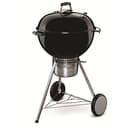
Weber Master-Touch 22-inch Charcoal Grill
443 sq in, a hinged GBS grate for mid-cook fuel, One-Touch ash cleanup and a 10-year bowl and lid warranty.
Price as of October 13, 2026. #ad How we’re funded
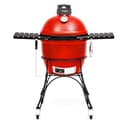
Kamado Joe Classic II 18-inch Ceramic Grill
1.25 in ceramic, 225-750°F+, Divide & Conquer racking and the fuel efficiency that comes with 188 lb of insulated mass.
Price as of October 13, 2026. #ad How we’re funded
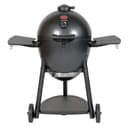
Char-Griller AKORN Kamado Charcoal Grill
447 sq in total in triple-wall 22-gauge steel, 200-700°F and 100 lb — the kamado shape without ceramic money or ceramic weight.
Price as of October 13, 2026. #ad How we’re funded
The option most people miss: a steel kamado
The Char-Griller AKORN is a kamado-shaped cooker built from triple-wall 22-gauge steel with an air gap instead of ceramic. It publishes 447 square inchesof total cooking area — more than the Master-Touch and far more than the Classic II — a 200–700°F range, and a 100-pound weight that is half the ceramic’s.
It holds heat better than a kettle and worse than ceramic, it heats up faster than either, and it cannot be cracked by thermal shock. For a kettle owner who wants to find out whether the kamado shape suits how they cook before committing serious money, it is the rational experiment. The trade-offs in detail are in ceramic vs steel kamado, and the head-to-head against the ceramic benchmark is AKORN vs Kamado Joe.
Who should buy which
Buy the kettle if grilling is the main event, if you need the grate space, if the grill has to move, or if you simply want the most capable charcoal cooker for the least money. It is the right default and the reason it has outlived every trend.
Buy the kamadoif low-and-slow smoking or high-heat baking is what you actually want to do, and you accept paying several times more for less grate in exchange for a cooker that holds a line without supervision. That is a completely defensible trade — it is just not the trade most buyers think they are making.
The full field on each side is in best charcoal grills and best kamado grills.
Frequently asked questions
Is a kamado better than a Weber kettle?
Not better — different. A Weber Master-Touch 22 publishes 443 sq in of cooking area against a Kamado Joe Classic II's 256, for roughly a fifth of the price, so on grilling capacity the kettle wins decisively. What the kamado buys is 1.25 in of ceramic: it holds a low temperature for many hours with almost no input, burns far less charcoal, and reaches past 750°F for pizza and baking. If you grill, keep the kettle. If you smoke overnight or bake, the ceramic is the real upgrade.
Does a kamado hold temperature better than a kettle?
Yes, by a wide margin, and it is the main reason to buy one. A kettle is a thin steel bowl that exchanges heat with the outside air constantly, so holding 225°F for eight hours means managing vents, watching the wind and adding fuel. A kamado's 188 lb of inch-and-a-quarter ceramic means the fire is heating a heavy insulated box instead of fighting a sheet of metal — it stabilises and stays there, and a cold night moves it far less.
Can you smoke on a Weber kettle?
Yes, and well. The standard technique is the snake method: a line of briquettes two wide and two high around the inside edge of the bowl, lit at one end, which burns slowly along the line for hours and holds roughly 225-275°F. A Master-Touch's hinged grate also lets you add fuel mid-cook without lifting the food. It takes more attention than a kamado and a two-probe thermometer is close to essential, but it genuinely works.
How much charcoal does a kamado save?
Enough to notice on every long cook, though not enough to repay the purchase price. Less heat escaping through the walls means less fuel needed to replace it, so a kamado on a low-and-slow cook is remarkably frugal. Kamado owners also routinely close both vents at the end to snuff the fire, then relight the same unburned lump next time — something a kettle does far less effectively because it does not seal as well.
What about a steel kamado like the Char-Griller AKORN?
It is the sensible middle option and the one most buyers overlook. The AKORN uses triple-wall 22-gauge steel with an air gap instead of ceramic, publishes 447 sq in of total cooking area — more than a Master-Touch — a 200-700°F range and a 100 lb weight, at a price between the two. It holds heat better than a kettle and worse than ceramic, heats faster than either, and cannot be cracked by thermal shock. It is the rational way to test whether the kamado shape suits you.
Keep reading
Ceramic vs Steel Kamado
Thick ceramic or triple-wall steel — heat retention, weight, durability and price, compared for the way you cook.
Compare them →The Snake Method on a Weber Kettle
How to hold 225°F for hours on a kettle with a line of briquettes — the free answer to most of the kamado's advantage.
Read the guide →Weber Master-Touch vs Performer
The two upgraded 22-inch kettles, on grate hardware, work surface and price.
Compare them →