Kamado Joe vs Primo
Every other ceramic kamado is a round egg. Primo's is an oval, and that single design decision changes what the cooker can do — for better in one specific way, and for worse in another.
Quick answer
Buy the Kamado Joe Classic IIfor the best-equipped round ceramic and the widest accessory market — Divide & Conquer racks, a proper hinge, and it’s on Amazon. Buy the Primo Oval XL 400if you want genuine two-zone cooking inside a ceramic, more grate area, and a US-made body with a 20-year ceramic guarantee — accepting a much smaller accessory market and a thinly stocked listing.
How this is funded: we earn a commission if you buy through our links, at no extra cost to you. It never changes which product we recommend, and we’ll tell you when we’d skip one, or point you to a cheaper option when it’s the better buy. Full disclosure.
| Spec | 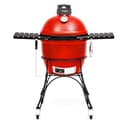 | 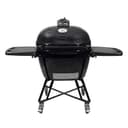 |
|---|---|---|
| Cooking area | 256 sq in (18 in) | 400 sq in (oval) |
| Shape | Round | Patented oval (two-zone) |
| Sold via | Amazon + authorized dealers | Amazon + authorized dealers |
| Price | $1,499.00 · View on Amazon Price as of October 21, 2026. #ad How we’re funded | $2,299.00 · View on Amazon Price as of October 21, 2026. #ad How we’re funded |
The oval, and why it exists
Every ceramic kamado descends from a round pot, and round is the shape that makes a kamado work: the dome reflects heat evenly onto everything under it, which is why a ceramic cooker is so good at holding a steady low temperature. It is also the shape’s one real limitation. In a round firebox, a bed of charcoal radiates towards the center from every direction, so a genuine hot side and cool side is difficult to create and harder to keep.
Primo’s patented oval solves precisely that. An elongated firebox lets you bank charcoal at one end and leave the other end empty, which gives you a real searing zone and a real indirect zone on the same cooker at the same time — the two-zone fire that is standard practice on a charcoal kettle but awkward in a round ceramic. If you have ever wanted to sear steaks and finish them gently without moving anything, that is the argument for the oval, and it is a real one.
The published numbers
Primo publishes 400 square inches of primary cooking area with a further 280 square inches available from its optional rack system. The Kamado Joe Classic II publishes 256 square inches on an 18-inch round grate, with its Divide & Conquer system adding a second tier. On raw primary area, the Primo is substantially larger — but note the comparison is not quite like for like, because the Classic II is Kamado Joe’s mid-size cooker rather than its largest, and Primo makes smaller ovals as well. The right way to read those figures is as a shape difference, not a brand ranking: an oval simply fits more grate under the same dome height.
Accessories and the hinge: Kamado Joe
Kamado Joe’s reputation is built on what comes in the box and what you can bolt on afterwards. Divide & Conquer — a multi-level, half-moon rack system — is genuinely useful and ships as standard, the air-lift hinge makes a heavy ceramic lid trivial to open one-handed, and the accessory market around the round kamado format is enormous because every round kamado is roughly the same shape as every other one. A round pizza stone, deflector, rotisserie ring or cast-iron griddle from a third party will very likely fit.
That is exactly what the oval gives up. Oval accessories are a specialist market with far fewer makers, and a round accessory does not fit an oval cooker. If you enjoy building out a cooker over years, that gap is the single strongest argument against the Primo, and it is worth more consideration than the cooking difference.
Where you buy it, and what that means
Both of these are buyable online, which is worth stating plainly because it did not used to be true of the Primo and a lot of writing about this brand still says otherwise. The Classic II is sold on Amazon and through dealers. The Oval XL 400 also lists on Amazon — as the All-in-Onepackage, meaning the ceramic oval in its cradle with side shelves rather than a bare grill head — alongside Primo’s authorized dealer network, which is still where you go if you want hands-on setup, a floor model to look at or an in-table build.
The real caveat on the Primo is not where you buy it but how much of it there is. The Amazon listing runs thin — only a handful of units showed when we last checked it — so the price in the table above can become a “check price” link without warning, and a dealer may simply be the faster route on any given week. That is a different situation from Big Green Egg, which genuinely is dealer-only: there is no Egg cooker listing on Amazon at all, and the link on that page goes to Big Green Egg purely as a cited spec source.
Both products in the table above now carry a live price, updated daily. Neither number appears in this text, because a price written into prose is wrong within a month and the table is the only place a number belongs.
Made in the USA and the ceramic guarantee
Primo manufactures in the United States and publishes a 20-year guarantee on the ceramics, which is worth something concrete: the body of a ceramic kamado is the part that cannot be replaced, and it is the part most likely to outlive every piece of hardware bolted to it. Kamado Joe’s Classic II publishes 1.25-inch ceramic walls, which is a thickness spec rather than a warranty, and its own long-term coverage is a matter for the current warranty terms at the point of sale. Neither company’s ceramic is a weak point in practice; the difference is mostly about who you would rather deal with in a decade.
Which should you buy?
Kamado Joe Classic II if you want the easiest ownership experience: the best stock hardware in the category, a huge accessory market, straightforward online buying and a well-known support path. It is the default recommendation for most people, and it is our pick in the best kamado grills roundup for that reason.
Primo Oval XL 400if the oval firebox solves a problem you actually have — if you want to sear and roast simultaneously in one ceramic, or you want more grate under one dome — and you are comfortable with a narrower accessory market and a listing that is not always in stock. It is a specialist answer, and it is the right one for a specific kind of cook.
If neither shape is the deciding factor and you are mostly weighing ceramic against the alternatives, read Big Green Egg vs Kamado Joe for the other classic ceramic matchup, and ceramic vs steel kamado for the cheaper way into the format.
Frequently asked questions
Is Primo better than Kamado Joe?
They're built for different priorities. Primo's oval firebox lets you bank charcoal at one end for genuine two-zone cooking, which a round kamado does poorly, and it publishes more primary cooking area plus US manufacture and a 20-year ceramic guarantee. Kamado Joe has the better stock hardware — Divide & Conquer racks and an air-lift hinge — and a vastly larger accessory market, plus you can buy it online. Most people are better served by the Kamado Joe.
What is the advantage of an oval kamado?
Two-zone cooking. In a round firebox, charcoal radiates towards the center from all directions, so creating a distinct hot side and cool side is difficult. An elongated oval firebox lets you bank the charcoal at one end and leave the other empty, giving you a searing zone and an indirect zone on the same cooker at the same time. An oval also fits more grate area under the same dome height.
Is Primo sold on Amazon?
Yes. The Oval XL 400 lists on Amazon as the All-in-One package — the ceramic oval in its cradle with side shelves — so there is a live online price for it, and that is what the table on this page shows. Primo's authorized dealer network is still the route for an in-table build, a floor model or hands-on setup. The one thing to watch is stock: the Amazon listing is thinly supplied, so availability can lapse. This is unlike Big Green Egg, which genuinely has no cooker listing on Amazon at all.
Are Primo grills made in the USA?
Yes — Primo manufactures its ceramic grills in the United States and publishes a 20-year guarantee on the ceramics. That's a meaningful claim on a kamado specifically, because the ceramic body is the one component you can't replace and the one most likely to outlast every piece of hardware attached to it. Most competing ceramic kamados are manufactured in Asia.
Do Kamado Joe accessories fit a Primo?
No. Round kamado accessories — deflectors, pizza stones, rotisserie rings, cast-iron grates — are built to a roughly standard round format that fits across brands, and none of them fit an oval. Primo accessories are a much smaller specialist market with far fewer makers. If building out a cooker with third-party gear over the years matters to you, that's the strongest practical argument for a round kamado.
Keep reading
Kamado Joe Classic II Review
The ceramic kamado that out-features the Big Green Egg for less — examined on its own.
Read the review →Ceramic vs Steel Kamado
Thick ceramic or triple-wall steel — heat retention, weight, durability and price.
Compare them →How to Cook Pizza on a Kamado
The cook a ceramic grill is unreasonably good at, and the one most people ruin in two minutes. The stack from the charcoal up, the temperature per style, and why the air gap under the stone decides it.
Read the guide →