A grill cover is the least interesting thing you will ever buy for a grill and one of the few that genuinely extends its life. It is also the accessory category with the worst information on the market, and the reason is simple enough to state in one sentence: the only specification that matters is whether it fits, and most sellers publish a single number — the width — and nothing else.
That is not a rhetorical complaint. Of the eight covers on this page, which include two from Weber, one from Traeger, one from Char-Broil and one from Blackstone, exactly two publish all three dimensions. Everything else gives you a width in the product name, sometimes a cooker model, and asks you to guess the rest. You can see it for yourself in the Dimensions column of the table below: most of that column is empty, because we print what a maker publishes and nothing else. The two that fill it in are the two we rank first and seventh, and that is not a coincidence.
So before any of the picks, here is the part of this page that will save you a return. Take three measurements with a tape, not from the listing of your grill.Width, with the lid closed and the side tables in whatever position you intend to leave them. Depth, front to back, including the handle and any rear heat shield. And height, from the ground to the top of the lid — not from the cart surface, because a cover has to reach down past the wheels or the wind gets under it. Write those three numbers down. Then buy a cover whose published width is a couple of inches more than yours, and treat any cover that does not publish a depth and height as a gamble you are taking knowingly.
What a cover is actually protecting, and it is different on every cooker
“Keeps the rain off” is true and useless. What water does to a grill depends entirely on what kind of grill it is, and the right cover is the one that addresses your cooker’s own failure mode.
On a gas grill, the vulnerable parts are the burner tubes, the igniter and the control panel. Burner tubes are thin steel with small ports drilled along them; water gets in, rust forms inside the tube, the ports partially block and the flame pattern goes uneven. That is the single most common reason a five-year-old gas grill has a cold spot, and it is why we treat a cover as a maintenance item rather than a cosmetic one in the gas grill buying guide.
On a pellet grill, the exposure is worse, because a pellet grill has a hopper full of compressed sawdust bolted to its side. Wet pellets swell, then bind, and a bound auger is not a five-minute fix — at worst you are emptying and clearing the hopper. That is equally true of the two budget pellet grills we weigh in Pit Boss vs Z Grills, because the hopper is the same exposed box on both. A pellet grill is the one cooker where we would call a cover close to mandatory rather than sensible, and it is also the cooker where a full-length cover matters: a cover that stops at the barrel and leaves the hopper open has missed the point.
On a charcoal kettle, water pools in the bottom of the bowl and mixes with ash, which is alkaline. That paste sits on the bottom vents and on the One-Touch sweeper blades and seizes them. That is the ash cleanup system we singled out as a performance feature in the Weber Master-Touch review, and it is the first thing on a kettle to seize. A kettle whose bottom vents will not move cannot be temperature-controlled at all, which turns a twenty-dollar omission into a grill you cannot run the snake methodon. A kettle is also the shape where a universal cover is genuinely useless — a rectangular bag over a sphere on three legs is a sail.
On a griddle, the seasoning is a microscopically thin film of polymerized oil over bare cold-rolled steel, and bare steel does what bare steel does. Rust is the only failure mode that actually ends a flat-top, which is why a cover sits on our list of griddle accessories worth owning rather than in the optional pile.
The four things we ranked on
Published fitment, first and above everything.A cover that is cut for your cabinet beats a better-made cover that is not. A maker-cut cover sits tight, does not pool water in the middle of the lid and does not need strapping down. A universal cover that is two inches too big flaps, and a cover that flaps abrades its own corners until it tears. Where a maker publishes a model-specific fitment we have said so in the Fits column, with the exact model name, because “fits Weber” and “fits select Spirit grills” are very different promises.
Sun, not rain.Nearly every cover is sold on waterproofing and nearly every cover dies of UV. Ultraviolet light breaks down the polymer in the fabric and the coating on its underside; the cover goes chalky, then stiff, then it cracks along the fold lines, and then it is a rain funnel. A cover that publishes a UV claim as well as a water claim is telling you it has thought about the thing that will actually kill it. None of these covers publishes a measured UV rating, because no one in this category does — so treat UV language as a design intention rather than a specification.
Whether it can be held down.Straps, buckles, drawcords or handles. Wind is the other half of what destroys covers, and a cover you cannot cinch will eventually be in a neighbor’s yard. This is also the cheapest problem to fix yourself: a bungee cord round the cart solves it on any cover on this page.
And honest cost. A cover is not where to spend money chasing quality, because no cover lasts as long as the grill under it. The right amount to spend is the amount that buys the correct size, and a cover you replace every three seasons for very little is a better deal than one you replace every six for four times as much. That is why the cheapest pick on this page is on it at all, and why we have deliberately not ranked by price.
One last note on what we are not doing. We have not weather-tested these covers, because we own no units and a cover test worth anything would take three years in a fixed location — our methodology is explicit about the difference between reading a spec sheet and testing a product. What follows is a ranking by published fitment, published dimensions where they exist, and honest reasoning about the failure modes above. Every price is live and updates daily.
Which cover for which cooker
If you would rather not read eight write-ups, this is the whole page in one table. Find your cooker on the left.
| If you own | Buy | Because |
|---|
| A three or four-burner gas cart | The Grillman 60-inch | It is the only universal here that publishes all three dimensions, so you can check it against your tape rather than hope. |
| A Weber Spirit | Weber’s own Spirit cover | Cut for the cabinet, so it does not billow or pool water. Check which Spirit generation the listing covers. |
| A Weber Genesis | The SunPatio 58-inch | Sized for the Genesis cabinet at roughly a third of brand money. Weber’s own Genesis cover was out of practical stock when we checked. |
| A budget gas grill | The Unicook 58-inch, or the Char-Broil basic | Spend about as much on the cover as the grill deserves, and replace it when it goes stiff. |
| A 22-inch Weber kettle | Weber’s 22-inch kettle cover | The kettle is the one shape no rectangular cover fits. This one is cut round and costs very little. |
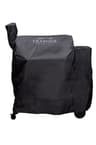
| A Traeger Pro 780 | The Traeger BAC504 | Full-length, so the hopper is covered too. Match the BAC number to your grill — they are not interchangeable. |
| Any other pellet grill | Measure, then buy a universal | Maker covers are cut per model. A 58 or 60-inch universal that reaches the ground beats a brand cover for a different grill. |
| A 36-inch Blackstone with a hood | The Blackstone 5482 | Blackstone publishes the size and the fitment. Read the hood clause: the hoodless station wants a different SKU. |
The mistake that does more damage than no cover at all
Covering a warm grill. A cover is a vapor barrier, and a grill that is still giving off heat is still giving off moisture — from the grease tray, from a damp firebox, from the food residue on the grates. Put a sealed cover over that and you have built a humidity chamber around your burner tubes and held it there until the next cook. This is the single most common way people rust a grill while believing they are protecting it.
The rule is simple and absolute: cover it cold. On a gas grill that is usually an hour after the knobs go off. On a charcoal grill or a kamado it can be considerably longer, because a mass of ceramic or a bowl of embers stays warm for hours — which is one more reason the vents have to be shut and the fuel burned out before anything goes over the top.
Two smaller habits follow from the same logic. Empty the grease tray before you cover a gas grill, because a tray of liquid fat under a sealed cover is both a moisture source and the reason you have ants. And if your cover has no vents at all, lift it for an hour on the first dry day after a wet week; a cover is much better at keeping water out than at letting it back out again.
What a cover will not fix
It will not substitute for a roof. A grill under an eave, a pergola or an awning lives a fundamentally easier life than a grill in the open, and no fabric closes that gap. If you have a choice of two spots, the sheltered one is worth more than any cover on this page.
It will not stop rodents. A cover is a dark, dry, sheltered cavity, which is an attractive proposition for a mouse in October, and the grease tray is the draw. Clean, then cover.
And it will not make a grill last if you never clean it. Rust on a grill almost always starts under something: under caked grease, under ash, under a grate that has been left wet. A cover stops new water arriving. It does nothing about the water already in there, which is why the maintenance order is clean, cool, then cover — and why the grates and the firebox matter more than the fabric. Our how to use a gas grill guide covers the burn-off and brush-down routine that goes with it.
A note on sizes and why 58 inches keeps appearing
Three of the covers here are 58 inches wide and one is 60, which is not a coincidence: the mainstream three-burner gas cart has settled into a fairly narrow band of cabinet widths, and cover makers build to it. That is useful to know, because it means the 58-inch size is the one that is always in stock and always has a dozen competing options — and it means a 58-inch cover on a grill that is 48 inches wide will be visibly slack. Slack is not harmless. It flaps, it abrades, and it holds a pocket of water on top of the lid, which is how a waterproof cover ends up dripping through a seam.
If your grill is genuinely small — a two-burner, a portable, a tabletop — do not buy a big cover and tie it off. Buy the size, or buy the maker’s cover for that model. The same logic applies at the other end: a four-burner with the side tables up can exceed 60 inches, and the honest answer there is to fold the tables before covering, which is what the Grillman’s published 60-inch width assumes.