Weber Q vs Weber Spirit
These two land close enough in price that cost will not decide it for you, and their spec sheets are closer than you would expect. What separates them is not performance — it is whether the grill has to move, and how many people you are cooking for.
Quick answer
Buy the Weber Spirit E-325if the grill will live in one place and you cook for four or more — three burners over 360 square inches of primary grate gives you proper two-zone cooking and a 10-year cookbox and burner warranty. Buy the Weber Q 2800N+if the grill has to move, or if a cart will not fit: it is about 32 lb, carries 320 square inches, and its published 250–700°F range is actually widerthan the Spirit’s. They sit close in price, so this is a decision about space and headcount — not about which grill is better.
How this is funded: we earn a commission if you buy through our links, at no extra cost to you. It never changes which product we recommend, and we’ll tell you when we’d skip one, or point you to a cheaper option when it’s the better buy. Full disclosure.
| Spec | 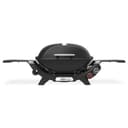 | 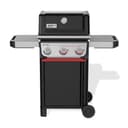 |
|---|---|---|
| Main burners | 2 | 3 |
| Primary cooking area | 320 sq in | 360 sq in |
| Cooking area | 320 sq in | 450 sq in |
| Grates | Porcelain-enameled cast iron | Porcelain-enameled cast iron |
| Price | $449.00 · View on Amazon Price as of October 14, 2026. #ad How we’re funded | $499.00 · View on Amazon Price as of October 14, 2026. #ad How we’re funded |
Why the spec sheet does not settle this
Look at the table above and the gap is small. 320 square inches against 360. Porcelain-enameled cast-iron grates on both. Two burners against three. On paper the Spirit wins narrowly, and if you stopped there you would buy the Spirit and probably be happy.
But the two grills answer different questions, and the specs that distinguish them are the ones Weber publishes for only one of the pair — which is why they are absent from the comparison table rather than filled in with a guess. We print what the maker publishes and nothing else, so the rows that matter most here need their own table:
| Spec | Weber Q 2800N+ | Weber Spirit E-325 |
|---|---|---|
| Burner output | 22,000 BTU (including the Plus burner) | 31,000 BTU (main burners) |
| Published temperature range | 250–700°F | Not published as a range |
| Weight | ~32 lb | Not published in our source |
| Warranty | Not published in our source | 10-year cookbox & burners |
| Sear provision | Plus (+) burner, part of the 22,000 BTU | Dedicated Sear Zone burner |
| Fuel connection | Small cylinders, or a 20 lb tank with an adapter hose | 20 lb tank (standard cart plumbing) |
Two things in that table are easy to misread. First, the Q’s 22,000 BTU figure already includes its Plus burner, while the Spirit’s 31,000 is main burners only — so the real output gap is wider than 9,000 BTU would suggest. Second, and pulling the other way, the Q is the only one of the two with a published top-end temperature, and 700°F is a serious number. On a per-square-inch basis the little grill is working harder: roughly 69 BTU per square inch against the Spirit’s ~86, but across a far smaller, better-insulated dome.
The question that actually decides it
Does the grill have to move? That is the whole comparison, and everything else follows from the answer.
A Spirit is a cart. It has wheels, so it rolls across a patio, but it does not go up a flight of stairs, into a car boot or onto a campsite table. It wants a permanent home, a 20 lb tank living underneath it, and somewhere to be covered up over winter.
A Q is a grill that one person picks up. At about 32 lb with detachable side tables, it goes on a balcony and comes back inside, it travels to a campsite or a tailgate, and it stores on a shelf. That portability is the product. If you do not need it, you are paying for engineering that is doing nothing for you — and you are giving up a burner and a published warranty to get it.
Headcount: the second question
Primary cooking area is the figure to use, and the two grills sit either side of a meaningful line.
- 320 sq in (Q)— comfortable for two to four. Four burgers and some vegetables, or a whole chicken roasted under the dome with room around it. Past four it becomes a batching exercise.
- 360 sq in (Spirit)— comfortable for four to six, and crucially it is 360 square inches split across three burners, which is not the same as 360 across two.
That burner count is worth more than the 40 square inches. Three burners let you run a genuinely hot zone and a genuinely cool one with a buffer between them, which is what almost every grilling technique requires: sear over the hot side, move across to finish. With two burners you can still do it, but your cool zone is right next to your hot one and the temperature difference is smaller. On a high-dome portable like the Q this matters less than it would on a flat-lidded two-burner, because the dome does a lot of the indirect work — but it is a real difference in control.
The thing nobody mentions: the gas bottle
The Q is designed around small camping cylinders, and that is convenient and expensive per cook. A 1 lb cylinder holds roughly 21,500 BTU of energy, so a 22,000 BTU grill running flat out gets under an hour from one. Fine at a campsite; irritating as a routine at home.
The fix is an adapter hose to a standard 20 lb tank, which is what most people who use a Q at home end up buying, and it changes the running cost by an order of magnitude. The catch is that a 20 lb cylinder is itself a storage problem — it has to live outdoors and upright, and on a balcony that may not be possible or permitted. Our guide to how long a propane tank lasts works that arithmetic through for both grills.
The Spirit has none of this complexity. It is plumbed for a 20 lb tank that sits in the cart, and that is the end of the subject.
Where each one genuinely wins
| If you… | Buy | Because |
|---|---|---|
| Cook for four to six most weeks | Spirit E-325 | More primary grate and a third burner for real two-zone control |
| Have a balcony, or no fixed outdoor space | Q 2800N+ | ~32 lb, detachable tables, stores indoors between cooks |
| Camp, tailgate or travel with a grill | Q 2800N+ | Runs off small cylinders and fits in a car |
| Want the longest published warranty of the two | Spirit E-325 | 10-year cookbox and burner term; no equivalent figure published for the Q |
| Want the highest published top-end heat | Q 2800N+ | 250–700°F published; the Spirit does not publish a range |
| Cook for two, but cook often | Either — honestly | Both do this well; pick on whether it has to move |
How this is funded: we earn a commission if you buy through our links, at no extra cost to you. It never changes which product we recommend, and we’ll tell you when we’d skip one, or point you to a cheaper option when it’s the better buy. Full disclosure.
Live prices on all three
Prices are fetched live and date-stamped. Check the numbers in these rows rather than any figure in the text — these two usually sit close together, and a sale on either one can change the answer.
Weber Spirit E-325 3-Burner Gas Grill
31,000 BTU across three burners and 360 sq in of primary grate, cast-iron grates, a dedicated Sear Zone burner and a 10-year cookbox and burner warranty.
Price as of October 14, 2026. #ad How we’re funded
Weber Q 2800N+ Portable Gas Grill
320 sq in and a published 250-700°F range in about 32 lb, with a high dome that roasts properly. The pick for a balcony, a campsite or a small patio.
Price as of October 14, 2026. #ad How we’re funded
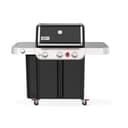
Weber Genesis E-335 Gas Grill
39,000 BTU over 513 sq in of primary grate, plus a 13,000 BTU Sear Zone burner and a 12,000 BTU side burner, under a 12-year warranty — the step up when you regularly cook for six or more.
Price as of October 14, 2026. #ad How we’re funded
Two mistakes to avoid
Buying the Q because it is cheaper. It usually is not, by much. These two land close together, which is exactly why the decision has to be made on space and headcount rather than on price. If you have room for a cart and cook for a family, buying the portable to save a little is how you end up cooking in batches for the next decade.
Buying the Spirit for a balcony.A three-burner cart is roughly four feet wide with the side tables up, and it needs clearance around it and a place to be covered. Measure before you order — the footprint with the lid open is the number that matters, not the closed one. We go through that measurement and the cross-fuel alternatives in best grills for small patios and balconies.
Where to go next
Each grill has a full write-up: Weber Spirit E-325 review and Weber Q review. If the Spirit is the direction and you are now wondering whether to stretch to the next model up, Weber Spirit vs Genesis is the comparison that follows this one. For the spec that decides how much grill you actually need, read how many BTUs a gas grill needs— it explains why the Q’s smaller number is not the disadvantage it appears to be. And whichever you buy, best grill covers has the fitment notes for both.
At the other end of the gas range, where infrared searing and a lifetime warranty replace the value argument entirely, the write-up is our Napoleon Prestige 500 RSIB review— useful mostly as a sense of what the money buys above this tier.
Frequently asked questions
Weber Q or Weber Spirit — which should I buy?
Buy the Spirit E-325 if the grill will live in one place and you cook for four or more: three burners across 360 sq in of primary grate give you proper two-zone control, plus a 10-year cookbox and burner warranty. Buy the Q 2800N+ if the grill has to move or a cart will not fit — it is about 32 lb, carries 320 sq in, and publishes a 250-700°F range. They sit close in price, so space and headcount decide it, not cost.
Is the Weber Q as good as the Spirit?
For two to four people, yes — and in one respect it is better, because the Q publishes a 250-700°F temperature range and the Spirit does not publish a range at all. What the Q gives up is a third burner, 40 square inches of primary grate and a published warranty figure. What it gains is that one person can pick it up. Neither is the better grill in the abstract; they are built for different situations.
How many people can a Weber Q 2800N+ cook for?
Two to four comfortably, on 320 square inches of primary grate. That is four burgers with room for vegetables, or a whole chicken roasted under the high dome with space around it. Past four people you are cooking in batches. The Spirit's 360 square inches across three burners is the better choice for four to six, and the burner count matters more than the extra area.
Does the Weber Q get hot enough to sear?
Yes. Weber publishes a 250-700°F range for the Q 2800N+, and 700°F at the top end is a serious searing temperature — the Plus (+) burner is what gets it there. Note that the grill's 22,000 BTU rating already includes that Plus burner, whereas the Spirit's 31,000 BTU is main burners only, so the output gap between the two is a little wider than the headline figures suggest.
Can you use a Weber Q with a big propane tank?
Yes, with an adapter hose, and at home that is usually the right move. A 1 lb camping cylinder holds roughly 21,500 BTU of energy, so a 22,000 BTU grill at full output gets under an hour from one — fine at a campsite, expensive as a routine. A 20 lb tank is around twenty times the fuel at a far lower cost per pound. The catch is storage: a 20 lb cylinder must live outdoors and upright, which on a balcony may not be possible or permitted.
Is two burners enough on a gas grill?
It is enough to cook well and it gives you less control than three. The point of multiple burners is zones — a hot side to sear on and a cooler side to move food to — and with two, your cool zone sits right beside the hot one so the temperature difference is smaller. On a high-dome grill like the Q this matters less, because the dome does much of the indirect work. On a flat-lidded two-burner it matters a lot.
Which Weber has the better warranty?
The Spirit, on published figures: Weber states 10 years on the cookbox and burners. We do not have a published warranty term for the Q 2800N+ from the source we use for its specs, so we leave that row blank rather than estimate it — treat it as a question for the retailer rather than as a mark against the grill. If warranty length is the deciding factor, the Spirit is the documented choice.
Will a Weber Spirit fit on a balcony?
Usually not comfortably. A three-burner cart is roughly four feet wide with the side tables up, and it needs clearance around it plus somewhere to be covered. Measure the space with the lid open, not closed — that is the footprint it occupies while you are actually cooking. If it does not fit, the Q is the Weber answer, and our small-spaces roundup covers the cross-fuel alternatives including charcoal, pellet and griddle options.
Keep reading
Weber Q Review
The portable that cooks like a real grill — the Plus burner, the high dome, and who should buy one.
Read the review →Weber Spirit E-325 Review
The three-burner most gas shoppers should buy — the Sear Zone burner, the grates and the warranty.
Read the review →Weber Spirit vs Genesis
The comparison that follows this one — what the step up from Spirit to Genesis actually buys.
Compare them →Best Grills for Small Patios and Balconies
One pick per fuel type for a balcony or tiny patio, ranked on footprint against usable cooking area.
See the picks →