Reverse-Flow vs Traditional Offset
Both are big Oklahoma Joe's Longhorns built from the same heavy steel; the only real difference is where the heat goes. Reverse-flow routes it under a baffle for even, forgiving temperatures. Traditional gives you a natural hot-to-cool gradient. Here's which airflow suits which cook.
Quick answer
Reverse-flow offsets run the heat under a solid steel baffle to the far end of the chamber and back before it exits, which flattens the firebox-side hot spot and makes the cook far more forgiving. A traditional offset gives you a natural hot-to-cool gradientthat’s better for multi-zone cooking and grilling, plus simpler cleanup. Pick reverse-flow for even, hands-off low-and-slow; pick traditional if you want to use the temperature gradient on purpose.
How this is funded: we earn a commission if you buy through our links, at no extra cost to you. It never changes which product we recommend, and we’ll tell you when we’d skip one, or point you to a cheaper option when it’s the better buy. Full disclosure.
| Spec | 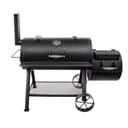 | |
|---|---|---|
| Total cooking area | 1,060 sq in | 1,060 sq in |
| Configuration | Reverse-flow (convertible) | Traditional offset |
| Steel gauge | 2.5 mm cold-rolled | 2.5 mm cold-rolled |
| Price |
The short version
The two smokers in the table above are almost the same product. Both are Oklahoma Joe’s Longhorns, both give you 1,060 sq in of total cooking area, and both are built from the same 2.5 mm cold-rolled steel. The only meaningful difference is the path the heat and smoke take through the cooking chamber — and that single change is what makes them behave differently on a long cook. This is the cleanest way to see what reverse-flow actually does, because everything else is held constant. Learn the airflow here and it applies to every offset you’ll ever look at.
How a traditional offset moves heat
In a traditional offset, the firebox sits at one end and the smokestack sits at the other. Heat and smoke enter the cooking chamber next to the firebox, drift across the food, and exit the stack at the far end. That layout is simple and it works, but it has one built-in consequence: the end nearest the firebox is always the hottest part of the chamber, and the far end near the stack is always cooler. On a large chamber that gradient can span a real spread of temperatures end to end. A skilled cook uses that on purpose — ribs near the cool end, a brisket point that wants more heat closer to the fire — and rotates the meat through the cook to even it out.
How reverse-flow moves heat
A reverse-flow offset adds a solid steel baffle plate under the cooking grates and moves the smokestack back over the firebox. Now the heat is forced to travel underneath that plate all the way to the far end of the chamber, then reverse direction and flow back over the top of the food before exiting the stack near where it started. The baffle does two jobs at once: it acts as a heat sink that radiates warmth evenly up through the whole grate, and it routes the airflow so the far end is no longer starved of heat. The result is a chamber that cooks much more uniformly from one end to the other, which is exactly why reverse-flow is the more forgiving setup for a newer cook or for a grate you’ve filled end to end.
The hot-spot problem
The hot spot next to the firebox is the single most common frustration new offset owners run into. On a traditional pit it means the rack of ribs nearest the fire is done and starting to dry while the far rack is still climbing, so you’re rotating meat and juggling positions all cook long. Reverse-flow is the direct engineering answer to that complaint: by pulling heat under the baffle to the far side first, it evens the temperatures so that everything on the grate cooks at a similar rate. You still get a small gradient, but it’s a fraction of what a traditional layout produces. If your main goal is to load the smoker and not babysit hot and cold zones, reverse-flow is the more relaxed way to cook.
The cleanup trade-off
Nothing is free. The same baffle plate that evens the heat also sits directly under the food and catches the grease and drippings that would otherwise fall to the bottom of the chamber. That means a reverse-flow smoker needs the plate scraped and cleaned periodically, especially after fatty cooks like pork shoulder or a rack of spare ribs, where a traditional open chamber would simply let the grease run off. On the Longhorn Reverse Flow the plate is removable, which makes that job manageable, but it is real, recurring work that a traditional offset doesn’t ask of you. If you hate cleanup, weigh that against the even-heat benefit honestly. Our guide to running an offset smoker covers the maintenance rhythm either layout needs.
Grilling and multi-zone cooking
There is one place a traditional offset is genuinely the better tool: when you want zones. Because a traditional layout has a natural hot end and a cool end, it lets you sear or grill hotter near the firebox while something holds gently at the far end — useful if you’re cooking different foods that want different heat, or if you want to grill directly over coals raked into the main chamber. A reverse-flow smoker’s whole design goal is to erase those zones, which is exactly what you don’t want when the zones are the point. Traditional is also the simpler machine: no baffle to clean, fewer parts, and the airflow is easy to reason about while you’re learning to read your fire.
Convertible smokers
You don’t always have to choose permanently. The Oklahoma Joe’s Longhorn Reverse Flow is built to convert: you can remove the baffle plates and relocate the smokestack to run it as a traditional offset instead. That flexibility is a genuine selling point — you can learn on the forgiving reverse-flow configuration while you’re building fire-management skill, then switch to a traditional gradient later if you decide you want the zones. Not every reverse-flow smoker converts, so if that option matters to you, confirm it before you buy. A convertible model is effectively two smokers, which softens the whole decision below.
Who should pick which
Pick reverse-flow if you want the most forgiving, even low-and-slow cook you can get from a factory offset, if you regularly fill the grate end to end, or if you’re still learning and want the machine to cover for you. The even heat is the reason most first serious offsets sold today are reverse-flow. Pick traditional if you value the natural hot-to-cool gradient for multi-zone cooking and grilling, if you want the simpler machine with less to clean, or if you already know how to work a gradient and would rather have the flexibility than have it engineered away. Both of the Longhorns here are built from the same heavy 2.5 mm steel, so you’re choosing behavior, not build quality. See how they sit against the rest of the field in our best offset smokers roundup, and read our methodology for how we compare offsets on published specs and owner consensus rather than claims of hands-on testing.
Frequently asked questions
What does reverse-flow actually do?
A reverse-flow offset places a solid steel baffle plate under the cooking grates. Heat and smoke from the firebox are forced to travel under that plate to the far end of the chamber, then reverse direction and flow back over the food before exiting through a stack mounted near the firebox. That longer, guided path evens out the temperature across the grate and tames the hot spot that forms next to the firebox in a traditional offset.
Is reverse-flow better than a traditional offset?
Better for even, forgiving low-and-slow cooking, not universally better. The baffle makes the whole chamber cook at a more uniform temperature, which is easier for a newer cook and better when you're filling the grate end to end. A traditional offset gives you a natural hot-to-cool gradient that's genuinely useful for multi-zone cooking and grilling, and it's simpler to clean. Neither is wrong; they suit different cooks.
Does reverse-flow smoke less?
No, it smokes the same; the fuel and the fire make the smoke, not the baffle. Reverse-flow only changes the path the heat and smoke take through the chamber. You'll often see a slightly more even smoke deposit across all the meat because the whole grate sees similar airflow, but the intensity of the smoke is a function of your fire, not the plumbing.
Is a reverse-flow smoker harder to clean?
Somewhat. The baffle plate that evens the heat also catches grease and drippings, so it needs scraping and periodic cleaning that a traditional open chamber doesn't. On the Oklahoma Joe's Longhorn Reverse Flow that plate is removable, which helps, but plan for a little more cleanup after fatty cooks like pork shoulder or ribs.
Can you convert between reverse-flow and traditional?
On some smokers, yes. The Oklahoma Joe's Longhorn Reverse Flow is built to convert: you remove the baffle plates and relocate the smokestack to run it as a traditional offset. That flexibility lets you learn on the forgiving reverse-flow setup and switch to a traditional gradient later if you want it. Not every reverse-flow smoker converts, so check before you buy if that matters to you.
Keep reading
Best Offset Smokers
Reverse-flow and traditional offsets, ranked on steel gauge and cooking area.
See the roundup →How to Use an Offset Smoker
Building and holding a clean fire for a full low-and-slow cook.
Read the guide →Oklahoma Joe's Longhorn Reverse Flow Review
The biggest reverse-flow offset from a mainstream brand, reviewed on the numbers — and compared with the Highland Reverse Flow.
Read the review →