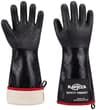
The short version: if you buy one thing, buy the ThermoPro TP25 four-probe monitor. It suits almost every smoker owner who does not already have one, it costs well under a hundred dollars, and it is the single accessory that most changes how their cooks turn out. If they already have a monitor, buy wood— a box of post oak chunks or a crate of kiln-dried splits — because fuel is the one thing they will certainly use and the one thing they never buy enough of.
Now the useful part, which is working out who you are actually shopping for.
First, check which kind of smoker they own
This matters more than anything else on this page, and it takes one look in the back garden. There are three families of cooker and they want different gifts.
A long horizontal barrel with a smaller box bolted to one end is an offset smoker, also called a stick burner. It burns split hardwood logs in that side box. The owner opens a fire door repeatedly over a twelve-hour cook, moves burning wood with their hands near the opening, and manages temperature by feel. This page is written primarily for them.
A round kettle or a vertical drum burns charcoal with wood chunks added for flavor. Nearly everything here fits them too, with one exception noted on the splits below.
A boxy grill with a bin hanging off the side is a pellet grill— a Traeger, Pit Boss, recteq, Camp Chef or Z Grills. It burns compressed sawdust pellets, not logs or lump, and it wants a different list. Buy from gifts for pellet grill owners instead. A heavy ceramic egg is a kamado, and it has its own short list of hardware that fits: see gifts for kamado owners.
Why a smoker owner is easy to buy for
Three reasons, and understanding them is most of the job.
They destroy things.Gloves are the clearest example. Running an offset means repeatedly reaching near a fire that is burning at several hundred degrees, and embers burn holes in coated fabric. A smoker owner’s gloves are almost always worse than they should be, because replacing them is the sort of errand that never gets done. The same is true of a cheap knife that has been sharpened into a different shape.
They burn consumables.Wood, charcoal, fire starters. A keen cook gets through a surprising volume of fuel across a season, and good fuel is a genuinely thoughtful gift rather than a filler one — because the fuel is the only ingredient the cooker contributes to the food. Buying someone a box of post oak is the barbecue equivalent of buying a baker good flour.
They under-buy instruments. Almost every smoker ships with a cheap lid-mounted dial gauge that measures the air at the top of the dome. That is not where the food is, and on a thin-steel cooker the difference between dome and grate can be thirty degrees or more. Plenty of experienced cooks are still working from that dial plus a pocket thermometer, and they will not spend their own money to fix it. You can.
How to not buy the wrong thing
Four rules that keep a gift out of the cupboard.
- Do not buy a cooker. Not a smoker, not a grill. Someone who owns one has opinions, and a cooker is a space and plumbing decision as much as a cooking one.
- Do not buy a wire-bristle grill brush. They shed. A peer-reviewed study of US emergency department data estimated 3,739 wire-bristle injuries between 2015 and 2023, a 229% increase on the preceding period. If you want to buy a cleaning tool, buy a bristle-free scraper — our picks are in best grilling tools.
- Do not buy rubs or sauce for a serious cook. They almost certainly make their own, and have views.
- Do check what they already own for the two gifts here that can duplicate: a multi-probe monitor (a small screen with wires clipped to the cooker) and a long slicing knife.
What is on this list, and why
The seven picks below cover the four jobs a smoker owner actually needs help with, in the order they matter: knowing the temperature (a four-probe monitor), handling fire safely(two different gloves, because one pair genuinely is not enough — a food glove is the wrong tool for a firebox and leather that has soaked up rendered fat should never touch meat), fuel (chunks for a charcoal cooker, real kiln-dried splits for a firebox), and the last two minutes (a slicer long enough to cross a brisket flat in one pull, which is the cheapest way to make twelve hours of work look like it cost more than it did).
Every one is a product we already cover and research for its own category page, so these are not gift-guide filler — they are the same picks, re-explained for someone who does not cook on a smoker themselves. Prices below are live and refreshed daily; the “as of” date sits under each button. We have not cooked with any of this gear ourselves — our methodology sets out exactly what we do instead.