The wire bristle problem
The standard grill brush — a block of stiff steel wire bristles on a handle — sheds. Bristles work loose, land on the grate, stick to food, and get swallowed. Once swallowed, a thin metal wire can lodge in the throat or perforate the bowel, which is emergency surgery rather than an inconvenience.
This is not a niche worry. Research published in the International Journal of Pediatric Otorhinolaryngology in 2026 estimated 3,739 wire-bristle grill brush injuries in the United States between 2015 and 2023 — a 229% increase over the 1,632 estimated for 2006 to 2014. The authors' conclusion is the uncomfortable part: awareness campaigns through the 2010s did not reduce the incidence at all. People know about it and keep buying the brushes.
So our position is simple, and it is the one place on this page where we would override a reader's price preference: do not buy a wire-bristle brush. There are two ways out, and they demand opposite habits.
- Clean hot, with steam.The Grill Rescue approach — a heat-resistant foam head wrapped in aramid fiber, dunked in water and wiped across a hot grate. The water flashes to steam and lifts the residue. There is nothing rigid on the tool to break off. It costs several times what a wire brush costs and it is genuinely useless on a cold grate, because steam is the entire mechanism.
- Clean cold, with nylon.The Weber Cold Clean approach. Cheap, no metal, and absolutely restricted to fully cool grates — Weber says so explicitly, because nylon on a hot grate melts. It is more physical work and it demands you remember the rule every single time.
A third option costs nothing: a tightly folded ball of foil held in your tongs, scrubbed over a hot grate. It works, it sheds nothing dangerous, and it is what we would tell you to use tonight if your only brush is a wire one.
How many tools do you actually need?
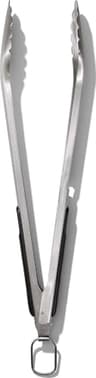
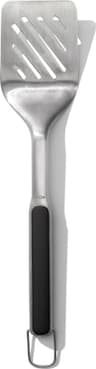
Two, if you are honest, and three if you cook fish or burgers often. Tongs first — they will do eighty percent of everything. A brush second, because a dirty grate makes food stick, and food that sticks is the reason most people reach for a turner in a panic. A turner third, for the jobs tongs physically cannot do: getting under a burger without compressing it, lifting a fillet that has bonded slightly to the bars.
If you are kitting out a grill from nothing and want to spend once, the Weber Precision set is the efficient answer — tongs and a spatula in one box, cheaper than the two OXO pieces bought separately, with a published spec sheet and a 2-year warranty behind it. If you already own decent kitchen tongs, skip straight to a turner and a brush and spend the difference on a pair of gloves or a probe thermometer, both of which change your results more than any tong upgrade will.
What we left out, and why
- Meat forks. A fork punctures food and lets juice out. It is useful for lifting a whole roast off a grate and for nothing else. Tongs and a turner cover the job without the hole.
- Twenty-piece cases. The corn holders, the four skewers, the basting brush that shreds. Piece count is a marketing number. Buy three good tools instead.
- Grill baskets and skewers.Genuinely useful, but they are cookware rather than tools — you buy them for a specific food (shrimp, vegetables, cubed meat), not as part of a base kit. Different page, different intent.
- Digital thermometers. The most valuable thing you can add to a grill, and important enough to have its own hub rather than a paragraph here. See best meat thermometers and, for instant reads specifically, the instant-read picks.
Looking after them
Stainless tools do not need much, but the two habits that matter are worth stating. Wash them after a cook rather than at the start of the next one — sugar in barbecue sauce carbonizes onto a head and gets much harder to remove once it has sat for a week. And hang them, do not pile them: a locking tong on a hook stays clean and stays findable, which sounds trivial until you are trying to flip twelve burgers and the tongs are under a bag of charcoal.
The brush is the one with a real replacement schedule. If you use a bristle-free head, replace it when the fiber wears through rather than when it looks dirty. If you have ignored everything above and kept a wire brush, inspect the head against a light before every single use, and retire it the moment bristles look loose or splayed — which, for most brushes, is considerably sooner than their owners think.
Where this fits in the kit
Tools are the cheap end of a charcoal setup and they punch above their price, but they are not the first thing to fix if your food is not coming out right. The order that actually helps: learn a two-zone fire, light it with a chimney starterrather than fluid, measure with a thermometer, and then worry about whether your tongs are long enough. If your grate itself is the problem — warped, rusted, or too widely spaced for small food — that is a grate upgrade rather than a tool purchase.
Owning the right brush only helps if it is used at the right moment, and the right moment is during the next cook's preheat rather than after dinner — cooled grease sets into a varnish that takes real force to shift. The full routine, including the deep clean the rest of the cooker needs, is in how to clean a grill.
Tools are only half the kit. The things that go around the cooker rather than in your hand — a thermometer, a chimney, gloves, a cover, wood and a grate upgrade — are in best grilling accessories, ordered by what to buy first and with no overlap with the tools above.