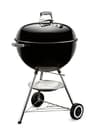
The best Weber grill for most people is the Weber Master-Touch 22 — a 22-inch charcoal kettle with 443 square inches across the main grate and a warming rack, a hinged Gourmet BBQ System grate you can lift to add fuel mid-cook, an enclosed One-Touch ash catcher and a built-in lid thermometer, all under the same 10-year bowl-and-lid warranty Weber puts on its cheapest kettle. It is the kettle with the three upgrades that actually change how you cook. The budget pick is the Weber Original Kettle 22 — the same 363-square-inch bowl, the same decade of warranty, without the hinged grate, the enclosed ash sweeper or the lid gauge. Every price on this page is read live from the current listing — 6 of 6 picks had a buyable offer as of November 22, 2026, and each button carries that date.
This page exists because “best Weber” is really three questions wearing one brand name. Weber sells charcoal kettles, propane grills and a dedicated charcoal smoker, and those are not competing products — they are different machines for different weekends. So the ranking below is not a straight line from worst to best. It names the best Weber in each job and then tells you which job you are actually in. If you already know you want gas, skip to the Spirit E-325 and read our Genesis write-up before you spend more.
What you are paying Weber for is parts, not performance. A 22-inch kettle is a steel bowl with a lid and three vents; plenty of brands build that shape for less, and some of them — an insulated AKORN, a crank-adjustable Royal Gourmet barrel — do specific things a kettle cannot. What none of them match is Weber’s spares situation: grates, ash catchers, One-Touch cleaning blades, lid handles, thermometers and dampers for current kettles stay available for many years, and third-party accessories are designed around the 22-inch bowl as a de facto standard. That is the real argument for buying Weber, and it is an argument about year eight, not about the first cook. If it does not persuade you, we wrote Weber kettle alternatives for exactly that reader.
The charcoal ladder has three rungs and only two of them are worth climbing. Original Kettle to Master-Touch buys the hinged GBS grate, the enclosed ash catcher and the lid thermometer — three things you touch every single cook, which is why it is the upgrade we recommend. Master-Touch to Performer swaps the leg tripod for a cart with a painted-steel work table and, on some configurations, gas ignition; the bowl and the 363-square-inch grate are unchanged. That is a convenience purchase, not a cooking one. Our Master-Touch vs Performer comparison runs that decision properly, and Original Kettle vs Master-Touch covers the rung below.
If you want to smoke, a kettle is a compromise and the Smokey Mountain is not. You can hold 250°F in a 22-inch kettle with the snake method, and thousands of people do — but you are fighting a grill-shaped firebox for six hours. The Smokey Mountain 18 is a bullet smoker: a charcoal ring at the bottom, a water pan above it to buffer the heat, two 481-square-inch-combined grates above that, and adjustable dampers at both ends. It gives up all grilling ability and in exchange holds a low temperature with less fiddling than any other charcoal cooker Weber makes. If brisket and ribs are the point, buy this and keep your old kettle for burgers.
On gas, the Spirit E-325 is the honest starting point and the Weber Q is the honest small-space answer. The Spirit publishes 31,000 BTU across three main burners, 450 square inches of total cooking area with 360 primary, porcelain-enameled cast-iron grates and a 10-year cookbox-and-burner warranty. The Weber Q 2800N+ is a different animal: two burners for a published 22,000 BTU, 320 square inches, cast-iron grates and about 32 pounds, so it lifts into a car. Neither one is a Genesis, and we would rather you understood what the Genesis premium buys before you spend it — Weber Q vs Spirit sorts the two picks here, and best gas grills for small spaces puts the Q against non-Weber portables.
Two honest gaps in this table. Weber does not publish a warranty figure in the spec sheets we read for either the Q 2800N+ or the Smokey Mountain 18, so those cells show a dash rather than a number we cannot cite. And cooking area is not comparable across shapes: 481 square inches of Smokey Mountain is two stacked smoking grates, while 450 square inches of Spirit is a main grate plus a warming rack. Count the longest thing you cook instead — a full packer brisket wants roughly 18 inches of clear grate. We have not tested these cookers; every spec here is Weber’s own published figure, read from the source named on each card, and how we work is on our methodology page.