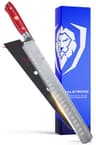
A brisket is the one cut where the knife genuinely changes the result. Everything else you cook on an offset can be pulled apart, chopped or portioned with whatever is in the drawer. Brisket is judged on the slice: pencil-width across the flat, thicker on the point, cut against a grain that changes direction partway through the muscle, and rendered so soft that the slice holds together only if the blade does the work instead of your arm. A chef’s knife cannot do that, and it is not a skill problem — it is a geometry problem.
Three specs decide it. Blade lengthis the first and the one most people get wrong. You want the blade to cross the entire width of the meat in one pull, because every time you stop and re-enter, you leave a ridge and you drag the fibers apart. A packer brisket flat is commonly 8 to 10 inches across at its widest; a chef’s knife is 8. That is why 11 inches is the practical minimum for a dedicated slicer and 12 inches is the comfortable answer.
Blade thickness and edge typecome next. A slicer is thin from spine to edge, so it parts the meat rather than wedging it apart the way a thicker chef’s knife does. The scalloped dimples along a Granton edgeexist to break the suction between the blade face and the wet cut surface — without them, a soft, fatty slice clings to the steel and tears as it falls away. It is a small thing that you notice immediately. Last is steel and hardness, which is really a question about maintenance rather than performance. A softer stainless blade (53–54 HRC) takes an edge in seconds on a honing steel and loses it just as readily. A harder Japanese steel holds its edge far longer and asks for a stone rather than a steel when it finally dulls.
What doesn’t matter: serrations (they saw and shred rendered meat rather than slicing it), a bolster (it gets in the way on a long pull), and any claim about a knife being “forged” — on a slicer, thin and stamped is a feature. We haven’t tested these; our methodology explains what we do instead, which is read the published specs, compare the geometry, and be honest about which differences you will actually feel.