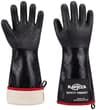
Barbecue gloves are the accessory people buy last and use most. That’s backwards, and it has a specific consequence: without a pair you can trust, you start improvising — a folded towel to lift a hot grate, bare fingertips on a foil edge, a tea towel wrapped round a firebox door handle. Every one of those is how people end up with a burn that keeps them off the smoker for a fortnight. A decent pair costs less than a bag of premium lump charcoal.
The reason there is no single winner is that the jobs are genuinely different in kind. Handling a hot, foil-wrapped brisket is a wet problem: the danger is steam and rendered fat, and steam goes straight through a fabric mitt and scalds you through it. Lifting a grate or a hot cast-iron pan is a conductive problem: brief contact with something very hot, where what matters is the thickness of the barrier and how quickly you can let go. Rearranging burning splits in a firebox is a radiant and abrasive problem: sustained heat on the whole forearm, plus embers and sharp split ends that will melt or tear a coated fabric glove.
Which is why materials matter more than the number printed on the box. Nearly every barbecue glove is advertised at 932°F, which is a laboratory figure for brief contact and tells you very little about a real job. Neoprene is the best all-round compromise: waterproof enough for steam, thick enough for hot metal, flexible enough to grip. Silicone is fully waterproof and grips wet things brilliantly, at the cost of dexterity and thickness. Leather takes radiant heat and physical abuse better than anything else and is completely unsuitable for handling food, because it soaks up grease and cannot be properly cleaned.
The other spec that actually matters is cuff length. Burns from reaching across a hot grate land on the forearm, not the palm, and a glove that stops at the wrist protects the part that was never in danger. Fourteen inches is a sensible minimum for a smoker; sixteen for anything involving an open firebox. We own none of these and have not tested them — see our methodology for exactly what we do instead.
How to choose
- Start with the wet test.If the job involves steam, a foil-wrapped cut, a water pan or a wash-up, you need a waterproof coating. Fabric gloves — including aramid ones — wick hot liquid straight through to your skin, and they do it fast.
- Buy for cuff length, not for the temperature claim.Almost every pair advertises 932°F. Almost none of them mean it for sustained contact. Cuff length is a real, checkable number that maps directly onto where people actually get burned.
- Keep food gloves and fire gloves separate.Leather absorbs rendered fat and can’t be washed out; it belongs on splits and coals, not on meat. Coated gloves wipe clean and belong on food. Two pairs, two jobs.
- Five fingers for control, mitts for heat. Separate fingers let you grip a bone, a probe or a grate handle properly. A mitt gives you more insulation and less control. For a smoker, fingers usually win.
- Buy a spare pair. The moment your only gloves are soaked in grease or dripping wet, you start doing things bare-handed. A cheap second pair on the shelf is genuinely a safety item, not a luxury.
What each material is actually for
Neoprene is the pair to reach for by default. It handles a foil-wrapped brisket, a hot grate, a chimney starter and a cast-iron skillet, and it wipes clean afterwards. Its weakness is bulk: you will not be trimming a brisket or turning shrimp in these.
Siliconeis the specialist for anything wet. Pulling a foil boat of steaming ribs, lifting a water pan, draining and rinsing — the coating is genuinely waterproof, so the steam that would soak through a fabric mitt stops at the surface. The trade is stiffness, and less protection against sustained radiant heat than a thicker glove.
Leatheris fire-management kit. If you run an offset, you are opening a firebox door, moving burning splits and repositioning a coal bed, all with your forearm inside the heat for seconds at a time. A sixteen-inch leather gauntlet is the only thing on this page that’s comfortable doing that, and embers that would melt a hole in a coated glove just bounce off. Keep it away from food.
Where gloves fit in the rest of the kit
Gloves, a probe thermometer and a chimney starter are the three purchases that change how a cook feels far more than any grill upgrade does. Our picks for the other two are in best meat thermometers for smoking and best charcoal chimney starters. If you’ve just bought a smoker and are working out what else you actually need, the short list is in what you need for an offset smoker — and the fire-management basics that make gloves necessary in the first place are in how to use an offset smoker.