Pit Boss vs Z Grills
The two brands that built the value end of pellet grilling, and they did it in opposite directions. Pit Boss sells capability — more grate, more hopper, app control and a lever that opens direct flame. Z Grills sells one job done cheaply and done well. On the published numbers.
Quick answer
Buy the Pit Boss Navigator 850if you want one cooker that both smokes and sears: 932 sq in, a 30 lb hopper, WiFi and Bluetooth, and a Flame Broiler lever that exposes the fire for direct-flame heat. Buy the Z Grills 700D4Eif you only want the core pellet-grill job done for as little money as possible: a PID controller holding a tight line over 697 sq in, no app, no searing, nothing to go wrong. The Pit Boss is the more capable grill; the Z Grills is the cheaper machine, and for a cook who only ever runs 225°F that is not a compromise.
How this is funded: we earn a commission if you buy through our links, at no extra cost to you. It never changes which product we recommend, and we’ll tell you when we’d skip one, or point you to a cheaper option when it’s the better buy. Full disclosure.
| Spec | 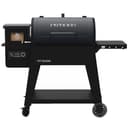 | 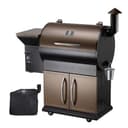 |
|---|---|---|
| Cooking area | 932 sq in | 697 sq in |
| Hopper capacity | 30 lb | 20 lb |
| Temp range | 180-500°F (sear to ~1,000°F) | 180-450°F |
| Control | WiFi + Bluetooth | PID controller |
| Price | $780.00 · View on Amazon Price as of October 14, 2026. #ad How we’re funded |
Why these two get cross-shopped
Because they are the two brands an upgrader lands on after deciding that a Traeger costs more than the badge is worth. Both sell a big, cart-mounted pellet grill at a price a mainstream brand cannot match, both have large and loyal owner bases, and both show up on the same shortlist for the same reason: you want square inches and steady temperature without four figures leaving your account.
Where they stop looking alike is in what each company decided the money should buy. Pit Boss spent it on features— more grate, a bigger hopper, wireless control and a mechanical searing solution. Z Grills spent it on nothing else at all, which is a real strategy and not an insult: a PID controller, a big barrel, a 20 lb hopper, and no app, no lever and no second cooking mode to pay for. That is the whole comparison, and which one is right for you comes down to a single question you can answer in one sentence.
A note on scope first, so you are reading the right page. This is the two value brands against each other. If you want either one against the category leader, that is Traeger vs Pit Boss and Z Grills vs Traeger. If you want Z Grills against the best-engineered grill in the category rather than the cheapest, that is Camp Chef vs Z Grills. And the Pit Boss against the enthusiast option is Pit Boss vs Camp Chef.
Capacity: 932 square inches against 697
This is the largest published gap between the two, and the easiest one to misread. 932 square inches against 697is about 34% more grate on the Navigator — in practical terms, two extra racks of ribs, or the difference between fitting a brisket with a pork shoulder beside it and fitting a brisket alone.
The misreading is treating that as a value measure. Capacity you never fill is dead weight: it is more steel to heat, more surface to lose heat through, and more pellets burned to hold a line on a half-empty chamber. If your honest answer to “when did I last cook for more than six people?” is a shrug, 697 square inches is already more grate than you use, and the Navigator’s extra third is something you pay to heat every weekend and use twice a year.
Where the Navigator’s size genuinely earns its keep is the specific case of cooking twolarge cuts at once. A brisket and a butt on the same overnight is a real thing people do, it is how you feed a crowd without cooking twice, and 697 square inches does not do it comfortably. Everything else — ribs for eight, a couple of chickens, a tray of wings — fits on either grill.
The hopper is really unattended runtime
30 lb against 20 lbis the second published gap, and hopper capacity is one of those specs that sounds like storage and is actually about sleep. A pellet grill burns roughly one to two pounds of pellets an hour at smoking temperatures, faster as the thermostat climbs and faster again in cold weather and wind. Both hoppers clear an all-day cook without a thought. The difference shows up on an overnight brisket, where 20 lb is close enough to the edge that a sensible cook sets an alarm, and 30 lb is not.
That is the whole argument for the bigger hopper, and it only matters if you actually cook overnight. If your cooking is daytime cooking, this row on the spec sheet is worth nothing to you.
Control: an app against a knob
The Navigator 850 publishes WiFi and Bluetoothcontrol as standard, not as an upsell — you set temperature, read probe temperatures and get alerts from your phone. The Z Grills 700D4E at this trim publishes a PID controller and no app at all.
Two honest observations about that. The first is that Z Grills’ PID is the part of the grill that matters most, and it is good: PID control means the controller predicts overshoot rather than simply reacting to it, which is why a cheap PID grill holds a tighter band than an expensive non-PID one. The core job — put the dial on 225°F and walk away — is done properly here, and that is the thing people actually buy a pellet grill for.
The second is that app control is worth more than it sounds for exactly one reason: it is a leave-in thermometer you did not have to buy, plus an alarm that works from inside the house. If you add up what the Navigator includes, part of its price premium is a monitoring system. The counter-argument is that a dedicated probe set is better than any grill’s built-in one and works on every cooker you will ever own — which is why we rank meat thermometersas the first accessory anyone should buy, app or no app. Pit Boss’s own app and controller are also the part of that grill owners criticize most; it works, but it is not the polished experience the mainstream brands sell.
The real difference: only one of these sears
Here is the mechanism that separates them, and it is not on most spec-sheet comparisons because it does not fit in a number. Both grills are convection ovens that burn wood. The Navigator publishes a 180–500°F range and the 700D4E publishes 180–450°F, and the practical difference between those two ceilings is close to nothing: neither will put a hard crust on a steak, because crust needs surface temperatures a fan-fed oven does not reach.
The Navigator answers that with the Flame Broiler— a sliding plate under the grate that you pull back to expose food directly to the firepot flame, which Pit Boss publishes as reaching around 1,000°F. That is a genuine second cooking mode on one zone of the grate, and it means one grill covers both the twelve-hour brisket and the Tuesday ribeye.
The 700D4E has no equivalent, and no lever, plate or setting will give it one. Searing on a Z Grills means a cast-iron skillet or a second grill. Plenty of good cooks reverse-sear in a pan deliberately, so this is not a flaw — but it is a fact, and if “one cooker for everything” is the reason you are buying, it decides the comparison on its own. The wider field of approaches to this problem, including the whole-chamber 700°F route, is ranked in best pellet grills for searing.
What each maker publishes that the other does not
One of the quiet frustrations of comparing value brands is that they do not publish the same figures, so some rows simply cannot be compared. Rather than fill the gaps with a reseller’s guess, here is exactly what each company’s own material gives us.
| Figure | Pit Boss Navigator 850 | Z Grills 700D4E |
|---|---|---|
| Max burner output | 40,000 BTU | Not published in the sources we read |
| Grate material | Not published in the sources we read | Porcelain-coated steel |
| Direct-flame searing | Flame Broiler lever, to about 1,000°F | None |
| App control | WiFi + Bluetooth, included | None at this trim |
Neither blank cell is an accusation. Grate material on the Navigator and burner output on the 700D4E are both perfectly ordinary things for a maker to leave off a listing. They are blank because we did not find them published, and a figure we did not find is not a figure we will print — our methodology explains why that rule exists.
Price, and the trap in comparing it
Both of these grills sit in the value band rather than the premium one, and the Z Grills is the cheaper of the two — usually by a meaningful margin, not a rounding error. We deliberately do not print either number in the text here, because pellet grill pricing moves weekly and a sentence with a dollar figure in it is wrong within a month. The live prices are in the table at the top of this page and they update daily.
What is worth saying about price is the trap: dividing price by square inches and calling the smaller number the better buy. That arithmetic consistently flatters whichever grill has the biggest barrel, and it quietly assumes you want every square inch, which almost nobody does. The same trap appears with BTU numbers, which we unpicked with real arithmetic in how many BTUs a grill actually needs. If you are choosing on value, choose on the features you will use, then look at the prices — not the other way round.
How this is funded: we earn a commission if you buy through our links, at no extra cost to you. It never changes which product we recommend, and we’ll tell you when we’d skip one, or point you to a cheaper option when it’s the better buy. Full disclosure.
Which of these two to buy
Prices update daily and both sit in the value band rather than the premium one. The Navigator is the more capable cooker; the Z Grills does the core job for less.
Pit Boss Navigator 850 Wood Pellet Grill
932 sq in, a 30 lb hopper, WiFi and Bluetooth, and a Flame Broiler lever for direct-flame searing — at the cost of a controller and app that owners find less polished than the mainstream brands'.
Price as of October 14, 2026. #ad How we’re funded
Z Grills 700D4E Wood Pellet Grill
A proper PID controller over 697 sq in for the least money in the category — no app, no searing and a smaller parts network, and none of that matters if 225°F is all you ask of it.
Reliability and support, honestly
Neither brand matches a mainstream manufacturer here, and it would be dishonest to pretend otherwise. Pit Boss is widely stocked in big-box retail, which makes parts and returns straightforward, but build tolerances vary unit to unit — lid fit, hopper seals and the quality of the paint are the things owners report inconsistently. Z Grills sells mostly direct, which means a smaller dealer and accessory network, offset by a simple, repairable design: a controller, an auger motor, a fan and a hot rod are the only things on a pellet grill that commonly fail, and all four are cheap, standard parts.
One shared vulnerability is worth naming, because it is cheap to fix on either grill: the hopper. Both of these cookers carry a box of compressed sawdust on the side, and wet pellets swell and jam an auger. A full-length cover — one that covers the hopper, not just the barrel — is the single cheapest piece of maintenance either grill will ever get, and we rank the options in best grill covers.
That last point is the one most buyers underweight. A pellet grill is not a sealed appliance; it is five replaceable components bolted to a steel box. Which parts wear out, roughly when, and what they cost is in how long a pellet grill actually lasts. The honest summary for both of these grills is that the barrel will outlive the electronics, and the electronics are replaceable.
Which one should you buy?
Buy the Pit Boss Navigator 850 if any of these is true: you want to sear on the same grill you smoke on, you cook two large cuts at once, you cook overnight and would rather not top up a hopper at 3am, or you want app alerts included rather than bought separately. You are paying for capability and you will use it.
Buy the Z Grills 700D4Eif your cooking is ribs, butts, chicken and the occasional brisket at 225°F, you already own or intend to buy a proper leave-in thermometer, and you are happy to finish a steak in a skillet. You are buying one job done well for the least money, and a PID controller is the right part of a pellet grill to spend your budget on.
And if neither sounds right because what you actually want is the biggest support network in the category, that is a different page: the Traeger Woodridge costs more than both and gives you less grill, in exchange for the certainty that every accessory fits and every problem has been solved publicly already. All three sit in the full ranking at best pellet grills.
Frequently asked questions
Is Pit Boss or Z Grills better?
Pit Boss makes the more capable grill and Z Grills makes the cheaper one. The Navigator 850 publishes 932 sq in, a 30 lb hopper, WiFi and Bluetooth control and a Flame Broiler lever for direct-flame searing. The Z Grills 700D4E publishes 697 sq in, a 20 lb hopper, a PID controller and no app. If you want one cooker that smokes and sears, buy the Pit Boss. If you only ever run 225°F and want to spend as little as possible doing it, the Z Grills does that job properly.
Can a Z Grills pellet grill sear?
Not really. The 700D4E publishes a 180-450°F range and has no mechanism to expose food to direct flame, so it behaves as a convection oven at every setting. You can brown food on it, but a hard steakhouse crust needs surface heat a fan-fed oven does not produce. Owners who want a crust finish in a cast-iron skillet or on a second grill. The Pit Boss Navigator's Flame Broiler lever is the mechanism the Z Grills lacks.
How much bigger is the Pit Boss Navigator 850 than the Z Grills 700D?
932 square inches against 697, which is about 34% more grate. Practically that is two extra racks of ribs, or the difference between fitting a brisket with a pork shoulder beside it and fitting a brisket on its own. It is only worth paying for if you genuinely cook two large cuts at once — capacity you never fill is extra steel to heat and extra pellets burned.
Does the Z Grills 700D have WiFi?
Not at this trim. Z Grills publishes a PID controller and no app connectivity on the 700D4E, where Pit Boss includes WiFi and Bluetooth on the Navigator 850 as standard. The PID part is the more important half: PID control predicts overshoot instead of reacting to it, which is why a cheap PID grill holds a tighter temperature band than an expensive non-PID one. For monitoring, a dedicated leave-in thermometer beats any grill's built-in probes anyway.
Which has the better warranty and support, Pit Boss or Z Grills?
They trade places. Pit Boss is stocked widely in big-box retail, so parts and returns are easy, but owners report inconsistent build tolerances between units. Z Grills sells mostly direct, so the dealer and accessory network is smaller, but the design is simple and repairable. On both grills the parts that fail are the controller, auger motor, fan and hot rod, and all four are cheap and standard.
Is the Pit Boss Navigator 850 worth the extra money over a Z Grills?
It is if you will use the features. The premium buys 235 more square inches, 10 more pounds of hopper, WiFi and Bluetooth, and a direct-flame searing mode — which means it covers the Tuesday ribeye as well as the weekend brisket. If your cooking is only low and slow and you already own a leave-in thermometer, you are paying for capability you will not use, and the Z Grills does the core job just as steadily.
Keep reading
Pit Boss Navigator 850 Review
The value pellet grill that also sears — a Flame Broiler lever, 932 square inches and WiFi, examined on the numbers.
Read the review →Z Grills 700D Review
The price-per-square-inch champion examined on the numbers — a PID controller, 697 square inches, and what you give up for the low price.
Read the review →Best Pellet Grills for Searing
Most pellet grills stop near 500°F. These are the ones that get hot enough to build a crust, and how each one does it.
See the picks →Best Pellet Grills Under $1,000
Every pellet grill here costs less than a grand, from a portable PID box to a searing-capable 900-square-inch cabinet.
See the picks →