Oklahoma Joe's Longhorn Reverse Flow Review
The biggest reverse-flow offset you can buy from a mainstream brand: the Longhorn's heavy chamber with four baffle plates under the grates and a smokestack you can move. An honest, spec-driven look at what the reverse-flow plumbing buys on a 1,060-square-inch pit, what it costs you in weight and cleanup, and who should buy the smaller Highland instead.
Quick answer
The Oklahoma Joe’s Longhorn Reverse Flow is the pick for a cook who wants a big, even-heating offset without a custom pit. Four baffle plates carry the heat under a 751 sq in main grate to the far end and back, which flattens the hot spot that makes a traditional Longhorn work to run, and the smokestack moves so you can convert it to a traditional draft later. The price is 268 lb, a bigger footprint and greasier cleanup. If you don’t need the extra grate, the Highland Reverse Flow does the same trick smaller and cheaper.
How this is funded: we earn a commission if you buy through our links, at no extra cost to you. It never changes which product we recommend, and we’ll tell you when we’d skip one, or point you to a cheaper option when it’s the better buy. Full disclosure.
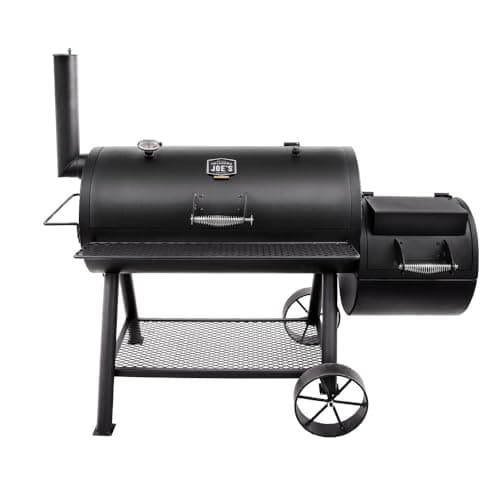
Oklahoma Joe's Longhorn Reverse Flow Offset Smoker
| Spec |  |  |
|---|---|---|
| Primary cooking area | 751 sq in | 619 sq in |
| Total cooking area | 1,060 sq in | 1,093 sq in |
| Configuration | Reverse-flow (convertible) | Reverse-flow (convertible) |
| Warranty | 2 years, parts | 2 years, parts |
| Price | $729.00 · View on Amazon Price as of September 21, 2026. #ad How we’re funded |
What it is
The Longhorn Reverse Flow is Oklahoma Joe’s big horizontal offset with the reverse-flow plumbing fitted from the factory. It is the same 1,060-square-inch chamber as the traditional Longhorn — 751 sq in on the main grate plus a 309 sq in secondary rack — with a firebox at one end, a large charcoal basket inside it, and four steel baffles locked beneath the porcelain-coated wire grates. The stack can be mounted in either of two positions, and the baffles lift out, so one pit runs either as a reverse-flow smoker or as a conventional offset. Oklahoma Joe’s publishes it at 64.3 inches wide, 35.5 deep and 55.5 tall, on wagon-style wheels with a bottom shelf and cool-touch handles, and it ships as a flat-pack that you assemble. It is the biggest reverse-flow offset sold on Amazon by a brand that publishes a real spec sheet, which is why it carries the “best big even cook” award in our best offset smokers roundup.
On the numbers: 1,060 sq in total cooking area, four removable baffles, a convertible smokestack, porcelain-coated wire grates, a professional-style lid gauge and a two-year warranty on all parts, all read from Oklahoma Joe’s own product page (model 17202053) on September 15, 2026. Oklahoma Joe’s describes the body only as “heavy-gauge steel”; the 2.5 mm cold-rolled figure that gets repeated for the Longhorn family comes from retailer listings, and we label it that way. The published weight is 268.3 lb, about 42 lb more than the traditional Longhorn’s 226 lb — the difference is, near enough, the baffle steel.
What reverse flow does on a chamber this size
A traditional offset drafts heat and smoke straight from the firebox, across the grate, and out a stack at the far end. That produces a hot-to-cool gradient along the chamber, and on a pit as long as the Longhorn the gradient is real: the grate nearest the firebox runs hotter than the far end, so a full load has to be rotated or the food nearest the fire is done first. Reverse flow changes the path. The baffles form a plate under the grates that carries the heat to the far end of the chamber before it can rise; it then travels back over the food and exits a stack mounted at the firebox end. The plate also heats up and radiates from below, which is what evens the grate out. Our reverse-flow vs traditional page goes through the mechanism and the trade-offs in general; the point here is that the benefit scales with chamber length. On a small pit the hot spot is a minor nuisance. On 751 sq in of main grate it is the difference between a full load of pork shoulders finishing together and finishing an hour apart, and that is the whole argument for paying for the Longhorn in this configuration rather than the traditional one.
The Longhorn does it with four baffleswhere the Highland uses the same count on a shorter chamber, so each plate is carrying a longer run of heat. That is not a criticism — it is why the design works on a pit this long — but it means the plates are large pieces of steel that take a while to come up to temperature. Plan on a longer preheat than a bare-chamber offset, and treat the plate as thermal mass that helps you hold a line once it is hot. It is also why we tell first-time reverse-flow owners to run the pit empty for the seasoning burn-in described in our seasoning guide: you are seasoning the plate as much as the chamber.
Convertible, and why that matters more than it sounds
Both the Longhorn Reverse Flow and the Highland Reverse Flow ship with two smokestack mounting positions and removable baffles. Lift the plates out, move the stack to the far end, and you have a traditional Longhorn. Most owners will never do it, and that is fine. But it settles the one reasonable objection to buying reverse flow first: that you might later want the hot-to-cool gradient a traditional pit gives you for two-zone cooking, or for grilling over the firebox end. With this pit you are not choosing between the two layouts; you are choosing which one to start with. For a cook new to offsets we would start in reverse flow, because the even grate forgives the fire-management mistakes everybody makes in the first month. Our how to use an offset smoker guide covers the fire itself.
Longhorn Reverse Flow vs Highland Reverse Flow
This is the real decision for most buyers, and it is a capacity decision, not a quality one. Both pits share the reverse-flow plumbing, the convertible stack, the removable baffles, porcelain-coated grates and the same two-year warranty; the comparison table above shows the published figures side by side. The Longhorn’s main grate is 751 sq in against the Highland’s 619 — about 21 percent more primary space, which is roughly one more full packer brisket or two more racks of ribs per load. The Longhorn also carries the heavier chamber steel of the Longhorn family, which the retailer figure puts at 2.5 mm; Oklahoma Joe’s publishes the Highland Reverse Flow at 156 lb against the Longhorn’s 268.3 lb, and that 112 lb gap is mostly steel. One honest footnote on the Highland’s numbers: Oklahoma Joe’s current page for the Highland Offset Reverse Flow (model 24203003) lists 616 sq in primary and 1,197 sq in total once the warming rack and the firebox grate are counted, while the Amazon listing and our table use the 619 / 1,093 figures. The main-grate difference between the two pits is the same either way.
| Published figure | Longhorn Reverse Flow | Highland Reverse Flow |
|---|---|---|
| Main grate | 751 sq in | 619 sq in (maker page: 616) |
| Total cooking area | 1,060 sq in | 1,093 sq in (maker page: 1,197 incl. firebox grate) |
| Weight | 268.3 lb | 156 lb |
| Footprint (W x D x H) | 64.3 x 35.5 x 55.5 in | 59 x 33.5 x 52.8 in |
| Baffles | 4, removable | 4, removable |
| Stack | Two positions (convertible) | Two positions (convertible) |
| Warranty | 2 years, all parts | 2 years, all parts |
So: buy the Longhorn Reverse Flow if you regularly cook for more people than a Highland feeds, or if you want the heavier chamber for its own sake. Buy the Highland Reverse Flow if you cook for a household and the occasional party, want a pit two people can move, and would rather put the price difference toward a probe thermometer, a gasket kit and a season of wood. The Highland is the offset we recommend to most upgraders for exactly that reason; the Longhorn is the one we recommend to the cook who has already outgrown it.
What it does well
- Even heat across a genuinely large grate.The reason to buy it. Reverse flow matters most on a long chamber, and this is the longest one Oklahoma Joe’s makes with the plumbing built in.
- Two pits in one. Removable baffles and two stack positions mean you can run it traditional later without buying anything.
- A real charcoal basket in the firebox.Oklahoma Joe’s includes a large basket, which keeps the fuel off the firebox floor, improves airflow and makes clean-out a lift-and-dump job rather than a shovel job.
- Heavy for a production offset.Mass is what makes a stick burner hold a line between splits; at 268 lb this has more of it than anything else in the Oklahoma Joe’s line.
- A published spec sheet and a parts network. Grates, firebox baskets and covers are all sold as replacement parts, which is not true of the unbranded reverse-flow pits on Amazon.
Where it falls short
The weaknesses are the flip side of the design, and they are worth stating plainly. It is heavy and big: 268 lb on a footprint over five feet wide is a place-it-once purchase, and two people are assembling it from a flat-pack. The baffle plate collects grease. Everything that drips off a pork shoulder lands on the plate rather than the chamber floor, and on a greasy cook that means scraping the plate before the next one or living with the flare-up risk; our reverse-flow explainer is honest that traditional offsets are simpler to clean. The plate also makes the pit slower to come up to temperature and slower to respond to a vent change, because you are heating a lot of steel before the grate moves. It still needs a fire managedevery 30 to 60 minutes — the even grate reduces the penalty for a mistake, it does not remove the job, and a cook who wants to set a temperature and leave should be reading our offset vs pellet page instead. And like every production offset it wants a gasket kit on the lid and firebox door; heavy-gauge is not the same as sealed. None of that is a surprise for a big stick burner. It is the honest cost of the even grate.
Setup and the first cook
Three things before the first brisket. First, assemble it where it will live; it does not move gracefully afterwards. Second, seal it: a roll of high-temp gasket on the lid lip and the firebox door turns the pit’s airflow into something the intake vent actually controls, and it is the single biggest gain per dollar on any Oklahoma Joe. Third, season it — the plate as well as the chamber — with a hot empty burn, per our seasoning guide. Then run it in reverse flow for the first month and cook to a probe thermometer at grate level, not to the lid gauge; the gauge reads the air at the top of the dome, not the grate where the food sits, and on a pit this long the two are not the same number. The short list of kit that turns a new offset into a working one is in what you need for an offset smoker.
Who should buy it
Buy the Longhorn Reverse Flow if you cook for a crowd, you want the heat evened out from the factory rather than by rotating pans, and you have a permanent spot for a 268 lb pit. It is the natural upgrade for the cook who has outgrown a Highland, and the right first offset for someone who knows they will fill a large grate every weekend. Choose the traditional Longhorn instead if you want the same chamber with a usable hot-to-cool gradient and simpler cleanup, and choose the Highland Reverse Flow if you want the even grate in a lighter, cheaper pit. Where all three land against the rest of the field is in our best offset smokers roundup, and if you are timing a purchase around the holidays, our Black Friday deals hubis honest that we have no dated sale record for offsets — buy it when you need it.
Frequently asked questions
Is the Oklahoma Joe's Longhorn Reverse Flow worth it?
For a cook who fills a large grate, yes. It is the biggest reverse-flow offset you can buy from a brand that publishes a real spec sheet: 1,060 square inches with 751 on the main grate, four removable baffles that even out the heat, and a smokestack that moves so it converts to a traditional offset. The costs are 268 lb, a footprint over five feet wide, and a baffle plate that needs scraping after greasy cooks. If you cook for a household, the smaller Highland Reverse Flow gives you the same even grate for less.
What is the difference between the Longhorn and the Longhorn Reverse Flow?
The chamber and the firebox are the same 1,060-square-inch Longhorn. The Reverse Flow version adds four steel baffles under the grates and a second smokestack position, so heat travels under the plate to the far end and back over the food instead of straight across the grate. That evens out the hot spot near the firebox. It also adds weight — Oklahoma Joe's publishes 268.3 lb for the Reverse Flow against 226 lb for the traditional Longhorn — and the plate collects grease. Because the baffles lift out and the stack moves, the Reverse Flow can be run as a traditional Longhorn too.
Longhorn Reverse Flow or Highland Reverse Flow — which should I buy?
It's a capacity decision. Both share the reverse-flow baffles, the convertible stack, porcelain-coated grates and a two-year warranty. The Longhorn's main grate is 751 square inches against the Highland's 619 — about 21 percent more — and it's the heavier pit, at 268 lb against the Highland's published 156 lb. Buy the Longhorn if you regularly cook for a crowd or have outgrown a Highland; buy the Highland if you cook for a household, want a pit two people can move, and would rather spend the difference on a thermometer, gaskets and wood.
How thick is the steel on the Longhorn Reverse Flow?
Oklahoma Joe's own product page describes it only as heavy-gauge steel construction. The 2.5 mm cold-rolled figure that's widely quoted for the Longhorn family comes from retailer listings, so we print it as a retailer figure rather than a manufacturer one. Either way it is heavier than the sub-$300 barrel offsets and not the quarter-inch plate of a custom pit — expect it to hold a line well between splits, and to still want a gasket kit on the lid and firebox door.
Does the Longhorn Reverse Flow need to be seasoned?
Yes, and the baffle plate needs it as much as the chamber. Run a hot empty burn after assembly to cook off manufacturing residue and lay down an initial coat on the interior, then touch it up when the inside looks dry and dull. Oklahoma Joe's ships it as a flat-pack that you assemble, so seasoning is the last step before the first cook. Our seasoning guide walks through the exact burn-in.
Can the Longhorn Reverse Flow grill as well as smoke?
It can, but the reverse-flow layout is built for even low-and-slow heat rather than for a hot direct-grilling zone. If you want to grill over the firebox end or use a hot-to-cool gradient for two-zone cooking, lift the baffles out and move the stack to the far position — the pit then runs as a traditional Longhorn. Most owners buy it for the even grate and leave it in reverse flow.
Keep reading
Reverse-Flow vs Traditional Offset
How the two airflows actually work, the hot-spot problem, cleanup and cost — the decision behind this review.
Compare them →Oklahoma Joe's Longhorn Review
The same chamber without the baffles — the traditional Longhorn, and who should pick it over the Reverse Flow.
Read the review →Oklahoma Joe's Highland Reverse Flow Review
The smaller reverse-flow Oklahoma Joe that most upgraders should start with.
Read the review →