Grate & Grill
Tool picks

Best Charcoal Chimney Starters

The cheapest upgrade in charcoal cooking, and the one that makes the biggest difference to how the food tastes. Three chimneys worth buying, sized for three different grills, with a live price on each.

By Stephen V.Last updated Our methodology

A chimney starter is a metal cylinder with a grate near the bottom and a handle on the side. You put paper or a wax cube underneath, charcoal on top, light the paper, and about fifteen minutes later you pour out a load of evenly lit coals. It costs less than a bag of premium lump and it is, without much competition, the best value purchase in charcoal cooking — because it solves two problems at once.

The first is taste. Lighter fluid is a petroleum distillate, and the reason food cooked over fluid-lit coals has that faintly chemical edge is that not all of it burns off before you start cooking. A chimney needs no accelerant at all: paper and airflow are enough. Self-lighting briquettes have the same problem built into the briquette, which is why they are worth avoiding for the same reason.

The second is consistency. The physics is a draft: the chimney is a tall, narrow tube, hot air rises out of the top, cold air is pulled in through the vents at the bottom, and that self-reinforcing airflow drives the coals from the bottom upward until the whole load is lit. Charcoal lit in a heap on the grate gets there eventually, but unevenly — some coals fully ashed over, some still black — so your fire keeps changing temperature for the first half hour. Chimney-lit coals are all at the same stage when they hit the grate, so the fire you build is the fire you get.

There is not much to differentiate one chimney from another, and this is a page where we would rather list three than pad to five. What genuinely varies is capacity (which should match your grill, not maximize), the body material (aluminized or zinc-plated steel both resist rust far better than plain steel), and the handle— specifically whether there is a heat shield between the burning cylinder and your hand, which is the detail cheap clones skip and the one you notice on every single pour. We haven’t tested these; our methodology explains what we do instead.

How this is funded: we earn a commission if you buy through our links, at no extra cost to you. It never changes which product we recommend, and we’ll tell you when we’d skip one, or point you to a cheaper option when it’s the better buy. Full disclosure.

The picks, side by side

Ranked, with the published specs and a live price on every pick. Select a row to jump to the full write-up. We haven’t tested these ourselves — here’s exactly what we do instead.

#ProductSizeMaterialPrice
1
Weber Rapidfire Chimney Starter (Standard)

Weber Rapidfire Chimney Starter (Standard)

Best overall
Standard (full-size)Aluminized steel
$24.99 · View on Amazon

Price as of September 6, 2026. #ad How we’re funded

2
Kingsford Heavy Duty Deluxe Charcoal Chimney Starter

Kingsford Heavy Duty Deluxe Charcoal Chimney Starter

Best value
10.74 x 6.8 x 11.25 inZinc-plated steel
$13.80 · View on Amazon

$15.9914% off

Price as of September 6, 2026. #ad How we’re funded

3
Weber Rapidfire Compact Chimney Starter

Weber Rapidfire Compact Chimney Starter

Best for small grills and smokers
5.8 in dia. x 8 in tallAluminized steel
$18.99 · View on Amazon

Price as of September 6, 2026. #ad How we’re funded

The picks in full

#1Best overall

Weber Rapidfire Chimney Starter (Standard)

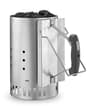
The one everybody copies. A full load lights enough charcoal for a 22-inch kettle in one go, the aluminized steel body survives being left out in the rain more often than it should be, and the heat shield behind the handle is the detail cheap clones skip — it's the difference between a confident pour and a nervous one. If you own a charcoal grill and not a chimney, buy this and stop reading.

What the numbers say
  • One full load lights enough charcoal for a 22-inch kettle
  • Aluminized steel body resists rust better than plain steel
  • Heat shield behind the handle makes pouring safe
Worth knowing
  • Too big for a Smokey Joe or a small firebox
  • Costs about twice a generic chimney of the same volume

Best for: The default chimney for a full-size charcoal grill

Specs read from Weber Rapidfire Chimney Starter product page + Amazon listing, last checked August 18, 2026. Prices change; the number in the card is fetched live.

#2Best value

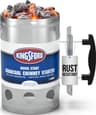
Kingsford Heavy Duty Deluxe Charcoal Chimney Starter

The value pick, and it isn't a compromise. Zinc-plated steel resists rust, the vented base and ring of circular side vents get the draft going as fast as the Weber does, and it carries the same heat shield and stay-cool handle. You're giving up brand and a little fit and finish, not function — which is why it's the chimney to buy if you'd rather spend the difference on charcoal.

What the numbers say
  • Vented base plus circular side vents light coals fast and evenly
  • Rust-resistant zinc-plated steel body
  • Heat shield and stay-cool handle included at a budget price
Worth knowing
  • Fit and finish is a step below Weber's
  • Zinc plating scuffs and discolors with heat over time

Best for: The same job as the Weber for meaningfully less

Specs read from Kingsford Heavy Duty Deluxe chimney starter Amazon listing + retailer spec sheets, last checked August 18, 2026. Prices change; the number in the card is fetched live.

#3Best for small grills and smokers

Weber Rapidfire Compact Chimney Starter

The right chimney for small fires, which is a bigger category than people expect. At 5.8 inches across and 8 inches tall it holds just under three quarts — the correct amount for a Smokey Joe, a portable kettle, or lighting the starter coals for a smoker firebox where a full standard chimney would give you far more fire than you want. It also fits in a camping tote, which the standard one does not.

What the numbers say
  • Just under 3 quarts — the right amount of fire for a small grill
  • 5.8 x 8 in body packs into a camping or tailgating box
  • Same aluminized steel and heat-shielded handle as the standard
Worth knowing
  • Not enough coals for a full 22-inch kettle in one load
  • You'll want the standard as well if you own both sizes of grill

Best for: Portables, small kettles and a smoker's starter coals

Specs read from Weber Rapidfire Compact Chimney Starter product page + Amazon listing, last checked August 18, 2026. Prices change; the number in the card is fetched live.

How to use a chimney starter properly

  • Two sheets of newspaper, loosely balled, or one wax cube. Packing the paper tightly is the classic mistake — it smothers the airflow the whole thing depends on. Loose and airy lights better than dense and full.
  • Fill to the top for a full grill, part-way for a small fire. A chimney does not have to be full to work. Match the amount of charcoal to the cook rather than lighting a full load and wasting most of it.
  • Wait for the top layer to ash over. Roughly 15 minutes. When the coals on top have turned gray and you can see flame licking through, the load is ready. Pouring early gives you a fire that keeps climbing after you have set your vents.
  • Set it on something non-flammable.A chimney gets hot enough to scorch a wooden deck or melt vinyl. The charcoal grate of your grill, a paving slab or bare concrete — never a table or decking.
  • Pour with two hands and gloves on. Use the swing handle to support the base as you tip. This is the moment a heat shield earns its money, and the moment a decent pair of gloves stops being optional.

Which size do you need?

Bigger is not better here; matching is. A standard chimney holds enough charcoal to fill a 22-inch kettle, which is what you want for a full grill of burgers or a hot bed for searing. A compactchimney holds roughly half that, which is the right amount for a portable grill, a small kettle, or — the use most people overlook — lighting the starter coals for an offset smoker’s firebox, where a full standard chimney would give you far more fire than you want at the beginning of a long cook. If you own both a full-size grill and a portable, owning both sizes is genuinely useful and they cost about as much together as one bag of good charcoal.

What about electric and torch lighters?

Both work, and both have a specific niche. An electric loop or hot-air lighter has no consumables at all and is excellent if you cook near an outlet; the trade is a power cord and a tool that only does one job. A propane torch lights coals fastest of anything and is genuinely useful for restarting a smoker firebox mid-cook, which a chimney cannot do without unloading the grill.

Neither replaces a chimney for the main job, because neither produces a whole load of evenlylit coals — they light the coals they touch, and the rest catch on afterwards. A chimney lights the entire load to the same stage, which is the actual reason it exists.

Where this fits in the kit

A chimney, a pair of gloves and a probe thermometer are the three items that change how charcoal cooking feels more than any grill upgrade would. Our picks for the other two are in best BBQ gloves and best meat thermometers for smoking. For what to actually light, see best lump charcoal, and for the two-zone method the chimney is feeding, read how to use a charcoal grill. If you’re starting from zero, charcoal grilling for beginners puts all of it in one place, and how much charcoal to useanswers the question this page raises next — how many chimney loads a given cook actually needs.

The tools you use once the coals are down — tongs, a turner and something to clean the grate with — are covered separately in best grilling tools. That page is also where we make the case for retiring the wire-bristle brush, which is the one genuinely unsafe item most charcoal cooks still own.
Frequently asked questions

What is the best charcoal chimney starter?

The Weber Rapidfire in its standard size, for most people with a full-size charcoal grill — one full load lights enough charcoal for a 22-inch kettle, the aluminized steel body resists rust, and the heat shield behind the handle makes pouring safe. The Kingsford Heavy Duty Deluxe does the same job in zinc-plated steel for less. If you cook on a portable grill or an offset firebox, the compact Weber is the better size.

How long does a chimney starter take?

About 15 minutes from lighting the paper to a pourable load. The coals are ready when the top layer has turned gray and ashed over and you can see flame through the top of the cylinder. Pouring early is the common mistake: half-lit coals keep catching after you've poured, so the fire climbs past the temperature you set your vents for.

Do you need lighter fluid with a chimney starter?

No, and that's the main reason to own one. Two loosely balled sheets of newspaper or a single wax fire-starter cube under the chimney is all it takes — the tall, narrow body creates a draft that pulls air up through the coals and lights the whole load from below. Lighter fluid is a petroleum distillate that doesn't fully burn off, which is where the faint chemical taste on fluid-lit food comes from.

What size chimney starter should I buy?

Match it to your grill rather than buying the biggest. A standard chimney holds enough charcoal to fill a 22-inch kettle. A compact one holds roughly half that, which suits portable grills, small kettles, and lighting the starter coals for an offset smoker's firebox — where a full standard load would be far more fire than you want at the start of a long cook. Owning both sizes is genuinely useful.

Can you use a chimney starter with lump charcoal?

Yes, and it works well. Lump lights faster than briquettes because it's less dense and more irregular, so expect closer to 10 to 12 minutes rather than 15. The irregular shapes also leave more air gaps, which helps the draft. The one thing to watch is that very large lump chunks can bridge inside the cylinder — break the biggest pieces down so the load settles evenly.

Keep reading