MEATER Plus Review
The fully wireless smart probe — no cable through the lid, dual sensors that read the meat and the chamber at once, and an app that estimates when dinner's ready. Here's an honest, spec-driven look at what the MEATER Plus does well, its one real limit, and who should buy it.
Quick answer
The MEATER Plus is the tidiest, smartest leave-in thermometer you can buy. It’s a single, completely wireless probe — nothing runs through the lid — with dual sensors that read the meat’s internal temperature and the ambient chamber temperature at once, and an app that estimates a finish time. Its one real limit is that it’s one probe: to monitor several cuts you’d need several. For a single beautiful cook, done elegantly, it’s the pick.
How this is funded: we earn a commission if you buy through our links, at no extra cost to you. It never changes which product we recommend, and we’ll tell you when we’d skip one, or point you to a cheaper option when it’s the better buy. Full disclosure.
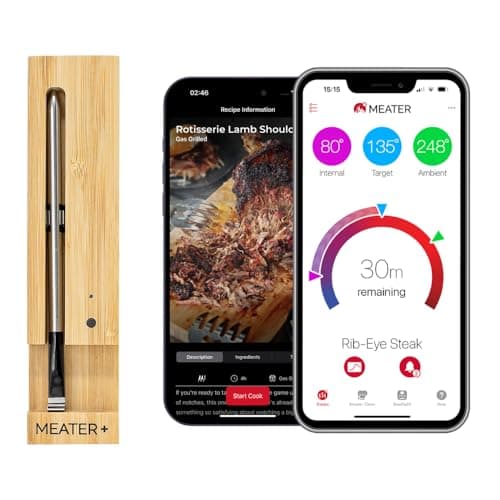
MEATER Plus Wireless Smart Meat Thermometer
What it is
The MEATER Plus is a leave-in wireless meat thermometer built around one idea: no cables. The entire device is a single stainless probe that goes fully into the meat, with all the electronics inside it — there’s nothing trailing out through the lid, no base station wired to probes, nothing to catch or melt. It pairs with your phone (extending its range through the wooden charger block, which acts as a Bluetooth repeater), and its app turns the readings into a guided cook. It’s the most modern-feeling thermometer in the category, and for a lot of cooks the cable-free design alone is the reason to buy it.
Dual sensors and the smart app
The MEATER’s cleverness is in that single probe. It carries two sensors: one at the tip reads the meat’s internal temperature, and one at the base reads the ambient temperature of the cooking chamber — so a single probe tells you both what the meat is doing and how hot the grill is, without a second cable. The app uses those readings to run a guided cook with an estimated finish time, which is genuinely useful for planning: you know roughly when to start the sides or when guests should arrive. Set a target, and it alerts you as the meat approaches and hits it. It does the core job — tell you the temperature, alert you — with more polish and less clutter than a wired probe.
Where it shines
The MEATER Plus is at its best on a single, unhurried cook— a roast, a reverse-seared steak, a whole chicken, a pork tenderloin. Push the probe in, set the target, and the cable-free design means nothing gets in the way as you cook, flip or move the meat; you just watch the app. The ambient sensor doubling as a grill thermometer is a real bonus on a cooker without a good built-in gauge. And because it’s so tidy and gadget-forward, it’s one of the best giftsyou can give someone who cooks — useful, impressive, and not something most people buy for themselves.
Where it falls short
One real limit, and one smaller one. The real limit: it’s a single probe. If you want to monitor several racks of ribs, or the meat and a separate spot at once, you’d need multiple MEATERs — and at that point a four-probe base-station unit like the ThermoPro TP25costs far less and does more. The smaller point: it’s a backyard-range Bluetooth device, reaching roughly 165 ft through the charger repeater — fine for monitoring from inside the house or around the yard, but not from the store or overnight from bed. For that you want a WiFi model, which we cover in best WiFi & Bluetooth thermometers.
Battery, charging and everyday use
Living with the MEATER Plus is mostly a pleasure and occasionally a small chore, and it’s worth knowing both sides. The probe charges inside the wooden block that doubles as the range repeater — a single AAA battery in the block tops up the probe between cooks — and a charged probe runs comfortably through a long cook. The flip side of putting all the electronics in a slim probe is that you have to keep it charged and keep track of the block; there’s no base-station display to fall back on, so a dead phone or a probe left uncharged means no readout. Cleaning is easy — wipe the probe, don’t submerge the whole thing past its rated line — and inserting it correctly matters, since the safety notch marks how far in the ambient sensor should sit above the meat. None of this is difficult; it’s simply the trade for a cable-free design. Treat the probe with a little care and it’s one of the tidiest, most satisfying tools in barbecue — and, again, an excellent gift, because the experience is as much of the appeal as the accuracy. For quick end-of-cook checks it still pays to keep a cheap instant-read alongside it.
Who should buy it
Buy the MEATER Plus if you want the tidiest, smartest setup — a single wireless probe with nothing through the lid, dual internal-and-ambient sensing, and an app that estimates when dinner’s ready — and you typically cook one cut at a time. It’s the nicer object and the more elegant experience, and it’s our wireless pick in the best meat thermometers roundup. If you cook a full smoker of meat and want the most probes for your money, the four-probe ThermoPro TP25is the better value — we compare the two directly there. And whichever leave-in you choose, pair it with a fast instant-read for quick final spot-checks.
Frequently asked questions
Is the MEATER Plus worth it?
It's worth it if you value the wireless design and the smarts, and you cook one cut at a time. The MEATER Plus is the tidiest leave-in thermometer — a single cable-free probe with dual sensors that read the meat and the chamber, and an app that estimates a finish time for planning. Its limit is that it's one probe, so for monitoring several racks at once a cheaper four-probe unit does more. For a single, unhurried cook done elegantly, it's the pick — and a great gift.
How does the MEATER Plus work without wires?
The whole device is a single stainless probe with the electronics inside it, so it goes fully into the meat with nothing trailing out through the lid. It connects to your phone over Bluetooth, extending its range through the wooden charger block, which acts as a repeater. Two sensors in the probe — one at the tip for the meat's internal temperature, one at the base for the ambient chamber temperature — feed the app, which runs a guided cook and estimates a finish time.
What is the range of the MEATER Plus?
Roughly 165 feet, using its charger block as a Bluetooth repeater. That's enough to monitor a cook from inside the house or around the yard, but it's a backyard-range device — it won't reach you at the store or overnight from bed. If you need to watch a long cook from anywhere, a WiFi thermometer like the Inkbird IBBQ-4T connects over the internet and has no range limit, which the MEATER's Bluetooth can't match.
Can the MEATER Plus monitor more than one piece of meat?
Not with a single unit — the MEATER Plus is one probe, so it monitors one cut (though that one probe reads both the meat and the ambient chamber temperature at once). To track several racks or cuts simultaneously, you'd need multiple MEATERs, or a four-probe base-station thermometer like the ThermoPro TP25, which costs far less and monitors four things at once. For a single cook the MEATER is elegant; for a full smoker, a multi-probe unit is more practical.
MEATER Plus or ThermoPro TP25 — which should I buy?
Buy the MEATER Plus if you want a tidy, fully wireless smart probe with a finish-time estimate and you usually cook one cut at a time. Buy the ThermoPro TP25 if you want four probes and longer range for less money, so you can monitor a whole smoker at once. The MEATER is the nicer object and the smarter app; the TP25 is the better value and does more. Our MEATER vs ThermoPro comparison lays out the decision in full.
Keep reading
MEATER Plus vs ThermoPro TP25
Fully wireless and smart, or four probes and cheap — the two most cross-shopped picks.
Read the comparison →Best Meat Thermometers
The full roundup — instant-read, leave-in and connected, compared on type and use.
See the roundup →Best WiFi & Bluetooth BBQ Thermometers
The leave-in probes that watch a long cook from your phone — Bluetooth for the yard, WiFi for the overnight and away.
See the picks →