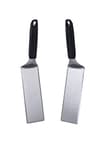
A flat-top griddle is the least self-sufficient cooker you can buy. A kettle works out of the box. A pellet grill works out of the box. A griddle arrives as a rectangle of bare cold-rolled steel, one stamped spatula and a grease cup, and everything that makes a flat-top worth owning — the cheese that melts in fifteen seconds, the smash burger with a lacy crust, the pile of onions that steams rather than burns — depends on a piece of gear that did not come in the carton. That is the good news and the bad news. The good news is that the whole list is short and cheap. The bad news is that searching for griddle accessories returns a wall of 35-piece kits full of items nobody has ever reached for twice.
So this page is ordered as a buying sequence, not a popularity list. Pick one is the first thing to buy; pick eight is the last, and costs more than the first five put together. Stop after three and you will have covered every real gap in the appliance. Each pick is here because it fixes a specific, nameable limitation of a flat-top, and each one carries the honest reason you might not need it.
Start with the tools, because a griddle is cooked with its accessories in a way no grill is. On a grill you reach for tongs once a minute. On a flat-top your hands are on two turners almost continuously — sliding, folding, chopping a pile of hash browns, scraping fond off the steel — which is why a pair of long spatulas is pick one and why the single short spatula in the box is the most commonly replaced part of any griddle. Right behind it sits the cheapest item on this page and one of the most useful: two squeeze bottles, one of oil and one of water. The oil bottle dresses the plate between batches. The water bottle is the one people skip, and it is the entire secret of griddle cooking — a squirt of water on hot steel under a cover produces a blast of steam that melts cheese, softens onions and finishes vegetables in seconds, on a cooker that otherwise has no way to put heat above the food.
Which brings us to the flat-top’s one structural limitation. A griddle heats from below and only from below. There is no lid, no dome, no radiant heat coming down from a hood, so anything that needs to melt, steam or cook through from the top has to be helped. A stainless basting cover is that help, and at the price of two bags of charcoal it is the single biggest upgrade in cooking ability per dollar on this page. Pair it with the water bottle and you have the diner technique in full: patty down, smash, cheese on, water beside it, dome over the top, count to fifteen. A cast-iron press covers the other half of that move. Weight is its whole specification — it is not a gadget, it is a lump of iron heavy enough to flatten a ball of beef against hot steel before the crust sets, and it doubles as the thing that stops bacon curling into a wave.
After the cooking gear comes the part of griddle ownership nobody advertises. A seasoned flat-top is a microscopically thin film of polymerized oil over bare steel, and bare steel rusts. Rust is not a cosmetic problem on a griddle; it is the only failure mode that actually ends one. Two picks here address it from opposite directions: a restoration kit that takes a top that has already gone orange back to bare metal so it can be re-seasoned, and a coverthat stops it happening in the first place. If you own a griddle, are reading this page, and only buy one thing from it, buy the cover — it is the cheapest insurance in outdoor cooking. If you have inherited or neglected a top that already looks bad, the kit is the rescue, and our griddle seasoning guide is the step you do immediately afterwards, because stripping a top and leaving it bare is worse than doing nothing.
The last two picks are about the environment the griddle lives in rather than the food on it. Wind guardsaddress the complaint that comes up every fall — that a griddle “will not get hot any more” — which is almost never a burner fault and almost always convection loss across an unprotected slab of steel in a breeze. And a hood, the most expensive thing here by a distance, finally gives a flat-top a lid, which turns it from a giant outdoor skillet into something that can roast and hold food warm.
A word about fitment, because it is the single thing most likely to turn one of these into a return. The first five picks fit any griddle from any brand — turners, bottles, a dome, a press and a bottle of rust remover do not care what badge is on your cart. The last three are sized hardware, and Blackstone alone sells five different 36-inch covers. Our cover pick is the with-hood size; our hood pick is published by Blackstone as fitting the V1 and Omnivore 36-inch griddles only. Measure, read your model number off the sticker, and match it before you order. Every pick below carries a “Fits” row in the comparison table for exactly this reason.
How we picked: we do not own a shed full of griddles, and neither does anyone else handing you an accessory listicle. What we did was compile the published manufacturer specifications for each product, name the source on every pick so you can check it yourself, and rank on what each item fixes rather than on star counts. This category makes that harder than most — Blackstone’s own product pages typically publish a SKU, one sentence and a one-year warranty, and nothing else. Where a maker does not publish a figure you will see that said plainly in the cons rather than a number we invented. Our full process is on the methodology page.