Big Green Egg vs Kamado Joe
The two ceramic kamados everyone cross-shops. On the food they're nearly identical; the split is in the stock accessories, the price, and how you buy them. Kamado Joe out-features the Egg from the box; the Big Green Egg answers with ecosystem, warranty and a local dealer. Here's the honest breakdown.
Quick answer
On the food these two are close— thick ceramic, a range that runs from low-and-slow to a hard sear, and similar cooking area. Kamado Joe wins out of the box: its Divide & Conquer racks, Air Lift hinge and Kontrol Tower vent beat the Egg’s stock hardware, usually for less money. The Big Green Egg wins on accessory ecosystem, its lifetime ceramic warranty and hands-on local-dealer support. Buy the Joe for value and features; buy the Egg for the ecosystem and the dealer.
How this is funded: we earn a commission if you buy through our links, at no extra cost to you. It never changes which product we recommend, and we’ll tell you when we’d skip one, or point you to a cheaper option when it’s the better buy. Full disclosure.
| Spec |  | 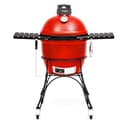 |
|---|---|---|
| Cooking area | 262 sq in (18.25 in) | 256 sq in (18 in) |
| Temp range | 150-750°F | 225-750°F+ |
| Weight | 162 lb | 188 lb |
| Price | Sold through authorized Big Green Egg dealers, not on Amazon, so there is no live price to show and no buy button here. Specs and the dealer locator are on Big Green Egg’s own site — a cited source, not an affiliate link. We earn nothing on it. | $1,499.00 · View on Amazon Price as of October 21, 2026. #ad How we’re funded |
The short version
The Big Green Egg and the Kamado Joe Classic are the two names every ceramic-grill shopper ends up comparing, and the honest truth is that they cook almost identically. Both are thick-walled ceramic kamados that hold heat superbly on a small amount of charcoal, run from a 225°F smoke up to a searing heat well past 700°F, and last for decades. The decision between them is not really about the barbecue — it’s about what comes in the box, what it costs, and how you buy it. Those three things pull in opposite directions, which is why this comparison stays interesting.
Cooking performance is close
Start with what doesn’t separate them. The Large Big Green Egg gives you 262 sq in of cooking area; the Kamado Joe Classic II gives you 256 sq in — a rounding error apart. The Egg’s glazed ceramic runs from 150°F to 750°F, and the Joe’s 1.25 in ceramic covers 225°F to past 750°F. Both hold a low-and-slow temperature rock-steady for hours, both sear a steak hard, and both sip fuel because that’s what thick ceramic does. If you put the same cook on each with the same charcoal, you would be hard-pressed to tell the results apart. Anyone who tells you one ceramic egg fundamentally out-cooks the other at this size is selling something. The cooking is a wash; the rest is where the money goes.
Stock accessories: the real gap
This is where Kamado Joe earns its reputation, because it ships with hardware you would otherwise buy separately for an Egg. The Divide & Conquer rack system splits the cooking surface into independent half-racks you can set at different heights, so you can sear low on one side and roast higher on the other in a single cook. The Air Lift hingecounterbalances the heavy ceramic lid so it opens with one finger and stays put — a genuine daily-use improvement over lifting a bare dome. And the Kontrol Tower top vent is machined to hold a precise setting and stays calibrated even when you open the lid, which makes dialing in a low temperature easier.
The Big Green Egg’s stock kit is more basic by comparison: a spring-assisted band hinge rather than a counterbalanced arm, and a simpler cast top and bottom vent that work perfectly well but ask a little more feel to set. None of this means the Egg cooks worse — it means you either live with the simpler hardware or buy the multi-level racks, better vents and hinge upgrades from the Egg’s vast aftermarket. Out of the box, at the same size, Kamado Joe simply gives you more grill for the money. That single fact is why so many upgraders pick the Joe.
The practical consequence for an Egg buyer is that the heat deflector is a separate purchase, and it is not optional — without it the cooker can only grill directly. Budget for it from day one, and note that Kamado Joe lists its own Classic-size deflector plates, cast-iron griddle and pizza stone as fitting the Large Big Green Egg as well, so the two ecosystems overlap more than the branding suggests. We rank the upgrades worth buying for either cooker, in the order worth buying them, in best kamado grill accessories.
Price and the dealer-vs-online model
Here the two brands diverge in a way that goes beyond a price tag. The Kamado Joe is sold on Amazon and through normal retail, so you can see a live price, compare it against a sale, and have it delivered to your driveway. The Big Green Egg is not sold on Amazon at all— it moves only through authorized local dealers, and that changes the whole buying experience. You can’t price-shop an Egg the way you can a Joe; the dealer generally sets the price, and you buy it in person. In the comparison table above you’ll see that plainly: the Kamado Joe cell carries a live Amazon price and a buy button, while the Big Green Egg cell carries no buy button at all — just a line pointing at Big Green Egg’s own site as a cited spec source and dealer locator. We re-checked Amazon on 9 October 2026 and there is no Egg cooker listed there, only accessories and third-party parts, so there is no marketplace listing to price and nothing we could earn on if there were.
Whether that’s a pro or a con depends on you. If you like ordering online and comparing prices, the Egg’s dealer-only model is a real friction. If you value a local shop that will help you choose accessories, assemble the grill, and handle a warranty claim face-to-face, the dealer relationship is a genuine part of what you’re paying for. It is a real difference, not a technicality — it affects what you pay, how you shop, and where you turn when something goes wrong.
Warranty and support
Both brands stand behind their ceramic for the long haul, but the Egg leans on its warranty as a headline feature. The Big Green Egg carries a lifetime warranty on its ceramic components, and because you bought it from a local dealer, that dealer is the one who administers a claim — a concrete upside of the dealer model when a ceramic part ever fails. Kamado Joe also warranties its ceramic body, but a claim runs through the retailer or the brand rather than a shop down the road. If the security of a long ceramic warranty backed by a person you can drive to matters to you, that tilts toward the Egg. If you’re comfortable handling support online, it’s a smaller factor.
Ecosystem and resale
The Big Green Egg’s trump card is time. It is the grill that built the modern ceramic-kamado category, and it has the largest accessory ecosystem and the deepest used market of any kamado — racks, pizza stones, tables, gaskets and tools from both the brand and a huge third-party world. That maturity also shows up in resale: a well-kept Egg holds its value about as well as anything in outdoor cooking, helped by name recognition and the lifetime ceramic warranty. Kamado Joe’s ecosystem has grown quickly and its own accessories are excellent, but the Egg still has more of everything and a slightly stronger resale reputation, mostly on brand.
The honest close
Neither of these is a mistake, and the food will be excellent from either one. Buy the Kamado Joe Classic IIif you want the most features and value out of the box — the Divide & Conquer racks, the Air Lift hinge and the Kontrol Tower vent are real, daily improvements you’d otherwise pay extra for on an Egg — and if you’re happy buying online. Buy the Big Green Egg if you want the original, the deepest accessory ecosystem, the lifetime ceramic warranty, and a local dealer to lean on, and you don’t mind that you can’t price-shop it or order it from Amazon. Weigh it against the rest of the field in our best kamado grills roundup, and see our methodology for how we compare them on published specs and owner consensus rather than any claim of hands-on testing.
There is a third dealer-direct ceramic brand that rarely makes these shortlists and probably should, because its oval firebox does something neither round kamado can: Kamado Joe vs Primo.
Frequently asked questions
Is Big Green Egg or Kamado Joe better?
On cooking they're close to a tie: both use thick ceramic, both run from low-and-slow smoking to a high-heat sear, and both hold temperature on very little charcoal. Kamado Joe generally wins out of the box because its stock accessories, hinge and vent are better and it usually costs less at the same size. The Big Green Egg wins on the depth of its accessory ecosystem, its lifetime ceramic warranty and hands-on local-dealer support.
Why isn't the Big Green Egg sold on Amazon?
Big Green Egg sells only through authorized local dealers, not online marketplaces like Amazon. That means you can't price-shop it the way you can a Kamado Joe, and the dealer typically sets the price and handles setup and warranty. For some buyers that hands-on local relationship is a real benefit; for others, not being able to compare prices or order online is a genuine drawback.
What do you get with a Kamado Joe that the Egg doesn't include?
The headline extras are the Divide & Conquer rack system, which splits the cooking surface into independent half-racks for two-zone cooking; the Air Lift hinge, which makes the heavy ceramic lid far easier to open; and the Kontrol Tower top vent, which is easier to set precisely than the Egg's simpler cap. The Egg can match much of this, but you buy the accessories separately from its aftermarket.
Do Big Green Egg and Kamado Joe hold their value?
Both hold value well because ceramic bodies last for decades, but the Big Green Egg has the stronger resale reputation and the deepest used market, helped by its name recognition and lifetime ceramic warranty. A well-kept Kamado Joe also resells easily. If long-term resale is part of your decision, the Egg has a slight edge, mostly on brand.
Which ceramic kamado should I buy?
Buy the Kamado Joe Classic II if you want the most features and value out of the box and you're happy buying online. Buy the Big Green Egg if you want the original, the largest accessory ecosystem, the lifetime ceramic warranty and a local dealer to support you. The cooking will be excellent either way; the decision is really about accessories, price and how you like to buy.
Keep reading
Best Kamado Grills
Ceramic and steel kamados, ranked on build, cooking area and value.
See the roundup →Kamado Joe Classic II vs III
Chose Kamado Joe? Decide whether the Classic III's SloRoller is worth the jump.
Read the comparison →Kamado Joe Classic II Review
Our full take on the ceramic kamado that out-features the Egg for less.
Read the review →Big Green Egg Large Review
The original ceramic examined on its own — ecosystem, lifetime warranty and the dealer-only catch.
Read the review →Best Offset Smokers
Prefer a stick-burner? The horizontal offsets, ranked.
See the roundup →