The smoker most people should buy is the Pit Boss Navigator 850 — a pellet grill with a PID controller, a 30 lb hopper, WiFi included and a direct-flame hatch that also sears a steak. It is for the cook who wants real barbecue on a weekday without babysitting a fire. The budget pick is the Royal Gourmet CC1830S, a charcoal grill with a bolt-on offset firebox that teaches fire management for less than a good thermometer and a bag of charcoal cost together. Every price on this page is read live from the current listing — 7 of 7 picks had a buyable offer as of November 12, 2026, and any pick without one shows “Check price” rather than a number.
Almost every “best smoker” list is really a list of one format with the others pushed aside, and that is the wrong shape for this decision. Smokers do not differ mainly by brand. They differ by what they ask of you, and that single question — how much of your Saturday are you willing to spend tending a fire? — sorts the whole category faster than any spec sheet. So this page names one pick per format and tells you honestly which kind of cook each one suits. Pick the format first. The brand argument comes later, on the category pages this one links to.
Pelletis the format that won the backyard, and for a good reason. A hopper of compressed hardwood feeds an auger, a fan feeds the fire, and a PID controller holds your set temperature within a tight band for as long as the hopper lasts. You load it, set 225°F and go to work. The trade is flavor intensity — pellet smoke is clean and polite rather than deep — and a ceiling near 500°F on most models, which roasts a steak but will not crust one. The Pit Boss gets around the second problem with a sear hatch. For the full field see best pellet grills, and is a pellet grill worth it for the honest case against.
Gravity-fed charcoalis the newest answer and arguably the cleverest: a vertical hopper of real charcoal feeds itself down to the firebox, and a fan on a thermostat holds the temperature. You get charcoal flavor, wood chunks in the same hopper, 700°F for searing, and set-and-forget control. The trades are an extension cord, a control board that can fail, and a hopper that holds under 16 lb — a long afternoon, not an unattended overnight. The gravity-fed smoker roundup covers the whole family.
Offset is the format that makes the best barbecue and asks for the most in return. Fire in a side firebox, smoke drawn across the meat and out a stack, nothing between you and the cook but vents and wood. There is no thermostat; there is you, every forty-five minutes, for twelve hours. The Highland Reverse Flow is where we send upgraders because its baffles even out the heat gradient that ruins cheap offsets, and it converts to a traditional smokestack when you want the gradient back. Start with how to use an offset smoker before you buy one, not after.
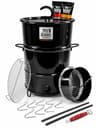
Drum is the format nobody expects to love. A barrel, a basket of charcoal at the bottom, meat hung on hooks above it, one intake set for your altitude and then left alone. Fat drips onto coals, which is most of why the food tastes like it came from a pit, and the cook is close to unattended. The trade is control: you get the temperature the barrel wants to run, in a band that suits ribs and pork butts and not much else. See best drum smokers for the field.
Electricis the format for people who want smoked food rather than the hobby of smoking. A heating element, a chip tray, a digital panel and a number. It is the most forgiving smoker you can buy and the only one you can run on an apartment balcony where open flame is banned. The honest limit is flavor — an element does not produce the combustion by-products wood fire does, so the smoke is lighter — and a published ceiling around 275°F, so there is no searing and no crisp chicken skin. The electric smoker roundup has the rest.
Kamadois the one cooker on this page that is genuinely good at everything. Thick ceramic holds heat so well that a Classic II will run low and slow all night on a basket of lump, then climb past 700°F for pizza the next evening. The trades are capacity (256 square inches is a small grate for the money), weight, and price. Read best kamado grills and kamado vs pellet if that do-everything case appeals.
Two notes on reading the table below. First, makers publish cooking area inconsistently — some give the main grate, some give a combined total including warming racks, and the Pit Barrel counts hooks as well as a grate — so compare the figures in each write-up rather than the biggest number. Where a maker publishes only a combined total, the column shows “—” and the write-up gives the figure. Second, we have not tested these cookers: we compiled every published spec, did the arithmetic, and read the consensus of real owners. Exactly how is on our methodology page.