Oklahoma Joe's Longhorn Review
The bigger, heavier Oklahoma Joe — 2.5 mm cold-rolled steel and a party-sized chamber. An honest, spec-driven look at what it does well, the mods it wants, and who should buy the Highland instead.
Quick answer
The Oklahoma Joe’s Longhorn is the heavy-steel traditional offset for a cook who wants mass over convenience. Its 2.5 mm cold-rolled chamber holds temperature well, and 1,060 square inches feed a party — but at 226 lb it gets placed once. Add a gasket kit, learn its hot firebox end, and it cooks beautifully; otherwise the lighter Highland is friendlier.
How this is funded: we earn a commission if you buy through our links, at no extra cost to you. It never changes which product we recommend, and we’ll tell you when we’d skip one, or point you to a cheaper option when it’s the better buy. Full disclosure.
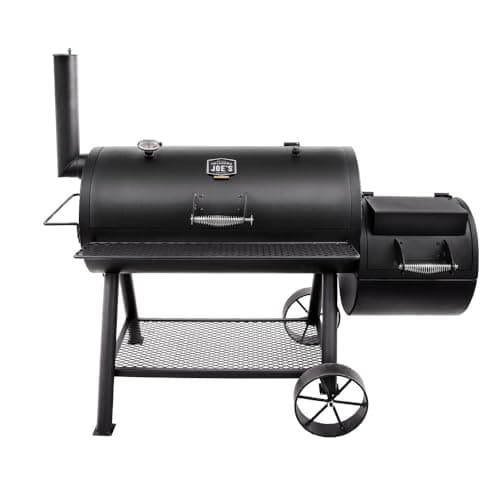
Oklahoma Joe's Longhorn Offset Smoker
What it is
The Longhorn is Oklahoma Joe’s big traditional horizontal offset — the heavier, roomier sibling of the mid-size Highland. It’s a classic stick-burner: a long cylindrical cook chamber with a firebox bolted to one end, heat and smoke drafting across the food and out a chimney at the far end. There’s nothing clever going on inside — no reverse-flow baffles, no controller, no electronics — and that’s the point. This is the smoker for someone who wants to learn and run real fire management on genuinely heavy steel, and who values thermal mass and capacity over the conveniences that make a cheaper pit easier to babysit. It ships with porcelain-coated grates and a 3-inch professional-style temperature gauge, and it lands at a price that’s still comfortably under a grand, which is a lot of steel for the money. It anchors the heavy end of our best offsets under $1,000 roundup.
The 2.5 mm steel, and why mass holds temperature
The headline spec, and the reason to buy a Longhorn, is the 2.5 mm cold-rolled steelchamber — genuinely heavier metal than the thin barrel offsets in the sub-$300 tier, and heavier than the Highland carries. Mass is what makes an offset easy to run. A heavy chamber acts like a thermal flywheel: it soaks up heat and stores it, so every time you open the lid or feed the firebox the temperature dips less and recovers faster, and the pit rides out the swings that make a thin-steel offset a chore. It also holds its own better in wind and cold, where a light pit sheds heat into the yard and forces you to run the fire harder. This is the single biggest practical difference between a budget barrel and the Longhorn: not that it cooks hotter, but that it cooks steadier, doing more of the temperature management for you. You still manage the fire — it’s not set-and-forget — but the steel is on your side.
Size: 751 square inches main, 1,060 total
The Longhorn is a big cooker. The main chamber gives 751 square inches of primary grate, and 1,060 square inchestotal once you count the secondary rack — room for a party’s worth of meat. In practical terms that’s several racks of ribs, a couple of pork butts, or multiple briskets at once, the kind of capacity you want if you cook for a crowd or like to fill the pit and freeze the extra. It’s worth being honest that on a traditional offset all that area isn’t uniform — the end near the firebox runs hotter than the far end — so you cook to the chamber’s zones rather than treating every square inch the same. But the sheer size means even the usable, evenly-cooking portion of the grate is generous. If you rarely cook for more than a family, this is more smoker than you need, and the smaller, lighter Highland will suit you better; if you regularly feed a crowd, the capacity is the point.
The traditional layout, and how to work the hot end
The Longhorn runs a traditional offsetlayout, which is simpler and more flexible than reverse-flow but asks a little more of the cook. Because heat drafts straight from the firebox across the food, the firebox end always runs hotter than the stack end — that temperature gradient is inherent to the design, not a defect. You work with it rather than against it: put the meat toward the cooler far end with the thickest part turned away from the fire, and rotate the racks partway through so nothing nearest the firebox pulls ahead. A lot of Longhorn owners even use the gradient deliberately, parking faster-cooking items nearer the heat and big cuts down at the cool end. If you’d rather not manage a hot spot at all, that’s exactly what reverse-flow solves, and it’s the core of the decision between this and the Highland — we lay it out spec by spec in Highland vs Longhorn. For the fundamentals of holding a clean fire and reading the smoke on any offset, our how to use an offset smoker guide walks through it.
Weight and siting
All that steel weighs something: the Longhorn comes in around 226 lbassembled. That’s a feature and a constraint. The mass is exactly what makes it hold temperature, but it also means this is a place-it-once smoker — you are not wheeling 226 lb of pit in and out of a garage or shuffling it around a small patio between cooks. Plan a permanent home for it on a level, solid surface (a concrete pad or pavers, not soft grass that the caster wheels sink into), with clearance around the firebox and room to work the fire from the side. Assembly is an afternoon’s job and best done where the smoker will live. If your space or your back makes a fixed 226 lb pit impractical, that alone is a strong argument for the lighter, more movable Highland, which is far easier to reposition.
The one mod it wants
Heavy steel doesn’t make an offset airtight, and like nearly every pit in this class the Longhorn ships with lid and firebox-door seals that leak a little out of the box. The single best thing you can do is add a gasket kit(about $20) to seal those gaps. It stops the small air leaks that cause temperature swings and let the fire pull air where you don’t want it — and it’s the near-universal first mod Longhorn owners make. Beyond that, the Longhorn needs less fussing than a budget offset: the mass already steadies it, and unlike a thin traditional pit it doesn’t urgently need tuning plates, though some owners add a baffle to nudge the heat gradient. The other must-buy isn’t a mod at all but a good probe thermometer: even with the Longhorn’s nicer 3-inch gauge, the dome reads the air at the top of the chamber, not the temperature at grate level or inside the meat, so run the cook by a grate-level probe.
Two practical notes on getting started. Assembly is an afternoon’s job, easier with a second pair of hands for the heavy chamber, and it’s worth taking the time to seat every bolt and the firebox-to-chamber joint squarely, because a slightly misaligned door is a leak you’ll fight on every cook afterward. And before your first brisket, season the pit: coat the interior with a high-smoke-point oil and run a hot fire for a couple of hours to burn off the factory oils and lay down a protective coating — the same burn-in every offset needs. Skip it and you cook manufacturing residue into your first cook; do it once, touch it up whenever the interior looks dry and dull, and the heavy steel will shrug off rust for years. Our how to use an offset smoker guide covers the seasoning burn-in and the fire management that follows it.
Where it falls short
No offset at this price is perfect, and the Longhorn’s weaknesses are the flip side of its strengths. It’s heavy and immovable, which rules it out for anyone short on space or without a permanent spot for it. The traditional layoutmeans you manage a hot firebox end, so it’s less forgiving for a brand-new offset cook than a reverse-flow pit. It still needs a fire managedevery 30 to 60 minutes for the length of a cook — heavy steel makes that easier, not unnecessary — so if you want to set a temperature and walk away, an offset is the wrong tool and a pellet grill is what you actually want. And while 2.5 mm is heavy for a production offset, it’s still not the quarter-inch plate of a custom pit, so in genuinely brutal weather even the Longhorn will ask for more fuel. None of these are surprises — they’re the honest terms of buying a big traditional stick-burner.
Who should buy it
Buy the Longhorn if you want the heaviest steel and the most capacity in Oklahoma Joe’s lineup at this price, you cook for a crowd, and you have a permanent, solid spot to put a 226 lb pit. It’s the pick for the cook who wants to learn real fire management on a traditional layout and values mass over convenience — add a gasket kit, buy a probe thermometer, and it will reward you for years. Choose the lighter, convertible Highland Reverse Flowinstead if you want a more forgiving, easier-to-move offset with reverse-flow baffles that even the heat from the factory — the better first serious offset for most upgraders. And if you love the Longhorn’s size but not its hot end, the Longhorn Reverse Flow adds baffle plates to this same 2.5 mm chamber, trading a little primary area and some cleanup for even heat across the whole grate. See where all of them land against the field in our best offset smokers roundup.
Frequently asked questions
Is the Oklahoma Joe's Longhorn a good smoker?
Yes, for the cook it's built for. Its 2.5 mm cold-rolled steel holds temperature better than the thin barrel offsets, its 1,060 square inches feed a crowd, and it comes with porcelain-coated grates and a 3-inch gauge. The trade-offs are weight and layout: at 226 lb it's a place-it-once pit, and its traditional design runs a hot firebox end you learn to work. Add a $20 gasket kit and a probe thermometer and it cooks beautifully.
How big is the Oklahoma Joe's Longhorn?
It offers 751 square inches of primary cooking area and 1,060 square inches total including the secondary rack — room for several racks of ribs, a couple of pork butts, or multiple briskets at once. That makes it a big offset suited to cooking for a crowd. If you rarely cook for more than a family, it's more smoker than you need, and the smaller, lighter Highland is the better fit.
How much does the Oklahoma Joe's Longhorn weigh?
Around 226 lb assembled. That mass is exactly what lets it hold temperature so well, but it also makes it a place-it-once smoker — you won't be wheeling it in and out of a garage or shuffling it around a small patio. Plan a permanent home on a level, solid surface like concrete or pavers, with room to work the fire from the side, and assemble it where it will live.
Does the Oklahoma Joe's Longhorn need modifications?
One cheap mod is close to essential: a gasket kit (about $20) to seal the lid and firebox door, which leak a little out of the box and cause temperature swings. Beyond that the heavy steel already steadies the pit, so it needs less fussing than a budget offset, though some owners add a baffle to tune the heat gradient. A good probe thermometer isn't a mod but is the other must-buy, since the dome gauge reads the wrong place.
Should I buy the Longhorn or the Highland?
Choose the Longhorn for the heaviest steel and the most capacity, and if you have a permanent spot for a 226 lb pit and want a traditional layout. Choose the Highland Reverse Flow for a lighter, easier-to-move, more forgiving offset whose reverse-flow baffles even the heat from the factory — the better first serious offset for most upgraders. Our Highland vs Longhorn comparison breaks the decision down spec by spec.
Keep reading
Highland vs Longhorn
The two Oklahoma Joe offsets compared on steel, area and airflow — how much smoker you actually need.
Read the comparison →Best Offset Smokers
All seven offsets we rank, on steel gauge, cooking area and price — see where the Longhorn lands.
See the roundup →Oklahoma Joe's Longhorn Reverse Flow Review
The biggest reverse-flow offset from a mainstream brand — four baffles under a 751 sq in grate, a movable stack, 268 lb. What the plumbing buys, what it costs, and when the Highland is smarter.
Read the review →