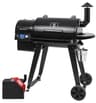
The best Traeger alternative for most people is the Pit Boss Navigator 850 — more cooking area, a 30 lb hopper instead of 20, WiFi and Bluetooth included rather than charged for, and a Flame Broiler hatch that opens direct flame for a real sear, which a Traeger Woodridge cannot do. It is for the cook who wants everything a Traeger does plus searing, for less money. The budget pick is the Z Grills 450B, the cheapest grill here, which runs the same steady PID fire from a body small enough for a balcony or a campsite. Every price is read live from the current listing — 4 of 4 picks had a buyable offer as of November 12, 2026, with that date under each button.
First, the fair version of what you are considering replacing, because an alternatives page that misrepresents the original is useless. Traeger is the most recognized name in pellet cooking and earns a lot of that reputation.The Woodridge publishes 860 square inches, a 20 lb hopper, a 180°F to 500°F range and a ten-year limited warranty — the longest coverage of any grill on this page. Its WiFIRE app is the most developed in the category: set temperatures, probe alerts and guided step-by-step cooks, run from an RTD chamber sensor that is a more accurate probe than the basic thermocouples some budget grills use. Add the largest accessory and dealer network in pellet, pellets on the shelf of every hardware store, and the best resale value in the category. Those are real advantages and no grill below takes all of them away. Our Traeger Woodridge review makes the case for buying one.
So why do people shop for an alternative? Three reasons, consistently. The first is price for spec: a Traeger generally costs more than an equivalently specified rival, which is the brand premium working as intended. The second is searing— the Woodridge publishes a 500°F ceiling, which roasts a steak nicely but will not build the hard, dark crust a screaming grate gives you. The third is hopper runtime: 20 lb handles an all-day cook, but a bigger bin means not thinking about it on an overnight brisket. Each pick below answers one of those directly.
The Pit Boss Navigator 850 answers all three at once, which is why it leads. 932 square inches is more grate than the Woodridge; the 30 lb hopper is half again as large; WiFi and Bluetooth are included at this trim rather than sold up; and the Flame Broiler lever slides a plate aside to expose open flame under the grate, searing up toward a published 1,000°F. What you give up is the app polish and the warranty length — and the dealer network, which matters more in year five than in year one. We put the two head to head in Traeger vs Pit Boss.
The recteq Patio Legend 600 answers the materials question.Its grates are 304 stainless steel, its WiFi is dual-band — it will join a 5 GHz network, which quietly solves the most common connected-grill complaint — and its warranty runs four years, the second-longest here. It also runs to 700°F on convection heat with no sear hatch at all, hot enough to crust a steak without opening the firepot. The trade is the smallest grate on this page at 665 square inches and an 18 lb hopper. Our recteq Patio Legend 600 review and recteq vs Traeger go through it properly.
The Masterbuilt Gravity Series 800 is the alternative that changes the fuel, and it belongs here because a lot of people shopping away from Traeger are really shopping away from pellet smoke. It is a gravity-fed charcoal cooker: real briquettes or lump in a vertical hopper, wood chunks in alongside them, and a fan on a thermostat holding your set temperature the way a pellet controller does. 800 square inches, a published 225°F to 700°F range, 225°F in eight minutes, a reversible cast-iron grate and a griddle insert in the box. You keep set-and-forget control and swap polite pellet smoke for charcoal flavor; you take on an extension cord, a 15.9 lb hopper and one year of warranty. See best gravity-fed charcoal smokers for the family, and pellet vs charcoal for the flavor argument.
The Z Grills 450B is the price answer.It is the cheapest grill on this page by a clear margin and it still runs a PID controller, which is the part that does the actual cooking — 459 square inches, a 15 lb hopper, a 180°F to 450°F range, controlled from a dial rather than a phone. If what you want is wood-fired set-and-forget barbecue and the app was never the point, this is where the money stops being necessary. It is also the only pick here you can move onto a balcony or into a truck. The honest trades are no connectivity, the smallest capacity, and a smaller dealer network than any brand above it; we lay out that case in Z Grills vs Traeger.
One thing none of these replaces.Traeger’s ecosystem is not a spec and it is not marketing — it is pellets at every hardware store, grates and covers for every model, a dealer who will talk to you in year six, and resale value when you upgrade. If you value that above price and searing, the right answer is to buy the Traeger and stop reading comparison pages. If you do not, there are four better uses of the money above. Prices across this category move constantly, so the live figure under each button, with its date, is what counts. We own none of these grills and have not tested them — every number here comes from the published spec sheet named on each write-up, and our methodology page explains what we do instead.