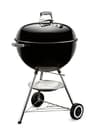
If you want one answer: buy the Weber Original Kettle 22-inch. 363 square inches of grate, a porcelain-enameled bowl and lid with a 10-year warranty, two dampers that give you real fire control, and a parts-and-accessory network no other charcoal grill comes close to. It is not the cheapest grill here and it is not the biggest, and it is still the one that will be cooking in fifteen years.
Here is the thing worth knowing before you shop this tier at all. Under $200 is not the compromise tier in charcoal. It is the normal tier.A charcoal grill is a steel bowl, a grate, a lid and two air vents; there is no burner assembly, no igniter, no controller, no auger and no fan to pay for. The charcoal grills three and four times this price on this site are not better at making fire — they add a work table, a hinged grate, a gas-assist starter or a ceramic body. That means the question on this page is not “what do I have to give up?” It is “which of these seven shapes matches my space and my cooking?”
The four criteria we ranked on
This is the argument behind the order, and the part worth disagreeing with.
1. Damper control, because it is the difference between a grill and a fire pit.A charcoal fire’s temperature is set by how much air reaches it. A cooker with an adjustable bottom intake and an adjustable lid exhaust can be run at 225°F for ribs or opened up to 600°F for steak. A cooker with fixed holes runs at one temperature: whatever the holes allow. Every pick on this page has two working dampers, and that single spec is why the cheapest Smokey Joe on this page outranks plenty of mid-tier grills that are not on this list at all.
2. Grate area measured against what you actually cook. The useful rule of thumb is roughly 70 to 100 square inches per person for burgers and chicken pieces, which makes 147 square inches a two-person cooker, 240 a four-to-six-person cooker and 363 a comfortable family grill with room for a two-zone fire. Two-zone capability is the part most size guides miss: you need enough grate to keep half of it empty, or you cannot cook anything thicker than a burger without burning it.
3. Whether the parts will exist in five years.A charcoal grill has three consumables — the grate, the ash sweeper or pan, and eventually the legs or wheels. Weber sells all of them, in stores, for grills it stopped making decades ago. That is a real and under-priced part of what four of these seven picks cost, and it is why a 363-square-inch Weber can be better value than a 490-square-inch barrel at a similar price. The barrel is not a bad grill; it is a grill you will replace rather than repair.
4. What the shape lets you do that a kettle cannot. Three picks here are deliberately not kettles. A crank-adjustable barrel sets heat by moving the fire up and down rather than only by vents. An offset-firebox barrel lets you keep the fire out of the cooking chamber entirely, which is the one thing a kettle genuinely struggles with. An insulated steel kamado burns a fraction of the charcoal for the same cook. Those are capability differences, not quality differences, and they decide the ranking as much as the grate numbers do.
What this page is not
It is not a test.We own none of these grills and have cooked on none of them. Every figure on this page and in every product card below comes from the manufacturer page named inside that card, and the live price on each row comes from Amazon’s own data with the date it was read. The ranking is editorial reasoning from published specs and the arithmetic we do ourselves — which is what our methodology commits to, and all it commits to. If your budget stretches further than this cap, best charcoal grills under $500adds the shapes $200 cannot reach — a kettle with a work table, an insulated steel cooker and a dedicated drum smoker.
It is not a beginner page. Four of these seven are also the right first grill, and best charcoal grill for beginners ranks the field on how forgiving each one is rather than on what it costs. This page ranks on value inside a hard price ceiling, which produces a different order: the two cheapest picks here are excellent grills and poor first grills, because 147 and 240 square inches do not leave room to make mistakes in.
And every price on it moves. The live number in each row is read from Amazon and stamped with its date. One of these seven picks sat within a dollar of the $200 line when this page was written, which means it may be above the ceiling by the time you read this. That is the honest reason the ranking is built on specs and shapes rather than on a price order: the specs hold, the prices do not.
The seven, at a glance
Read the second column first. Shape decides more about what you can cook than any other spec in this tier.
| Grill | Shape | Grate | Buy it if |
|---|
| Weber Original Kettle 22" | Kettle | 363 sq in | You want the safe default |
| Royal Gourmet CD1824M | Barrel + crank pan | 490 sq in | You need the most grate for the money |
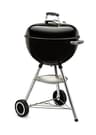
| Weber Original Kettle 18" | Kettle | 240 sq in | A 22-inch bowl will not fit your space |
| Char-Griller AKORN Jr. | Steel kamado | 153 sq in | You want long, fuel-efficient cooks |
| Royal Gourmet CC1830S | Barrel + offset firebox | 811 sq in total | You want to learn real smoking cheaply |
| Weber Jumbo Joe 18" | Portable kettle | 240 sq in | The grill has to travel |
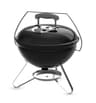
| Weber Smokey Joe 14" | Portable kettle | 147 sq in | You want in for the least money possible |
Where the money goes in this tier
Prices move, so the live number in each row above is the one to trust. The shape of the spend is stable, and in charcoal it is unusually legible:
- The bottom of the tier buys the bowl and the two dampers. That is the whole cooker, and it works. What you do not get is an ash catcher, a lid thermometer, a hinged grate or anywhere to put the tongs down.
- The middle buys grate area, or it buys a shape. Around the middle of this tier you are choosing: more square inches from a thinner-steel barrel, or the same Weber kettle hardware in a bigger bowl. Both are real value. Neither makes better fire.
- The top of the tier buys insulation or a firebox.The AKORN Jr. and the CC1830S are the two picks whose money goes into capability rather than size — a triple-wall body that holds heat for hours on very little fuel, and a separate firebox that keeps the fire away from the food.
- And then there is fuel, which nobody budgets for.A 20 lb bag of briquettes is about four cooks on a kettle. Over three years of weekend grilling that is more than any grill on this page costs, which is the real argument for the insulated pick — how long a bag of charcoal lasts does the arithmetic properly.
If your ceiling is softer than $200, the next tier up is genuinely different rather than just bigger: a hinged or GBS grate, a work table, or a gas-assist starter. The Original Kettle vs Master-Touch comparison is the exact decision at that line, and Black Friday BBQ deals records which classes of cooker have actually discounted in past Novembers.
The three things to buy with it
A sub-$200 grill plus three cheap items beats a grill at twice the price with none of them, and that is not a figure of speech — two of these three fix problems the grill itself cannot.
- A chimney starter. Non-negotiable. It lights charcoal in about fifteen minutes with a sheet of newspaper, with no lighter fluid and no fluid taste, and it is the cheapest upgrade in charcoal cooking. Our best charcoal chimney starters page covers capacity and the handle detail that decides how safe the pour is.
- A leave-in thermometer.Four of the seven picks here have no lid thermometer at all, and the ones that do are measuring air at the dome rather than at the grate. A two-probe unit — one at grate level, one in the meat — turns guessing into cooking. See best meat thermometers, and the USDA’s own guidance cited at the foot of this page is blunt that color is not a doneness test.
- Tongs and a turner you can actually use.Long, stiff and metal. Not a wire grill brush — the peer-reviewed injury study cited below is the reason there is no wire brush anywhere on this site. Our best grilling tools page covers all three jobs.
How to get the most out of any of them
Four habits matter more on a cheap charcoal grill than the choice between these seven models.
- Build a two-zone fire every single time. All the coals on one side, nothing on the other. You sear over the fire and finish over the empty side with the lid on, which is how the cheapest grill here cooks a thick chop properly and a grill costing five times as much, run as one big hot zone, does not. Our how to use a charcoal grill guide walks it through.
- Control heat with the bottom vent, not the top. The intake meters the oxygen that feeds the fire; the exhaust mostly controls draft. Leave the top damper wide or nearly wide and make your adjustments at the bowl, in small increments, and wait ten minutes before judging whether it worked.
- Empty the ash before every cook. On a cooker this size a bed of old ash blocks the intake, and a blocked intake is the single most common reason a charcoal grill will not get hot. This matters most on the four picks here without a sealed ash catcher.
- Measure your charcoal in chimney loads, not handfuls. One full chimney is a hot grilling fire on a 22-inch kettle and far too much on a 14-inch one. How much charcoal to use gives the loads by grill size and by cook, which also stops you burning through a bag every weekend.
Who should spend more than $200
Three groups, and we would rather say it here than sell you the wrong grill.
If you want to smoke, and smoking is the point, skip this tier except for one pick.A kettle will hold 250°F for six hours with the snake method, and that is a real technique rather than a workaround — but it is fiddly and capacity is tight. The CC1830S on this page is the honest cheap entry to real offset cooking; above it, best budget offset smokers and best offset smokers for beginners are where the category properly starts. If you want smoke with no fire management at all, read best electric smokers instead.
If you cook for eight or more every weekend, buy grate area with steel behind it. The cheap route to 500 square inches is thin steel, and thin steel loses heat in wind and cold exactly when a big cook needs stability. A 22-inch Weber with a chimney and good technique feeds eight; above that the answer is a bigger kettle or a cart grill, not a thinner barrel.
If you want somewhere to put things down, that costs money and nothing else will fix it. No grill in this tier has a work surface. That sounds trivial until you are holding a platter of raw chicken with nowhere to set it; it is the single most common reason people upgrade from a kettle, and it is exactly what the Weber Performer sells.
Where to go next
If you have landed on a kettle and want to cook on it this weekend, your first charcoal grill cook is the whole evening written out in order, and common charcoal grilling mistakes is the shorter version of everything that goes wrong. For fuel, the choice between lump and briquettes matters more on a small cooker than a large one, because a small firebox makes briquette uniformity worth more. And if you are still deciding whether charcoal is the right fuel at all, charcoal vs gas is the comparison that saves the most money.