Napoleon Prestige 500 RSIB Review
Four burners and 48,000 BTU is an ordinary spec sheet. Two infrared burners, 8.5 mm stainless wave grates and a lifetime bumper-to-bumper warranty are not. Examined on the published numbers, with an honest account of what the extra money buys and who should buy a Weber instead.
Quick answer
Buy the Prestige 500 RSIBif you want infrared searing and rotisserie cooking on a grill you will never have to re-buy. The headline 48,000 BTU across four main burners is unremarkable; what you are paying for is the 16,000 BTU infrared SIZZLE ZONE, the 18,000 BTU infrared rear rotisserie burner with the kit included, 8.5 mm stainless wave grates and a lifetime bumper-to-bumper warranty. Total output is 82,000 BTU across 914 square inches, 500 of it primary. Skip it if you mainly cook burgers and chicken for four — a Weber Spirit or Genesis does that for a fraction of the money and does it well.
How this is funded: we earn a commission if you buy through our links, at no extra cost to you. It never changes which product we recommend, and we’ll tell you when we’d skip one, or point you to a cheaper option when it’s the better buy. Full disclosure.
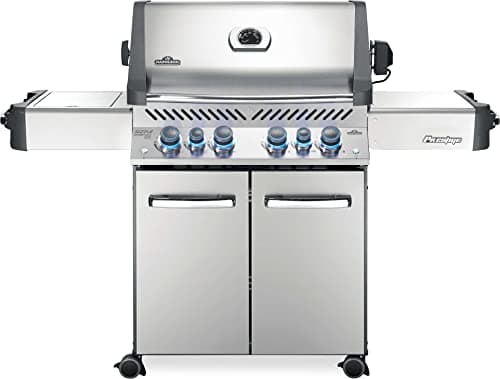
Napoleon Prestige 500 RSIB Gas Grill
Price as of October 14, 2026. #ad How we’re funded
What this grill actually is
The Prestige 500 RSIB sits at the top of our gas registry, and the first thing to understand about it is that its main burners are not the reason. Four burners at a combined 48,000 BTU over 500 square inches of primary grate works out at roughly 96 BTU per square inch — healthy, and almost exactly what you would get from a Weber Genesis S-435 at the same main-burner rating. If main-burner output is all you want, this grill is expensive for what it does.
What separates it is that it carries two burners that are not tube burners at all. The RSIB designation in the model name is the giveaway: Rear and Side Infrared Burners. A 16,000 BTU infrared side burner — Napoleon calls it the SIZZLE ZONE — and an 18,000 BTU infrared rear burner behind the cooking grates for rotisserie work. Those two account for 34,000 of the grill’s 82,000 BTU total, and they are what the price premium is actually for.
For the reader this site is written for — someone who already owns a grill, knows what a two-zone fire is, and is upgrading a specific weakness — that matters. The weakness an infrared burner fixes is one a conventional gas grill genuinely has, and we will come back to what it is.
The published specs
Every figure below is read from the source named in the product card above. We own no units and have tested nothing; our methodology sets out exactly what that means.
| Spec | Published figure | What it means in practice |
|---|---|---|
| Main burners | 4 | Three independent heat zones plus a spare; comfortable two-zone cooking |
| Main burner output | 48,000 BTU | ~96 BTU per sq in of primary grate — ample, not exceptional |
| Total output | 82,000 BTU | Includes both infrared burners; not comparable to a main-burner figure |
| Primary cooking area | 500 sq in | Feeds six comfortably |
| Total cooking area | 914 sq in | The difference is warming racks — useful for holding, not searing |
| Grates | 8.5 mm stainless steel wave | Thick enough to hold heat through a cold steak; will not flake like enamel |
| Warranty | Lifetime, bumper to bumper | The strongest published warranty in our gas registry |
Two of those rows deserve a warning rather than praise. 82,000 BTU is a total, not a main-burner figure, and it is the number that will be quoted at you in a showroom. Comparing it against a Weber Genesis’s 39,000 or 48,000 BTU main-burner rating is invalid — that is comparing a sum to one of its terms. Our guide to how many BTUs a gas grill needs explains why that distinction decides more purchases than it should.
And 914 square inches is a total area too.The honest figure for comparison is 500 square inches of primary grate — the surface directly over the burners that you can actually sear on.
The SIZZLE ZONE: what an infrared burner is for
A conventional gas burner heats air, and the air heats your food. That works, and it has a ceiling: you cannot get a tube burner meaningfully past the temperature at which it is already heating the whole cookbox, so a gas grill tends to top out somewhere that produces a decent crust but not a steakhouse one.
An infrared burner heats a ceramic or metal surface, and that surface radiates heat directly onto the food. Very little energy goes into the air. The practical consequence is a small, extremely hot zonethat browns the outside of a steak faster than the heat can travel inward — which is the entire technical definition of a good sear. At 16,000 BTU over a side-burner footprint, this is a searing station, not a second grill.
Two honest caveats. First, it is small: it is sized for one or two steaks, so if you are searing for six you are doing it in batches. Second, it is the single feature most likely to go unused. If your cooking is burgers, sausages and chicken thighs, the SIZZLE ZONE will sit under its cover for years, and you will have paid a lot for it. Be honest with yourself about which of those two cooks you actually are.
The rotisserie burner, and why “kit included” matters
The 18,000 BTU rear infrared burner exists for one job: turning meat on a spit in front of radiant heat rather than above a flame. It is the right way to cook a whole chicken or a pork loin on gas, and it produces something a grate genuinely cannot.
The commercially relevant detail is that the rotisserie kit is included with this model. On most grills that advertise a rear burner, the motor, spit and forks are a separate purchase, and that purchase is not cheap. A rear burner with no kit is a feature you have not finished buying. Worth checking on whatever you cross-shop this against.
Grates: 8.5 mm stainless, and what that number does
Grate mass is the most underrated spec in gas grilling. When a cold steak lands on a grate, it pulls heat out of the metal; a thin grate loses that heat instantly and the steak steams in its own moisture instead of browning. A thick one has enough stored energy to keep searing.
8.5 mm stainless is at the heavy end of what mainstream gas grills ship. Stainless also behaves differently from the porcelain-enameled cast iron Weber uses: cast iron stores slightly more heat per unit volume, but its enamel coating can chip, and once it does the iron underneath rusts. Bare stainless cannot chip because there is no coating to lose. Neither is wrong — stainless trades a little heat retention for essentially unlimited service life, which pairs logically with a lifetime warranty.
The warranty is a real part of the value
“Lifetime, bumper to bumper” is the strongest published warranty term in our gas registry, and on a grill in this price class it is not a throwaway line. A premium gas grill is a ten-to-fifteen-year purchase, and over that period the things that fail are burners, ignition components, grates and the cookbox — precisely what a bumper-to-bumper term covers.
Compare it to what else is on the shelf: Weber publishes 10 years on the Spirit cookbox and burners and 12 on the Genesis cookbox. Those are good terms. A lifetime term is better, and it is the reason the per-year cost of this grill is not as far above a Genesis as the sticker price suggests. Read the actual terms before you rely on that — warranties are documents, not slogans, and the registration requirements and exclusions are the parts worth your attention.
What it costs you
The two honest arguments against this grill are in the product card above, and both are real.
It costs considerably more than a Weber Genesis of comparable size. That is the whole decision in one sentence. A Genesis E-325 gives you 39,000 BTU over 513 square inches of primary grate — more primary area than the Napoleon — with cast-iron grates and a 12-year cookbox warranty, for a great deal less. If you do not specifically want infrared searing or rotisserie, the Genesis is the better buy and we would say so.
Two extra burners are two more things that can eventually fail. Complexity has a cost. An infrared burner, a rotisserie motor and the extra ignition circuits are all components a three-burner Spirit simply does not have. The lifetime warranty is the mitigation, not the absence of the risk, and “covered” still means a service call and a wait.
One more thing worth saying plainly: this grill is overkill for most backyards, and that is not a criticism of the grill. If your honest weekly cook is six burgers and some chicken, a Weber Spirit E-325 at a third of the money will cook them identically and leave you with enough left over for a good thermometer and a year of charcoal for something else.
How this is funded: we earn a commission if you buy through our links, at no extra cost to you. It never changes which product we recommend, and we’ll tell you when we’d skip one, or point you to a cheaper option when it’s the better buy. Full disclosure.
Live prices on all three
Prices are fetched live and date-stamped — compare the numbers in these rows rather than any figure in the text. All three are in our registry with specs read from the sources named in their cards.
Napoleon Prestige 500 RSIB Gas Grill
48,000 BTU main plus a 16,000 BTU SIZZLE ZONE and an 18,000 BTU rear rotisserie burner with the kit, on 8.5 mm stainless wave grates, under a lifetime warranty.
Price as of October 14, 2026. #ad How we’re funded
Weber Spirit E-325 3-Burner Gas Grill
31,000 BTU over 360 sq in, cast-iron grates, a Sear Zone burner and a 10-year cookbox and burner warranty. Cooks the same weekly food for a fraction of the money.
Price as of October 14, 2026. #ad How we’re funded
Weber Q 2800N+ Portable Gas Grill
320 sq in and a published 250-700°F range in a ~32 lb body. The pick when a four-burner cart will not fit the space at all.
Price as of October 14, 2026. #ad How we’re funded
Who should buy it
- The cook who sears steaks regularly and has decided that the crust a tube burner produces is not good enough. This is the clearest case, and the SIZZLE ZONE is a genuine answer rather than a marketing one.
- Anyone who wants rotisserie cooking without a second purchase. The rear burner plus the included kit is the complete version of that feature.
- The buy-it-once buyer.If you intend this to be your last gas grill, the lifetime term and the 8.5 mm stainless grates are aimed exactly at you, and the per-year arithmetic is more favorable than the sticker.
- Someone cooking for six or more regularly who wants the capacity and would rather not buy twice.
Who should not
- Anyone whose cooking is weeknight burgers and chicken. Buy the Weber Spirit E-325 and spend the difference on better meat.
- Anyone who wants maximum primary grate per dollar. A gas grill under $1,000 buys more usable cooking surface, straightforwardly.
- Anyone chasing smoke flavor.No gas grill is the answer here and this one is no exception — a propane burner makes heat, not smoke. If that is the real goal, read offset smoker vs pellet grill instead and spend the money there.
- Anyone with a small patio or a balcony. This is a four-burner cart. See best grills for small patios and balconies.
Where to go next
The direct cross-shop is Napoleon vs Weber, which puts this grill against the Weber Genesis S-435 at an identical 48,000 BTU main-burner rating and shows where the money actually diverges. The premium tier as a whole is in best high-end gas grills. If you are still working out how much grill you need, the gas grill buying guide is the checklist and how many BTUs is the arithmetic. And once it arrives, how to use a gas grill covers the preheat-and-two-zone routine that makes any of this worth it.
And if this grill is simply more than the space or the budget allows, the decision one tier down is between Weber’s entry cart and its portable — two grills at a similar price that are not really competing on specs at all: Weber Q vs Weber Spirit.
Frequently asked questions
Is the Napoleon Prestige 500 worth the money?
It is if you specifically want infrared searing or rotisserie cooking, and if you intend it to be your last gas grill. You are not paying for the 48,000 BTU main burners, which are ordinary — you are paying for a 16,000 BTU infrared SIZZLE ZONE, an 18,000 BTU rear rotisserie burner with the kit included, 8.5 mm stainless wave grates and a lifetime bumper-to-bumper warranty. If your cooking is weeknight burgers and chicken for four, a Weber Spirit does that identically for a fraction of the price.
What does RSIB mean on a Napoleon grill?
Rear and Side Infrared Burners. It tells you the model carries two burners that are not conventional tube burners: an infrared side burner for searing (Napoleon's SIZZLE ZONE, 16,000 BTU on this model) and an infrared rear burner for rotisserie work (18,000 BTU here). Those two make up 34,000 of the grill's 82,000 BTU total output, and they are the reason this model costs what it does.
How many BTUs does the Prestige 500 RSIB have?
48,000 BTU across the four main burners, and 82,000 BTU total once both infrared burners are counted. Those are different measurements and only the first is comparable to another grill's main-burner figure — comparing 82,000 against a Weber Genesis's 39,000 or 48,000 main-burner rating is comparing a sum to one of its terms. On primary cooking area of 500 sq in, the 48,000 figure works out at roughly 96 BTU per square inch.
What is a SIZZLE ZONE and do I need one?
It is an infrared side burner that heats a radiating surface rather than the air, producing a small, very hot zone that browns the outside of a steak faster than heat travels inward — which is what a good sear actually is. You need one if you sear steaks often and have concluded a normal gas burner does not get there. You do not need one for burgers, sausages or chicken, and it is the feature on this grill most likely to go unused for years.
Napoleon Prestige 500 vs Weber Genesis — which should I buy?
The Genesis if you want cooking area and value; the Napoleon if you want infrared searing, rotisserie and a lifetime warranty. A Genesis E-325 publishes 39,000 BTU over 513 sq in of primary grate — more primary area than the Napoleon's 500 — with cast-iron grates and a 12-year cookbox warranty, for considerably less money. Our Napoleon vs Weber comparison runs the Prestige 500 against the Genesis S-435, where both publish 48,000 BTU main burners.
Are stainless steel grates better than cast iron?
They are a different trade, not a straight upgrade. Porcelain-enameled cast iron, which Weber uses, stores slightly more heat per unit volume — good for searing — but the enamel can chip, and once it does the iron beneath rusts. Bare stainless has no coating to lose, so it cannot chip or flake, which is why it pairs logically with a lifetime warranty. At 8.5 mm, the Napoleon's stainless wave grates are at the heavy end of what mainstream gas grills ship, so the heat-retention gap is small.
Does the Prestige 500 come with a rotisserie kit?
Yes, and that is a commercially meaningful detail. Many grills advertise a rear infrared burner but sell the motor, spit and forks separately, which is not a cheap addition — a rear burner with no kit is a feature you have not finished buying. Worth confirming on anything you cross-shop against this model.
Can you smoke on a Napoleon Prestige 500?
Not in any sense that would satisfy someone who wants barbecue. A propane burner produces heat and almost no smoke, so the best you can do is run one burner low with a foil packet of wood chips on the grates for a mild flavor. If smoke is the real goal, the money is far better spent on a pellet grill or an offset smoker — see our offset smoker versus pellet grill comparison.
Keep reading
Napoleon vs Weber
The Prestige 500 against the Weber Genesis S-435 — identical 48,000 BTU main burners, and everything that actually separates them.
Compare them →Best High-End Gas Grills
The premium tier ranked on grate material, warranty and primary cooking area, with a live price on every pick.
See the picks →How Many BTUs Does a Gas Grill Need?
Why a total BTU figure is not comparable to a main-burner one, and the arithmetic run across nine grills.
Read the guide →Weber Spirit E-325 Review
The three-burner most gas shoppers should actually buy — and the honest case for spending far less.
Read the review →