Kamado Joe Classic II Review
The ceramic kamado that out-features the Big Green Egg at the same size for less. An honest, spec-driven look at the Divide & Conquer racks, Kontrol Tower vent, Air Lift hinge, and who it's for.
Quick answer
The Kamado Joe Classic II is our top kamado pick because it out-features the Big Green Egg at the same 18 in size, usually for less money. Its 1.25 in ceramic holds anything from a 225°F smoke to a 750°F+ sear rock-steady, and it ships with the Divide & Conquer half-racks, the Kontrol Tower vent and the Air Lifthinge — hardware you’d buy separately for an Egg. It’s heavy and it ships without a cart, but it’s the ceramic value benchmark.
How this is funded: we earn a commission if you buy through our links, at no extra cost to you. It never changes which product we recommend, and we’ll tell you when we’d skip one, or point you to a cheaper option when it’s the better buy. Full disclosure.
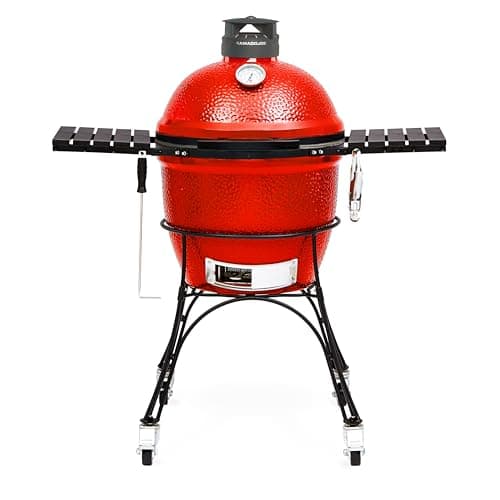
Kamado Joe Classic II 18-inch Ceramic Grill
Price as of October 22, 2026. #ad How we’re funded
What it is
The Kamado Joe Classic II is the 18 in ceramic kamado that sits at the center of the brand’s lineup, and it’s the grill we point most upgraders toward. A kamado is a sealed, egg-shaped charcoal cooker whose thick walls store heat and radiate it back at the food, so it sips fuel and holds a temperature with almost no babysitting. The Classic II gives you 256 sq in of cooking area — enough for a couple of racks of ribs, a pork shoulder, or a full grate of steaks — and it earns its reputation not by cooking better than a Big Green Egg (they’re close) but by giving you more grill in the box for less. We rank it first in the best kamado grills roundup for exactly that reason.
The 1.25 in ceramic and the temperature range
The heart of the grill is its 1.25 in-thick ceramic body. That mass is what makes a kamado behave like a thermal flywheel: it takes a little while to load with heat, and then it holds whatever you set it to with only small vent tweaks, shrugging off wind and cold that would push a thin steel grill around. The published range runs from 225°F to 750°F+, which is the whole point — the same grill that holds a 225°F brisket steady overnight will also choke down enough charcoal and open enough airflow to sear a steak hard the next day. Very few single cookers span that range, and the ceramic is the reason this one does it on a surprisingly small amount of fuel.
Divide & Conquer half-racks and two-zone cooking
The feature that defines the Classic II is the Divide & Conquer rack system. Instead of one flat grate, you get a tiered frame that holds independent half-racks you can set at different heights and swap between grate, half-moon cast iron and other surfaces. In practice that means genuine two-zone cooking on a round grill: sear something low and close to the coals on one side while roasting or holding at a gentler height on the other, all in a single load of charcoal. It turns the kamado from a one-temperature bowl into a flexible cooker, and it’s the single biggest reason people choose the Joe over an Egg, where you’d buy multi-level racks separately from the aftermarket.
Air Lift hinge and Kontrol Tower vent vs the Egg’s stock parts
Two more pieces of hardware separate it from a stock Big Green Egg. The Air Lift hinge counterbalances the heavy ceramic lid so it opens with one finger and stays where you leave it, instead of asking you to heave a bare dome. The Kontrol Towertop vent is machined to hold a precise setting and — crucially — keeps its calibration even when you open and close the lid, so you can return to the same low temperature without re-guessing the airflow. A stock Egg uses a simpler band hinge and a cast cap that both work perfectly well but ask a little more feel to set. None of this makes the Egg cook worse; it means the Joe hands you upgrades the Egg leaves to its aftermarket. We walk the full head-to-head in Big Green Egg vs Kamado Joe.
Living with it: weight, siting and the missing cart
Ceramic’s virtues come with ceramic’s realities. The Classic II weighs 188 lb, so this is a place-it-once grill: get help positioning it, set it on a solid, level surface, and leave it there. The ceramic is superb but fragile against impact and freezing water, so keep it covered and don’t let water pool and freeze inside a neglected body. And at this price the Classic II ships without a cart— it comes on a base but not the rolling cart you might picture, which is a genuine extra to budget for if you want to move it or want a work surface. Beyond that it’s an easy grill to run; our how to use a kamado grill guide covers lighting, vent control and the two-zone setup so your first cooks go smoothly.
Where it falls short
The honest caveats are few but real. It’s heavy and immobile, it’s fragile if you’re careless with it, and the cart is an added cost that pushes the real out-the-door price past the sticker. There’s also a learning curve common to every kamado: the thick ceramic is slow to react, so if you overshoot a low target temperature you’ll wait a while for it to settle back down — you learn to sneak up on a temp rather than chase it. Its 256 sq in is plenty for a family but not a crowd-feeding surface — if you routinely cook for a party, the round footprint is a limit ceramic can’t easily beat. And while it holds low temperatures well, a bare ceramic dome doesn’t distribute low-and-slow heat as evenly as a dedicated diffuser does, which is the exact gap the Classic III’s SloRoller insert was built to close. If you smoke far more than you sear, that difference is worth reading about in Classic II vs III before you decide.
Who should buy it
Buy the Classic II if you want one ceramic kamado to keep for decades and you want the most features for the money out of the box — the Divide & Conquer racks, the Air Lift hinge and the Kontrol Tower vent are daily-use improvements you’d otherwise pay extra for on a Big Green Egg, which is why we’d take the Joe over a stock Egg at this size; the full case is in Big Green Egg vs Kamado Joe. Choose the Classic IIIinstead if you smoke often and want the SloRoller for the most even low-and-slow heat — see Classic II vs IIIto judge whether the jump is worth it. Either way it’s our overall pick in the best kamado grills roundup.
Frequently asked questions
Is the Kamado Joe Classic II worth it?
For most upgraders, yes — it's our top kamado pick. It out-features a same-size Big Green Egg out of the box with its Divide & Conquer racks, Air Lift hinge and Kontrol Tower vent, usually for less money, and the 1.25 in ceramic holds anything from a 225°F smoke to a 750°F+ sear rock-steady. It's heavy and ships without a cart, but it's the ceramic value benchmark.
What is the Divide & Conquer system on the Classic II?
It's a tiered rack frame that replaces the single flat grate with independent half-racks you can set at different heights and swap between grate and cast iron. That enables genuine two-zone cooking on a round grill — sear low and close to the coals on one side while roasting higher on the other, all in one load of charcoal. It's the Classic II's signature feature.
How much does the Kamado Joe Classic II weigh, and does it come with a cart?
It weighs about 188 pounds, so it's a place-it-once grill — get help positioning it on a solid, level surface and leave it there. At this price it ships on a base but without the rolling cart, which is a separate cost if you want to move it or want a work surface. Keep it covered and away from freezing water, since ceramic is fragile against impact and ice.
Classic II or Classic III — which should I buy?
Choose the Classic II if you want the best value ceramic kamado and cook a mix of searing and smoking. Choose the Classic III if you smoke often and want its SloRoller diffuser, which distributes low-and-slow heat far more evenly than a bare ceramic dome, plus a three-tier rack. Our Classic II vs III comparison breaks down whether the SloRoller is worth the step up in price.
Is the Kamado Joe Classic II better than a Big Green Egg?
On the food they're close — both are thick ceramic that spans low-and-slow to a hard sear. The Classic II wins out of the box because its stock racks, hinge and vent are better and it usually costs less at the same size. The Egg answers with a deeper accessory ecosystem, a lifetime ceramic warranty and local-dealer support. Our full comparison lays out the trade.
Keep reading
Kamado Joe Classic III Review
The flagship 18-inch — the three-tier rack, the SlōRoller and whether the step up from the II is worth it.
Read the review →Big Green Egg vs Kamado Joe
The two ceramic kamados everyone cross-shops — features, price and how you buy them.
Read the comparison →Best Kamado Grills
Ceramic and steel kamados, ranked on build, cooking area and value.
See the roundup →